
 Source:
 False spirea (Astilbe ‘Erika’) short overview
Astilbe 'Erika' is a tall Arendsii Group perennial valued for its airy pink plumes, reddish stems, and bronze-tinted new foliage. It thrives in partial to full shade with consistently moist, humus-rich soil that does not dry out. In U.S. gardens it is commonly grown in woodland borders, shaded beds, pond-side plantings, and cut-flower displays. Mature plants usually reach about 30–36 inches tall and are generally hardy in USDA Zones 4–9.
Taxonomic classification
False spirea (Astilbe ‘Erika’) care guide
Light and placement
Give 'Erika' partial shade to full shade, ideally with bright morning light and protection from hot afternoon sun. In cooler climates it can tolerate more sun if the soil stays constantly moist; full sun increases watering demand. Scorched, brown foliage signals heat or drought stress, while weak, stretched stems and reduced flowering may indicate excessively dark conditions.
Watering and humidity
Water deeply whenever the surface begins to dry, keeping the root zone evenly moist rather than alternating between drought and saturation. Check plants frequently during hot weather, especially in sunnier locations or containers. Apply mulch to reduce evaporation, and water at the base to limit foliar disease. Humidity is secondary to dependable soil moisture.
Soil and growing medium
Use fertile, humus-rich soil that holds steady moisture while still draining excess water. A loamy woodland-style soil is ideal. Slightly acidic to neutral conditions are suitable. Improve sandy soil with compost, but avoid sites that remain stagnant and waterlogged in winter.
Feeding
Top-dress with compost or leaf mold in spring. If growth is weak, apply a balanced, slow-release fertilizer at label rate as growth begins. Avoid heavy nitrogen feeding, which can produce soft foliage and does not compensate for inadequate water. Do not fertilize drought-stressed or newly transplanted plants until they recover.
Growth and habit
This is a clump-forming perennial that develops a basal mound and sends flowering stems above the foliage. Growth is strongest when the root zone stays evenly moist. Divide older crowns when overcrowding reduces vigor or the center becomes sparse.
Planting and repotting
Plant in spring or early fall, setting the crown at soil level rather than burying it deeply. Space plants about 18–24 inches apart, depending on the desired massing effect. Mulch with compost or leaf mold and maintain even moisture while roots establish.
For containers, repot or divide when the crown becomes crowded, usually every 3–4 years. Move the plant in early spring or early fall, keeping the crown at its previous soil level and watering thoroughly after replanting.
Propagation and pruning
Propagation
Divide established clumps in early spring or early fall, separating healthy crown sections with roots and shoots. Division preserves the cultivar. Seed is not recommended for maintaining exact 'Erika' characteristics.
Pruning
Remove spent flower stems after bloom if a cleaner appearance is preferred. Leaving them in place preserves dried structure into fall. Cut the remaining foliage to the ground in late fall or early spring once it has declined naturally.
Overwintering
Leave healthy dried stems until late winter if they provide structure, then cut back before new growth expands. Apply a light organic mulch in cold, exposed sites, but do not bury the crown. Container plants need protection from repeated freeze-thaw cycles and should not be allowed to dry completely.
Uses
Useful for shaded perennial borders, woodland gardens, pond and stream margins, mass plantings, and cut-flower arrangements. The upright pink plumes provide vertical contrast above divided foliage. Cut stems when flowers are partly open; vase life is considered useful, though exact performance depends on harvest stage and handling.
Appearance
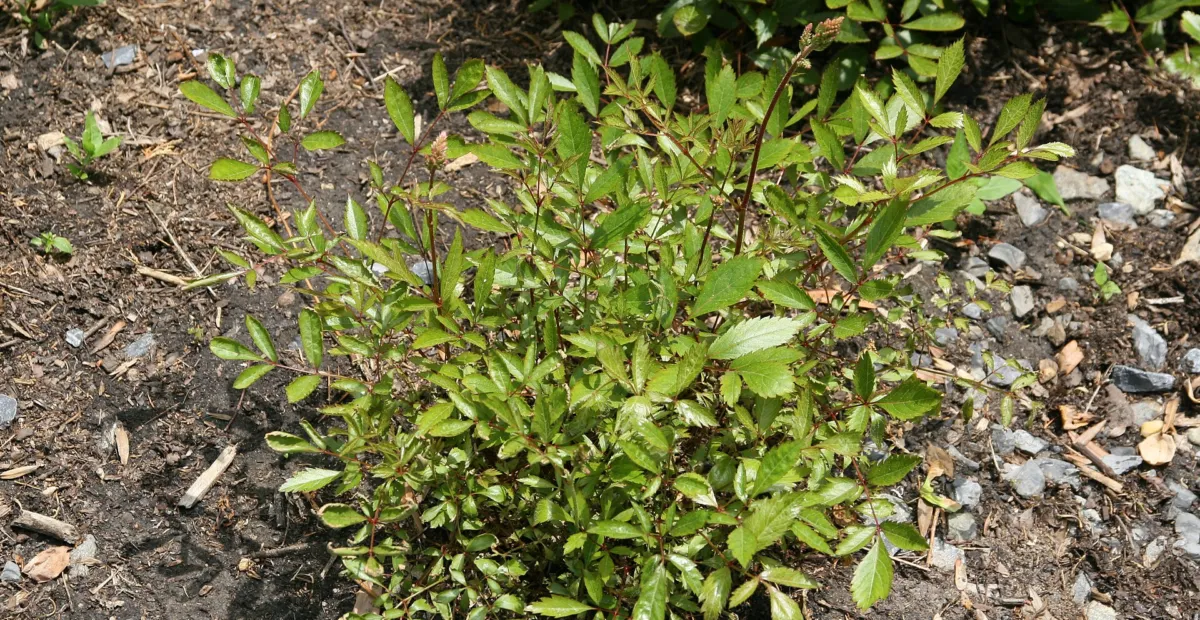
The plant forms a basal mound of finely divided, fern-like leaves. New foliage may emerge reddish bronze before turning dark green. Upright reddish stems carry airy, narrow pink panicles, giving the cultivar a vertical, feathery appearance. The dried flower heads can remain decorative after the fresh color fades.
Flowering
The cultivar produces upright, narrow, plume-like panicles composed of many tiny flowers. Reliable U.S. references place flowering mainly in June and July, although warmer or cooler regions may shift the season and some horticultural sources describe midsummer bloom. Faded stems may be removed for tidiness or left to provide late-season structure.
Pollination and visitors
Astilbe flowers can be visited by butterflies and other small insects, but cultivar-specific pollinator records are limited. The open plume structure presents many small flowers above the foliage and may provide a modest nectar and pollen resource during bloom.
Astilbe 'Erika' photos
Click any photo for a larger view. Source, author and license are shown separately.
Diseases and pests
Diseases
Avoid drought stress and overcrowding, which can encourage foliar problems. Powdery mildew and wilt may occur. Improve air movement, water at the soil surface, remove badly affected foliage, and avoid repeatedly wetting leaves. Persistent wilt or crown decline may require removal of the plant and sanitation.
Pests
Japanese beetles may chew the foliage, while deer and rabbits generally avoid astilbes. Inspect leaves regularly, hand-pick visible beetles, remove severely damaged foliage, and support plant vigor with adequate moisture. Avoid routine broad-spectrum insecticides during bloom.
Toxicity and pollen
No reliable cultivar-specific toxicology evidence was located for Astilbe 'Erika'. Do not treat the plant as proven edible or medicinal. Prevent habitual chewing, and contact a veterinarian or poison service if a pet consumes a large amount or develops symptoms.
- Pollination / pollen
- Insect-dispersed pollen
Astilbe 'Erika' is insect-pollinated, so its pollen is not typically released in large windborne clouds. However, no cultivar-specific clinical allergy assessment was located, so airborne allergy relevance remains unknown rather than proven absent.
Native habitat
Astilbe cultivars derive from woodland and streamside perennial lineages associated with moist, humus-rich soils and filtered light. In cultivation, 'Erika' suits cool, moisture-retentive sites rather than exposed, drought-prone beds.
Interesting fact
Introduced by Georg Arends around 1940, 'Erika' is an old Arendsii Group cultivar. Its new foliage can show bronze tones before maturing dark green. The dried panicles can retain ornamental value after flowering.
Frequently asked questions (FAQ)
The most relevant questions about this plant, with short and direct answers.
🌱Quick care
What is Astilbe 'Erika' commonly called?⌄
Astilbe 'Erika' is commonly sold as false spirea. It is also an Arendsii hybrid astilbe, but cultivar naming may appear as Astilbe x arendsii 'Erika' in nursery catalogs.
Is Astilbe 'Erika' a perennial?⌄
Yes, Astilbe 'Erika' is a hardy herbaceous perennial that returns from its crown each year. Its foliage dies back in cold climates and regrows in spring.
How tall does Astilbe 'Erika' get?⌄
Astilbe 'Erika' commonly reaches about 24 to 32 inches tall and spreads roughly 14 to 16 inches. Size can vary with soil moisture, shade, climate, and growing conditions.
🌤️Environment and placement
How much sun does Astilbe 'Erika' need?⌄
Astilbe 'Erika' grows best in partial shade to full shade. In cooler, consistently moist locations it can tolerate more light, but hot afternoon sun may scorch the foliage.
Can Astilbe 'Erika' grow in full shade?⌄
Yes, Astilbe 'Erika' can grow in full shade, although flowering may be less abundant than in bright partial shade. Keep the soil evenly moist for the strongest growth.
Where should I plant Astilbe 'Erika'?⌄
Plant Astilbe 'Erika' in a cool, shaded bed, woodland garden, border, or moist area near a pond or stream. Avoid exposed sites where the soil dries rapidly.
What type of soil does Astilbe 'Erika' prefer?⌄
Astilbe 'Erika' prefers humus-rich, moisture-retentive, well-drained loam. Improve poor soil with compost or other organic matter while preserving good drainage around the crown.
Does Astilbe 'Erika' need acidic soil?⌄
Astilbe 'Erika' generally tolerates slightly acidic to neutral soil. A fertile soil rich in organic matter is more important than achieving a narrowly specific pH.
Can Astilbe 'Erika' grow under trees?⌄
Yes, Astilbe 'Erika' can grow under deciduous trees if it receives bright shade and enough water. Tree roots may compete strongly for moisture, so supplemental irrigation and organic mulch are often needed.
💧Care and problems
How often should I water Astilbe 'Erika'?⌄
Water Astilbe 'Erika' whenever the soil surface begins to dry so the root zone stays evenly moist. Increase watering during hot, dry periods, especially in the first growing season.
Can Astilbe 'Erika' tolerate drought?⌄
No, Astilbe 'Erika' does not perform well in drought. Extended dryness can cause leaf scorch, weak growth, and reduced flowering, so mulch and regular irrigation are helpful.
Why are the leaves on my Astilbe 'Erika' turning brown?⌄
Brown astilbe leaves are most commonly caused by dry soil, hot sun, or heat stress. Move the plant toward deeper shade if necessary and restore consistent moisture without leaving the soil waterlogged.
Should I mulch Astilbe 'Erika'?⌄
Yes, apply a 2- to 3-inch layer of organic mulch around Astilbe 'Erika' to conserve moisture and moderate soil temperature. Keep mulch slightly away from the crown to reduce rot risk.
Does Astilbe 'Erika' need fertilizer?⌄
Astilbe 'Erika' usually needs only moderate fertilization when grown in fertile, compost-enriched soil. A spring application of a balanced perennial fertilizer can help if growth or flowering is weak.
🪴Planting and repotting
When is the best time to plant Astilbe 'Erika'?⌄
Plant Astilbe 'Erika' in spring or early fall in the United States. Spring planting is especially useful in colder regions, while fall planting should be early enough for roots to establish before the ground freezes.
How deep should I plant Astilbe 'Erika'?⌄
Plant Astilbe 'Erika' with the crown at soil level or just barely covered. Planting the crown too deeply can encourage crown rot and poor emergence.
How far apart should Astilbe 'Erika' be planted?⌄
Space Astilbe 'Erika' about 14 to 18 inches apart, adjusting for the desired density and mature spread. Good spacing improves airflow while allowing the clumps to fill in.
Can Astilbe 'Erika' be grown in a container?⌄
Yes, Astilbe 'Erika' can grow in a container if the pot has drainage and the mix remains evenly moist. Place the container in partial to full shade and protect the root ball from severe winter exposure.
✂️Propagation and pruning
Should Astilbe 'Erika' be cut back in fall?⌄
You can cut Astilbe 'Erika' to the ground in late fall after the foliage dies back, or leave the dry stems for winter interest. Remove old growth before spring regrowth begins.
When should Astilbe 'Erika' be divided?⌄
Divide Astilbe 'Erika' in early spring as new growth begins or in early fall. Division is useful when clumps become crowded or flowering declines, and it is generally recommended every three to five years if needed.
How do you propagate Astilbe 'Erika'?⌄
Propagate Astilbe 'Erika' most reliably by dividing established clumps. Seed propagation is less dependable for preserving the named cultivar’s exact characteristics.
Does Astilbe 'Erika' spread aggressively?⌄
Astilbe 'Erika' forms gradually expanding clumps rather than spreading aggressively. It can be divided when it becomes too large or crowded for its planting space.
⚠️Toxicity and safety
Is Astilbe 'Erika' deer resistant?⌄
Astilbe 'Erika' is generally considered deer resistant, although no plant is completely deer-proof. Hungry deer may still browse it when preferred food is scarce.
Is Astilbe 'Erika' rabbit resistant?⌄
Astilbe 'Erika' is often listed as rabbit resistant. Protection may still be needed in areas with heavy rabbit pressure or limited alternative food.
Is Astilbe 'Erika' poisonous to dogs or cats?⌄
There is no reliable cultivar-specific toxicity classification for Astilbe 'Erika'. Because plant-identification and toxicity data can vary, contact a veterinarian or poison-control service if a pet or child has ingested it.
🌸Flowering and special interest
When does Astilbe 'Erika' bloom?⌄
Astilbe 'Erika' typically blooms from late spring to summer, with timing varying by climate and growing conditions. In many gardens, the pink plumes appear around June or July.
What color are Astilbe 'Erika' flowers?⌄
Astilbe 'Erika' produces upright pink to rose-pink flower plumes. The exact intensity can vary with light, soil fertility, weather, and climate.
Why is my Astilbe 'Erika' not flowering?⌄
Astilbe 'Erika' may fail to flower because of insufficient light, drought stress, young age, excessive nitrogen, or overcrowding. Bright shade, steady moisture, and division when congested usually improve performance.
Should I deadhead Astilbe 'Erika'?⌄
Deadheading Astilbe 'Erika' is optional and mainly improves appearance. The dried plumes can remain for fall and winter interest, but remove them if you prefer a tidier display or want to prevent self-sowing.
Can Astilbe 'Erika' be used as a cut flower?⌄
Yes, Astilbe 'Erika' can be cut for arrangements, preferably when the flower plumes are partly open. Vase life depends on harvest stage, hydration, and handling.
Similar plants
 Azure Monkshood (Aconitum carmichaelii) care guideAconitum carmichaelii
 Monkshood (Aconitum ‘Stainless Steel’)Aconitum 'Stainless Steel'
 Monkshood (Aconitum ‘Bressingham Spire’)Aconitum 'Bressingham Spire'
 Golden full moon maple (Acer shirasawanum ‘Aureum’)Acer shirasawanum 'Aureum'
 Globosum (Acer platanoides ‘Globosum’)Acer platanoides 'Globosum'
 Striped maple (Acer pensylvanicum) care guideAcer pensylvanicum