
 Source:
 Alyssum montanum short overview
Alyssum montanum is a low-growing, evergreen perennial from rocky parts of central Europe. Its gray-green, hairy foliage forms a spreading mat, while small, fragrant yellow flowers appear in spring and early summer. This sun-loving species suits alpine beds, rock gardens, gravel borders, and containers with excellent drainage. It is generally easy to maintain when kept out of heavy, moisture-retentive soil.
Taxonomic classification
Alyssum montanum care guide
Light and placement
Provide full sun, ideally in an open site with a south-, east-, or west-facing orientation. Strong light supports compact growth and the best flowering. Too little light can produce loose stems and fewer flowers; excessive heat is usually tolerated if the roots remain cool and the soil drains rapidly.
Watering and humidity
Water deeply but infrequently once established, allowing the upper several inches of soil to dry between waterings. During the first season, water when the root zone begins to dry. Reduce watering in cool or wet weather and keep winter moisture especially low. Extra humidity is unnecessary and can increase rot risk.
Soil and growing medium
Use a sharply drained, gritty substrate based on coarse sand, fine gravel, and lean loam. Alyssum montanum tolerates neutral to alkaline conditions and is especially suitable for calcareous or rocky soils. Avoid heavy clay, stagnant winter moisture, and rich organic mixes that encourage soft, sprawling growth.
Feeding
This plant generally needs little fertilizer. Incorporate only a small amount of mature compost into poor soil at planting, then use a dilute balanced fertilizer once in spring if growth is weak. Avoid high-nitrogen feeding and repeated rich amendments, which can produce lax foliage and reduce the compact, drought-adapted habit.
Growth and habit
This evergreen perennial develops a low, spreading, mat-forming habit from short ascending stems. It remains compact when grown lean and bright. After flowering, light trimming removes spent racemes and helps maintain a tidy cushion without cutting deeply into old woody bases.
Planting and repotting
Plant in spring or early fall when temperatures are moderate. Set the crown at soil level rather than deeply burying the short stems. Space plants about 12–18 inches apart to allow the mat-forming habit to develop, and water regularly during the first growing season while roots establish.
Repot container plants in spring only when the root system has filled the container. Move the plant into a slightly larger pot with a gritty, fast-draining mix and avoid burying the crown. Handle the root ball carefully because excessive disturbance can slow establishment.
Propagation and pruning
Propagation
Sow seed in spring or early fall on the surface of a gritty mix and press it in lightly; do not bury deeply. Softwood cuttings can be taken after active spring growth begins. Provide bright light, restrained watering, and excellent drainage to reduce damping-off and basal rot.
Pruning
Cut back lightly after flowering to remove spent racemes and tidy the mat. Do not shear into old, leafless woody sections, because deep cutting may leave bare patches. Remove winter-damaged stems in spring after new growth becomes visible.
Overwintering
Plants are cold hardy when grown in sharply drained soil. Avoid winter wet around the crown, especially in containers. Move pots against a sheltered wall or under rain protection in regions with repeated freeze-thaw cycles. Do not bring established plants into warm indoor conditions unless container survival requires it.
Uses
Use Alyssum montanum in rock gardens, alpine troughs, gravel borders, raised beds, and the front of sunny perennial plantings. Its low evergreen foliage provides structure outside the flowering period. It is also suitable for containers with gritty soil. It is not recommended as a culinary or medicinal plant without verified species-specific preparation guidance.
Appearance
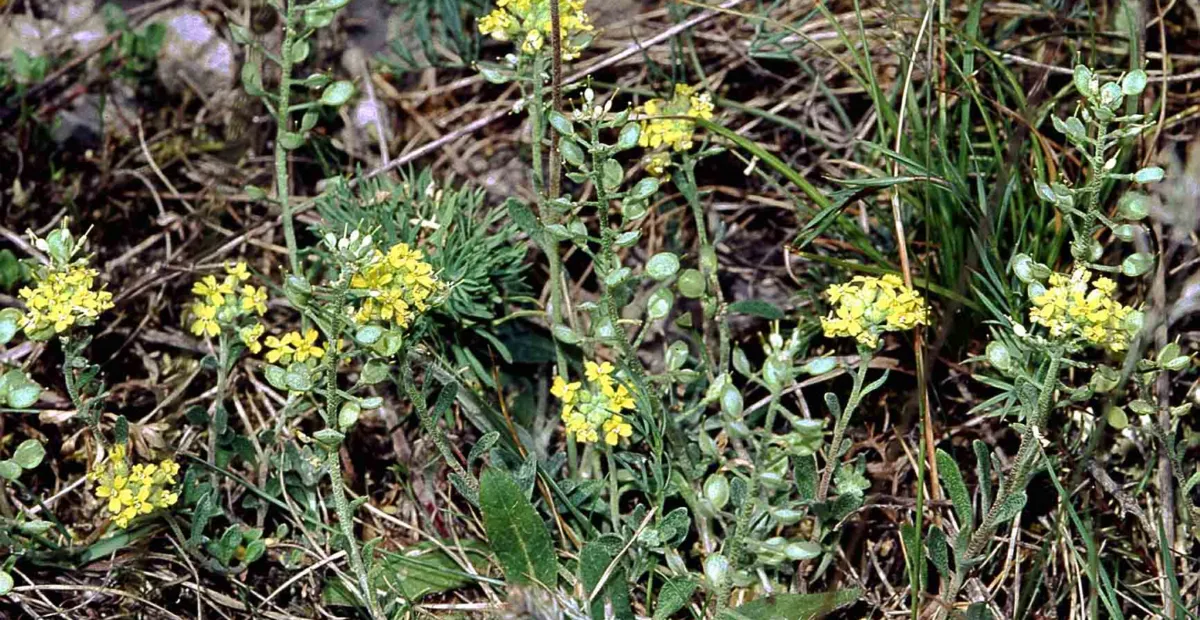
The plant has short, partly ascending stems and narrow to spoon-shaped leaves covered with distinctive star-shaped hairs. This dense indumentum gives the foliage a silvery gray-green cast. Short racemes of yellow flowers rise above the mat, and the inflorescences lengthen as flattened seed pods form.
Flowering
Small, four-petaled yellow flowers are carried in short racemes that elongate as fruits develop. Bloom is concentrated from spring into early summer, with the strongest display in cool, bright conditions. Light trimming after flowering can preserve a neat cushion and reduce lanky growth.
Pollination and visitors
The yellow flowers are visited by small insect pollinators, with bees and hoverflies documented or considered characteristic visitors for cultivated alyssums. Evidence for a particular pollinator species specific to Alyssum montanum is insufficient, so no species-level Latin visitor name is assigned.
Alyssum montanum photos
Click any photo for a larger view. Source, author and license are shown separately.
Diseases and pests
Diseases
Usually trouble-free in sharply drained soil. Root and crown rots are the main concern where soil remains wet, especially during cool weather. Improve drainage, avoid overwatering, and remove damaged tissue. Good air movement and spacing help limit foliar spotting during prolonged damp weather.
Pests
Aphids may colonize young shoots and flower stems; inspect new growth and wash off light infestations with a firm water spray. Slugs can damage plants in damp gardens. Avoid routine broad-spectrum insecticides, especially during bloom, to reduce harm to visiting insects.
Related diseases and pests
Only Plant Doctor profiles whose host data indicate this plant may be affected are shown here.


Toxicity and pollen
Alyssum is listed as non-toxic to dogs and cats by a major veterinary poison-control reference. Species-specific human toxicity data for Alyssum montanum are limited, so ordinary plant-handling precautions are sensible and large ingestion should be avoided. Do not confuse this species with hoary alyssum, a different plant associated with livestock toxicity.
- Typical season
- Spring to early summer in the United States when cultivated outdoors
- Pollination / pollen
- Insect-dispersed pollen
Alyssum montanum is an insect-pollinated flowering plant, so its pollen is not typically released in large airborne clouds like wind-pollinated grasses or trees. Species-specific U.S. allergen measurements are unavailable; sensitive people may still react to direct contact with flowers or plant material.
Native habitat
The species is native from France through Switzerland to southwestern Germany, where it occurs in temperate, open habitats associated with rocky, calcareous, dry, or otherwise well-drained soils. Its garden performance reflects adaptation to exposed, sunny sites with limited standing moisture.
Interesting fact
The accepted name is Alyssum montanum L., first published by Linnaeus in 1753. The species is a low subshrub rather than a tender annual alyssum. Its star-shaped hairs give the foliage a gray appearance and help identify it. The flower raceme lengthens as the flattened fruits mature.
Frequently asked questions (FAQ)
The most relevant questions about this plant, with short and direct answers.
🌱Quick care
How do you care for Alyssum montanum?⌄
Grow Alyssum montanum in full sun, gritty or rocky well-drained soil, and water sparingly once established. Avoid consistently wet conditions, especially during winter, because poor drainage can cause root problems.
Is Alyssum montanum perennial?⌄
Yes, Alyssum montanum is generally described as a perennial subshrub. Its persistence is greatest when it receives strong sunlight, sharp drainage, and protection from prolonged wet soil.
Is Alyssum montanum the same as sweet alyssum?⌄
No. Alyssum montanum is a perennial Alyssum species, while sweet alyssum is usually Lobularia maritima, a different genus and commonly grown annual or short-lived plant.
🌤️Environment and placement
How much sun does Alyssum montanum need?⌄
Alyssum montanum performs best in full sun, meaning at least 6 hours of direct sunlight daily. More shade may reduce flowering and produce less compact growth.
What USDA hardiness zone is Alyssum montanum?⌄
Alyssum montanum is considered frost hardy, but a universally agreed USDA hardiness-zone range is not consistently documented for the species. Regional performance depends on drainage, winter moisture, and the source of the plant or seed.
Is Alyssum montanum native to the United States?⌄
No, Alyssum montanum is native to parts of Europe, including France and southwestern Germany, rather than the United States. Do not confuse it with unrelated native plants or with other Alyssum species that may occur in North America.
Is Alyssum montanum suitable for a rock garden?⌄
Yes, Alyssum montanum is well suited to rock gardens, alpine beds, gravel gardens, raised crevices, and other sites with full sun and rapid drainage. It is less suitable for damp borders or heavy garden soil.
💧Care and problems
Does Alyssum montanum tolerate drought?⌄
Alyssum montanum has low water needs and can tolerate dry conditions once established. Water it during prolonged drought or after planting, but let the soil dry between waterings.
How often should you water Alyssum montanum?⌄
Water newly planted Alyssum montanum when the soil has begun to dry, then reduce irrigation after the roots establish. In a well-drained bed, occasional deep watering is preferable to frequent light watering.
Why is my Alyssum montanum turning yellow?⌄
Yellowing in Alyssum montanum is often associated with excessive moisture, poor drainage, root stress, or insufficient light. Check that water drains freely and that the plant receives full sun before increasing fertilizer or irrigation.
🪴Planting and repotting
Can Alyssum montanum grow in containers?⌄
Yes, Alyssum montanum can grow in a container if the pot has excellent drainage and a gritty, sandy planting mix. Choose a relatively shallow alpine-style pot and avoid a saucer that holds standing water.
What type of soil does Alyssum montanum need?⌄
Use gritty, sandy, rocky, or otherwise sharply drained soil for Alyssum montanum. Heavy clay should be amended substantially or avoided, because the plant is adapted to lean, well-drained conditions rather than moisture-retentive soil.
When should you plant Alyssum montanum?⌄
Plant Alyssum montanum in spring or fall when temperatures are moderate and the soil is workable. In regions with wet winters, spring planting can reduce the risk of prolonged cold, saturated soil around new roots.
✂️Propagation and pruning
Should Alyssum montanum be deadheaded?⌄
Deadheading Alyssum montanum is optional rather than essential. Remove spent flower clusters to improve appearance or limit self-seeding, but leave some flowers if you want the plant to produce seed.
How do you prune Alyssum montanum?⌄
Prune Alyssum montanum lightly after flowering to remove spent stems and maintain a compact shape. Avoid cutting deeply into old woody growth, because hard pruning may reduce regrowth.
How do you propagate Alyssum montanum from seed?⌄
Alyssum montanum can be propagated by seed. Sow the seed in a free-draining medium, cover it lightly or press it onto the surface according to the seed source’s instructions, and keep it evenly but not excessively moist during germination.
Can Alyssum montanum be propagated from cuttings?⌄
Cuttings may be possible because Alyssum montanum has subshrub-like growth, but species-specific propagation guidance is limited. Seed propagation is the more defensible general method unless a specialist nursery provides cutting instructions for a particular form.
⚠️Toxicity and safety
Is Alyssum montanum toxic to dogs or cats?⌄
Alyssum is generally classified as non-toxic, but species-specific evidence for Alyssum montanum is limited. Prevent pets from eating large quantities of any ornamental plant, and contact a veterinarian if illness follows ingestion.
🌸Flowering and special interest
Why is Alyssum montanum not flowering?⌄
Alyssum montanum may flower poorly when it receives too much shade, excessive water, or overly rich soil. Move container plants into brighter light and avoid heavy fertilization, which can favor foliage over flowers.
When does Alyssum montanum bloom?⌄
Alyssum montanum commonly flowers in spring, although the exact timing varies with climate, elevation, and the plant’s form. In cooler areas, blooming may begin later than in lower or warmer locations.
What color are Alyssum montanum flowers?⌄
Alyssum montanum produces small yellow flowers typical of many ornamental Alyssum species. Flower color and intensity can vary somewhat among populations and cultivated forms.
Similar plants
 Azure Monkshood (Aconitum carmichaelii) care guideAconitum carmichaelii
 Monkshood (Aconitum ‘Stainless Steel’)Aconitum 'Stainless Steel'
 Monkshood (Aconitum ‘Bressingham Spire’)Aconitum 'Bressingham Spire'
 Golden full moon maple (Acer shirasawanum ‘Aureum’)Acer shirasawanum 'Aureum'
 Globosum (Acer platanoides ‘Globosum’)Acer platanoides 'Globosum'
 Striped maple (Acer pensylvanicum) care guideAcer pensylvanicum