
 Source:
Moss phlox (Phlox subulata ‘Scarlet Flame’) short overview
Phlox subulata 'Scarlet Flame' is a compact, evergreen moss phlox cultivar that forms a spreading mat of fine, needle-like foliage. In spring, it becomes densely covered with vivid rosy-red to deep pink flowers marked by darker centers. Use it to brighten rock gardens, sunny borders, retaining walls, and slopes where excellent drainage, modest watering, and several hours of direct sun support the best flowering.
Taxonomic classification
Moss phlox (Phlox subulata ‘Scarlet Flame’) care guide
Light and placement
Grow in full sun for the densest flowering and strongest mat; a site with a south-, east-, or west-facing exposure is suitable. Light afternoon shade is tolerated, especially in hot climates, but deep shade produces fewer flowers and looser growth. Pale, sparse flowering or stretched stems indicate insufficient light; scorched foliage usually reflects drought, heat, or reflected afternoon exposure rather than excessive sun alone.
Watering and humidity
Water deeply but infrequently once established, allowing the upper soil to dry somewhat between waterings. During the first growing season, water whenever the root zone begins to dry; in summer, increase frequency during prolonged heat or drought. Reduce watering in cool fall weather and avoid winter irrigation in poorly drained soil. Average outdoor humidity is adequate.
Soil and growing medium
Use a lean to moderately fertile soil that drains quickly. Sandy or gritty loam is suitable, and a rocky or calcareous site is tolerated. Avoid heavy, persistently wet clay and locations where winter moisture collects. Soil reaction can range from mildly acidic through neutral to mildly alkaline, provided drainage is reliable.
Feeding
Feed lightly in early spring with compost or a balanced, slow-release fertilizer if growth is weak or the soil is poor. Avoid high-nitrogen feeding, which can produce lush foliage with fewer flowers and may encourage soft growth. Do not fertilize drought-stressed, newly transplanted, or waterlogged plants.
Growth and habit
This cultivar forms a dense, spreading mat and can cover open ground when given sunlight and sharp drainage. Growth is generally vigorous after establishment, but the plant performs poorly where winter wetness or excessive shade weakens the foliage. Its low habit makes it useful for visual edging and erosion-limiting coverage on small slopes.
Planting and repotting
Plant in spring or early fall, setting the crown level with the surrounding soil. Space plants about 14–18 inches apart for a connected mat, or closer for faster coverage if local growing conditions are favorable. Water thoroughly after planting and keep evenly but lightly moist during establishment; do not bury the stems under mulch.
Container-grown plants can be shifted in spring or early fall. Move them into a slightly wider, shallow container with a gritty, well-drained mix and ensure the crown remains at the same level. Repot only when roots fill the container or drainage declines; excessive pot size increases the risk of wet soil.
Propagation and pruning
Propagation
Propagate readily from softwood cuttings in spring or by separating rooted stems in spring or early fall. Division or detachment of established rooted sections preserves the cultivar. Take cuttings from healthy, nonflowering growth and keep them evenly moist while rooting.
Pruning
Pruning is usually unnecessary. After flowering, lightly shear or trim the outer stems if the mat becomes untidy or needs shaping. Avoid cutting deeply into old, woody interior growth, and never remove more foliage than needed because the evergreen mat provides structure through winter.
Overwintering
Leave the evergreen foliage in place through winter. In cold regions, the main protection is excellent drainage and avoidance of freeze-thaw heaving; a light, airy mulch can help after the ground freezes. Do not cover the mat with heavy, wet material. Container plants are more exposed to cold and should be sheltered in a protected, unheated location if severe winter conditions are expected.
Uses
Use as a low groundcover for rock gardens, sunny edging, slopes, retaining walls, raised beds, and container displays. Its evergreen mat helps cover bare soil and its spring flowers provide an early ornamental and nectar resource. It is not documented here as a culinary or medicinal plant.
Appearance
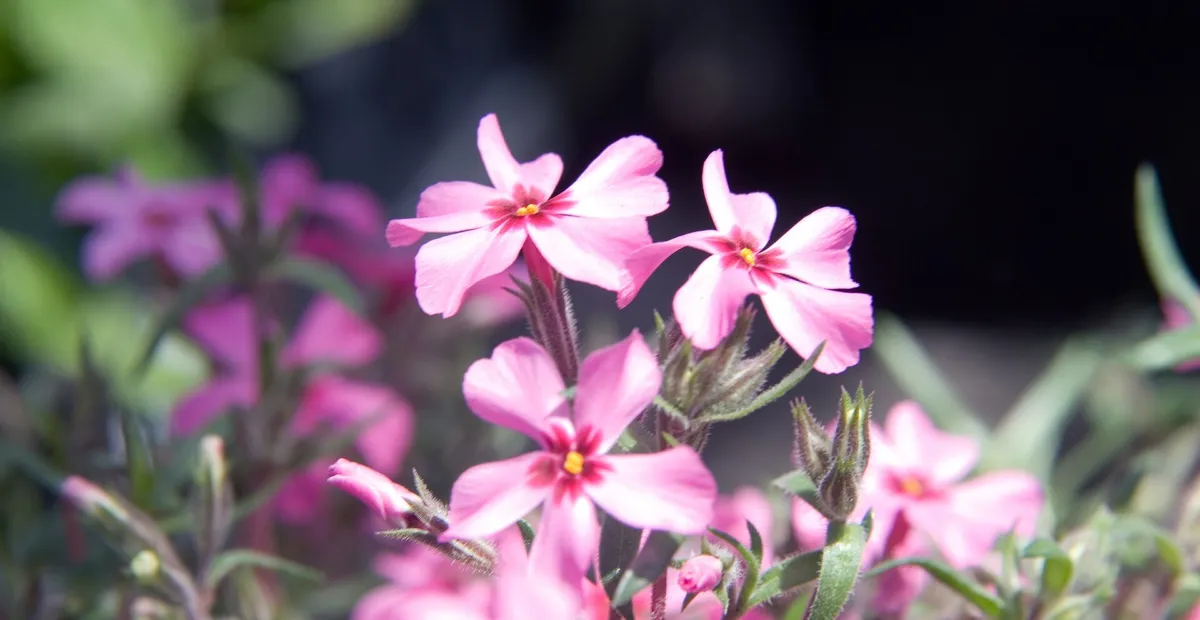
The plant forms a low, cushion-like mat of slender, needle-shaped evergreen leaves on trailing to spreading stems. In spring, short flowering stems rise just above the foliage and carry star-like, five-lobed blooms with a darker central eye. The dense texture and persistent green foliage help distinguish it from taller, upright garden phlox.
Flowering
Flowers are produced in a concentrated spring display, with individual blooms held above the foliage on short stems. In the United States, flowering is typically strongest in April and May, though timing shifts earlier in warm regions and later in cold climates. The cultivar is valued for saturated rosy-red to deep pink color and darker centers.
Pollination and visitors
Moss phlox flowers are documented as attracting insect visitors, especially bees and butterflies. The cultivar’s vivid spring display can provide an early nectar and pollen resource, although visitor intensity varies with weather, region, and nearby habitat.
Phlox subulata 'Scarlet Flame' photos
Click any photo for a larger view. Source, author and license are shown separately.
Diseases and pests
Diseases
Good air movement, full sun, and fast drainage help limit leaf spot and powdery mildew. Remove badly affected foliage, avoid overhead irrigation, and do not allow dense debris to remain trapped in the mat. If disease recurs, improve spacing and site drainage before considering a labeled ornamental fungicide.
Pests
Watch for spider mites in hot, dry conditions and occasional nematode damage. Inspect foliage for stippling, distortion, or declining shoots. Reduce stress with appropriate watering, remove affected growth, improve sanitation, and use targeted controls only when damage is confirmed.
Toxicity and pollen
Phlox subulata is listed as non-toxic to dogs and cats by the ASPCA. No specific human toxicity concern is established for this cultivar, but ingestion of any ornamental plant material can cause temporary stomach upset in some people or animals. Avoid treating it as an edible plant.
- Typical season
- April–May in much of the United States
- Pollination / pollen
- Heavy, insect-transferred pollen
Phlox flowers are insect-pollinated and generally release less airborne pollen than wind-pollinated plants. Allergy risk is therefore expected to be low, but cultivar-specific aerobiological data are limited and sensitive individuals can still react to pollen or fragrance.
Native habitat
The species is native to the eastern and central United States, where it occurs in open, sunny settings including rocky or sandy sites and dry woodland margins. It is adapted to well-drained soils and seasonal moisture rather than saturated ground. 'Scarlet Flame' is a cultivated selection, not a wild population.
Interesting fact
The cultivar is noted for unusually saturated rosy-red flower color compared with many pale creeping phlox selections. Its evergreen, needle-like foliage gives the plant winter structure even outside the flowering period. The cultivar name is documented in United States plant collections and USDA germplasm records.
Frequently asked questions (FAQ)
The most relevant questions about this plant, with short and direct answers.
🌱Quick care
What is Phlox subulata 'Scarlet Flame'?⌄
Phlox subulata 'Scarlet Flame' is a low-growing, evergreen moss phlox cultivar that forms a spreading mat of needle-like foliage and vivid scarlet-red flowers. It is commonly used as a ground cover, edging plant, or rock-garden perennial.
How big does Phlox subulata 'Scarlet Flame' get?⌄
Phlox subulata 'Scarlet Flame' typically grows about 4–6 inches tall and spreads roughly 1–2 feet wide. Mature width can vary with soil, climate, and growing conditions.
What USDA zones are best for Phlox subulata 'Scarlet Flame'?⌄
Phlox subulata 'Scarlet Flame' is generally hardy in USDA Zones 3–9, although published ratings vary slightly by grower and source. Very wet winter soil can cause problems even where temperatures are suitable.
Is Phlox subulata 'Scarlet Flame' evergreen?⌄
Yes, Phlox subulata 'Scarlet Flame' usually keeps its green, needle-like foliage through winter. Foliage may thin or discolor temporarily in severe weather or poorly drained soil.
🌤️Environment and placement
Does Phlox subulata 'Scarlet Flame' need full sun?⌄
Phlox subulata 'Scarlet Flame' flowers best in full sun, meaning at least 6 hours of direct light daily. It tolerates partial shade, but reduced light may produce fewer flowers and a looser mat.
Can Phlox subulata 'Scarlet Flame' grow in partial shade?⌄
Yes, Phlox subulata 'Scarlet Flame' can grow in partial shade, especially where it receives bright morning or afternoon light. Expect less dense growth and lighter flowering than in full sun.
What soil is best for Phlox subulata 'Scarlet Flame'?⌄
The best soil for Phlox subulata 'Scarlet Flame' is sandy, loamy, rocky, or otherwise sharply drained soil. Avoid heavy, waterlogged ground because winter and crown moisture can lead to decline.
Is Phlox subulata 'Scarlet Flame' drought tolerant?⌄
Yes, Phlox subulata 'Scarlet Flame' is drought tolerant once established. Water it more regularly during its first growing season and during prolonged heat or drought.
Can Phlox subulata 'Scarlet Flame' grow in a rock garden?⌄
Yes, Phlox subulata 'Scarlet Flame' is well suited to rock gardens, gravel beds, sunny slopes, and spaces between rocks. Excellent drainage is especially important in these locations.
Is Phlox subulata 'Scarlet Flame' good for slopes or erosion control?⌄
Phlox subulata 'Scarlet Flame' works well on sunny, well-drained slopes because its spreading stems form a low mat. It provides light soil coverage, but it is not a substitute for deep-rooted plants on unstable slopes.
💧Care and problems
How often should I water Phlox subulata 'Scarlet Flame'?⌄
Water Phlox subulata 'Scarlet Flame' when the soil begins to dry, keeping it moderately moist while newly planted. Once established, it usually needs supplemental water only during extended dry spells.
Why is my Phlox subulata 'Scarlet Flame' not blooming?⌄
The most common causes of poor flowering are insufficient sunlight, excessive moisture, overfertilization, or a plant that is still establishing. Move or thin surrounding growth if needed and provide well-drained soil with more direct sun.
Why is Phlox subulata 'Scarlet Flame' turning brown in the center?⌄
A brown or thinning center often results from aging, excess moisture, poor air circulation, or dense growth that needs rejuvenation. Improve drainage, remove dead material, and divide older clumps if the center continues to decline.
Does Phlox subulata 'Scarlet Flame' need fertilizer?⌄
Phlox subulata 'Scarlet Flame' generally needs little fertilizer when grown in reasonably fertile soil. A light, balanced feeding in spring is sufficient; excessive nitrogen can encourage foliage at the expense of flowers.
What problems affect Phlox subulata 'Scarlet Flame'?⌄
Phlox subulata 'Scarlet Flame' can be affected by powdery mildew, leaf spot, and occasional nematode problems, especially in crowded or poorly ventilated conditions. Water at the soil line, improve airflow, and remove diseased foliage.
🪴Planting and repotting
When should I plant Phlox subulata 'Scarlet Flame'?⌄
Plant Phlox subulata 'Scarlet Flame' in spring after the ground can be worked or in early fall, allowing roots to establish before severe weather. Avoid planting into saturated soil.
How far apart should I plant Phlox subulata 'Scarlet Flame'?⌄
Space Phlox subulata 'Scarlet Flame' about 14–24 inches apart, depending on whether you want quicker coverage or more separation. Use the narrower spacing for a faster-forming ground-cover mat.
Can Phlox subulata 'Scarlet Flame' grow in containers?⌄
Yes, Phlox subulata 'Scarlet Flame' grows well in containers, troughs, and pots with drainage holes. Use a gritty, well-drained potting mix and protect the container from extreme winter freeze-thaw exposure.
✂️Propagation and pruning
How do I propagate Phlox subulata 'Scarlet Flame'?⌄
Propagate Phlox subulata 'Scarlet Flame' by dividing rooted pieces in spring or early fall, or by taking softwood cuttings in spring. Division is usually the simplest method for established garden plants.
Should I prune Phlox subulata 'Scarlet Flame' after flowering?⌄
Yes, lightly trim Phlox subulata 'Scarlet Flame' immediately after flowering to maintain a compact shape and encourage denser growth. Do not prune before flowering if you want the best spring display.
Can I divide Phlox subulata 'Scarlet Flame'?⌄
Yes, divide Phlox subulata 'Scarlet Flame' in spring or early fall when the weather is mild. Older clumps may benefit from division every few years if the center becomes thin or woody.
⚠️Toxicity and safety
Is Phlox subulata 'Scarlet Flame' toxic to dogs or cats?⌄
Phlox subulata 'Scarlet Flame' is considered non-toxic to dogs and cats. Pets may still experience stomach upset after eating large quantities of any unfamiliar plant material.
🌸Flowering and special interest
When does Phlox subulata 'Scarlet Flame' bloom?⌄
Phlox subulata 'Scarlet Flame' usually blooms in mid to late spring, with timing varying by USDA zone and weather. In some regions, flowering may begin in early spring or continue into early summer.
What color are the flowers on Phlox subulata 'Scarlet Flame'?⌄
The flowers of Phlox subulata 'Scarlet Flame' are typically vivid scarlet red to scarlet pink, often with a darker central eye. Color intensity can vary with light, temperature, and growing conditions.
Does Phlox subulata 'Scarlet Flame' attract pollinators?⌄
Yes, Phlox subulata 'Scarlet Flame' can attract bees, butterflies, and other pollinating insects when in bloom. Its value for wildlife is greatest when planted alongside other nectar-producing plants.
Is Phlox subulata 'Scarlet Flame' fragrant?⌄
Phlox subulata 'Scarlet Flame' may have a light fragrance, but scent intensity varies and is usually less noticeable than its flower color. Fragrance is strongest in warm, calm conditions.
Similar plants
 Mcdaniel’s Cushion (Phlox subulata ‘Mcdaniel’s Cushion’)Phlox subulata 'Mcdaniel's Cushion'
 Bright Eyes garden phlox (Phlox paniculata ‘Bright Eyes’)Phlox paniculata 'Bright Eyes'
 Fall phlox (Phlox paniculata) care guidePhlox paniculata
 Creeping phlox (Phlox subulata ‘Candy Stripe’)Phlox subulata 'Candy Stripe'
 Maischnee (Phlox subulata ‘Maischnee’)Phlox subulata 'Maischnee'
 Drummond’s phlox (Phlox drummondii) care guidePhlox drummondii