
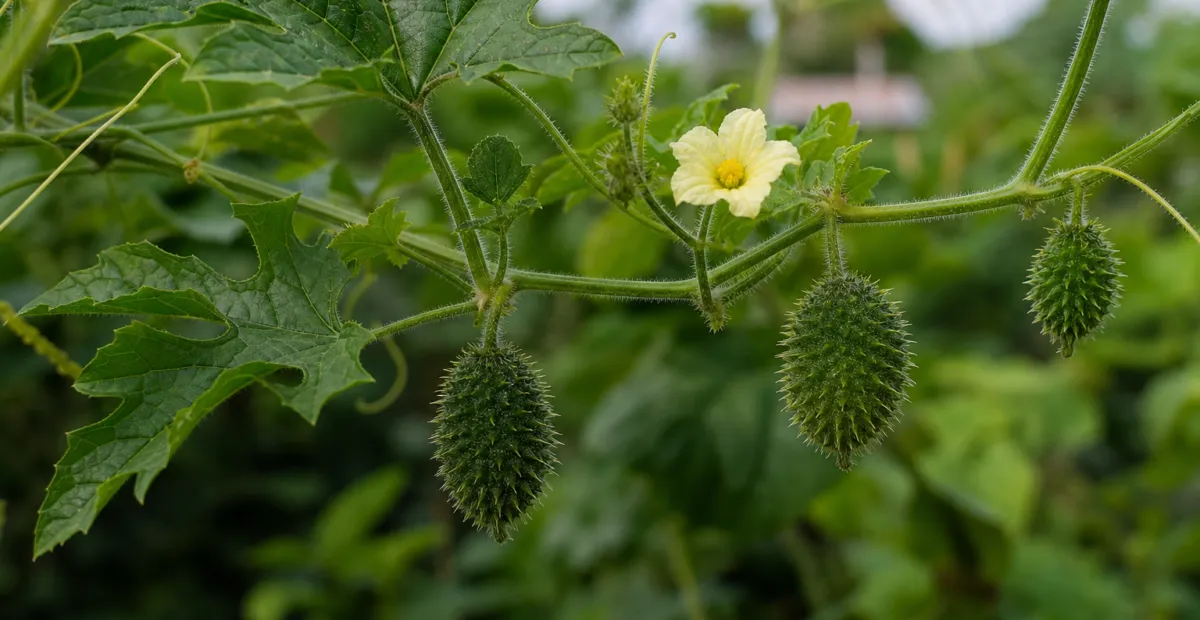
Spiny gourd or spine gourd or teasle gourd and also known as bristly balsam pea (Momordica dioica) short overview
Spiny gourd, Momordica dioica, is a vigorous perennial climbing vine in the cucumber family. It produces separate male and female plants, yellow flowers, and small green fruits covered with soft spines that mature reddish-orange. Native from the Indian subcontinent to Myanmar, it is grown mainly as a vegetable in warm climates. In the United States, it is best treated as a frost-tender tropical crop, grown in a long, hot season or overwintered from its tuberous root.
Taxonomic classification
Spiny gourd or spine gourd or teasle gourd and also known as bristly balsam pea (Momordica dioica) care guide
Light and placement
Give this vine a sunny site with at least 6–8 hours of direct light, ideally on a south- or west-facing trellis. In very hot inland climates, light afternoon shade can reduce leaf scorch. Sparse growth and poor flowering usually indicate insufficient light; bleached leaves, crisp margins, or rapid midday wilting suggest excessive heat or root stress.
Watering and humidity
Water deeply when the upper 1 inch of soil begins to dry, keeping the root zone consistently moist but never waterlogged. Increase frequency during flowering, fruit set, and hot weather; reduce watering after seasonal dieback or when overwintering dormant roots. Mulch helps moderate soil moisture and temperature. Humidity is useful, but wet foliage and stagnant air encourage disease.
Soil and growing medium
Use fertile soil with dependable drainage and substantial organic matter. A loam amended with compost is suitable; heavy clay should be raised or amended to prevent stagnant winter moisture. A slightly acidic to neutral reaction is appropriate. In containers, use a moisture-retentive but porous vegetable mix rather than dense garden soil.
Feeding
Incorporate finished compost before planting, then feed during active vine growth with a balanced fertilizer at label strength. A second application can be made when flowering begins if growth is pale or weak. Avoid high-nitrogen feeding after fruit set because it can produce excessive foliage with fewer harvestable fruits. Do not fertilize dormant plants.
Growth and habit
The vine emerges from a persistent underground tuber and makes long, tendril-bearing shoots during warm weather. Male and female plants are separate, so fruit production requires a compatible female plant and access to pollen. Provide a sturdy trellis early; harvesting young fruits regularly helps maintain production and prevents heavy fruit from pulling down the vine.
Planting and repotting
Plant outdoors only after frost danger has passed and warm weather is established. Set seeds about 1 inch deep in fertile soil, or place dormant tubers just below the surface with buds oriented upward. Use separate male and female plants when fruit is the goal. Install trellising before vigorous growth begins and mulch after the soil has warmed.
Container plants should be shifted into a larger pot when roots fill the mix or growth becomes weak. Use a heavy container for stability, a drainage hole, and a sturdy trellis. Repot in spring before vigorous growth, disturbing the tuberous root system as little as practical. Replace compacted mix rather than moving repeatedly during flowering.
Propagation and pruning
Propagation
Propagate from seed or dormant tubers. Seeds may germinate slowly and unevenly, so warm conditions and consistent moisture are helpful. Tubers are generally the more dependable method when available; divide or separate dormant tuber pieces only when each section has viable buds. Plant or pot divisions in spring as temperatures rise.
Pruning
Guide young shoots onto the trellis and remove damaged, diseased, or overcrowded growth. After the growing season, cut back dead or frost-killed vines to the crown once growth has finished. Avoid severe pruning while the plant is actively flowering and fruiting unless needed for access or disease control.
Overwintering
In USDA Zones 10–11, protect the root zone with mulch and keep soil only lightly moist during dormancy. In colder areas, move container plants indoors before frost or lift and store dormant tubers in a cool, dry, frost-free medium. Keep overwintered roots above freezing and avoid persistent wetness, which can cause rot.
Uses
The immature fruits are used as a vegetable in South Asian cuisines and are commonly cooked rather than eaten raw. Young shoots and leaves are also reported as food in traditional culinary use, but preparation and local practice vary. Grow it primarily as a specialty edible crop or botanical collection vine; do not treat traditional medicinal claims as established medical advice.
Appearance
Leaves are alternate, green, and broadly heart-shaped to shallowly lobed, with toothed or undulate margins. Slender climbing stems use simple tendrils for support. The most distinctive feature is the small ovoid to oblong fruit, whose green surface is densely covered with short spines and later changes toward reddish-orange as it ripens.
Flowering
The species is dioecious: staminate and pistillate flowers are borne on different plants. Flowers are yellow and open during the warm growing season, with male flowers generally appearing or opening earlier than female flowers. Fruit set depends on pollen transfer from a male plant to a female plant; hand pollination may improve results when visitor activity is low.
Pollination and visitors
The yellow flowers are insect-pollinated, with bees and other small flower-visiting insects reported or considered characteristic visitors of cucurbit flowers. Because male and female flowers occur on separate plants, effective visitation must move pollen between plants for fruit production.
Momordica dioica photos
Click any photo for a larger view. Source, author and license are shown separately.
Diseases and pests
Diseases
Prevent fungal and bacterial problems with full morning sun, good air circulation, clean tools, and drip irrigation rather than overhead watering. Remove severely spotted leaves and discard diseased debris. Waterlogged soil can cause root or tuber rot; improve drainage and avoid planting into cold, saturated ground.
Pests
Inspect new growth and leaf undersides for aphids, whiteflies, spider mites, cucumber beetles, and caterpillars. Use strong water sprays for light infestations, hand-pick larger pests, and protect beneficial insects by avoiding unnecessary broad-spectrum insecticides. Trellising and sanitation improve monitoring and reduce foliage contact with soil.
Toxicity and pollen
Reliable species-specific toxicity information for Momordica dioica is limited and should not be inferred from the better-studied bitter melon, Momordica charantia. Although immature fruits are documented as food in culinary contexts, eat only correctly identified, properly prepared produce from a trusted source. Keep ornamental or unverified plant material away from children and pets and seek professional advice after ingestion or an adverse reaction.
- Typical season
- Typically June–September in warm U.S. cultivation
- Pollination / pollen
- Dry pollen released from male flowers during morning anthesis
The plant produces pollen from male flowers, but reliable evidence quantifying airborne pollen exposure or clinical allergy risk for Momordica dioica is limited. Flowers are insect-pollinated, which may reduce widespread airborne dispersal compared with wind-pollinated plants, but it does not prove zero allergy risk. People with strong pollen sensitivity should avoid handling flowers during peak release and wash after gardening.
Native habitat
It is native to seasonally dry tropical regions from the Indian subcontinent to Myanmar. The plant grows as a climber in warm environments with a distinct wet growing period and a drier resting period. Productive cultivation requires heat, fertile soil, regular moisture during growth, and protection from prolonged cold or saturated winter soil.
Interesting fact
The species name dioica refers to its separate male and female plants. It survives unfavorable seasons with an underground tuberous root. Its fruits are spiny rather than smoothly ribbed like many cultivated gourds. Fruit production requires pollen from a male plant, making sex ratio important in small plantings.
Frequently asked questions (FAQ)
The most relevant questions about this plant, with short and direct answers.
🌱Quick care
What is Momordica dioica commonly called?⌄
Momordica dioica is commonly called spiny gourd, spine gourd, or teasle gourd, and it is also known as bristly balsam pea. It is a climbing member of the Cucurbitaceae family.
Is Momordica dioica a perennial or annual plant?⌄
Momordica dioica is a perennial climbing vine in warm climates. Its underground tuber can survive dormancy, but the plant is frost tender and may need protection or indoor storage in colder parts of the United States.
Is Momordica dioica the same as bitter melon?⌄
No, Momordica dioica is a different species from bitter melon, which is usually Momordica charantia. Their common names can overlap, so verify the scientific name before buying seeds, fruit, or plants.
🌤️Environment and placement
How much sun does Momordica dioica need?⌄
Grow Momordica dioica in full sun to partial shade. Full sun generally supports stronger growth and better fruiting, while light afternoon shade can help in very hot climates.
What type of soil is best for spiny gourd?⌄
Spiny gourd grows best in fertile, well-drained loam. Avoid waterlogged soil, and improve heavy clay with organic matter before planting.
How large does a Momordica dioica vine get?⌄
Momordica dioica is a climbing vine that can become vigorous when provided with warmth, moisture, fertile soil, and support. Its final size varies with climate and growing conditions, so give it room to climb rather than treating it like a compact annual.
Can Momordica dioica survive winter outdoors?⌄
Momordica dioica may survive winter outdoors only where the ground does not freeze deeply and the tuber remains protected. In most frost-prone areas of the United States, grow it as a protected perennial or bring the tuber or container indoors.
💧Care and problems
How often should I water Momordica dioica?⌄
Water Momordica dioica regularly enough to keep the soil moderately and evenly moist. Let the surface begin to dry slightly between waterings, but do not allow the root zone to remain saturated.
How do I protect Momordica dioica from frost?⌄
Protect Momordica dioica whenever temperatures may fall below 32°F. Cover outdoor plants before a light freeze, move container plants indoors, and in cold climates consider lifting and storing the dormant tuber in a cool, dry, frost-free place.
Does Momordica dioica go dormant?⌄
Yes, Momordica dioica can enter dormancy, with above-ground growth declining during unfavorable conditions. Reduce watering after the vine dies back, but do not let stored or planted tubers remain wet.
What pests affect spiny gourd?⌄
Spiny gourd may be affected by common cucurbit pests such as aphids, cucumber beetles, squash bugs, and spider mites. Inspect leaves and growing tips regularly and use the least-toxic control appropriate for the pest.
What diseases can affect Momordica dioica?⌄
Momordica dioica can be vulnerable to cucurbit problems such as powdery mildew, downy mildew, rot, and viral diseases. Good airflow, well-drained soil, clean tools, and watering at the soil surface help reduce risk.
Why is my Momordica dioica not growing?⌄
Slow or stalled growth is commonly caused by cold temperatures, insufficient light, poor drainage, drought, or a dormant tuber. Warm the root zone, maintain even moisture, and check that the tuber is firm rather than rotting.
🪴Planting and repotting
Can Momordica dioica grow in containers?⌄
Momordica dioica can be grown in a large container if it has fertile, well-drained soil, drainage holes, and a sturdy trellis. Choose a container large enough to accommodate its vigorous vine and underground tuber.
Does spiny gourd need a trellis?⌄
Yes, spiny gourd benefits from a strong trellis, fence, or other support. Supporting the vine keeps fruit off the ground, improves airflow, and makes harvesting easier.
When should I plant Momordica dioica in the United States?⌄
Plant Momordica dioica outdoors after the danger of frost has passed and the soil has warmed. In colder USDA zones, start with a container or protect the tuber because growth is damaged below 32°F.
How should I prepare soil before planting spiny gourd?⌄
Prepare a sunny bed with fertile, well-drained loam and incorporate mature compost if the soil is poor. Install the trellis before planting so the developing vine can be trained without disturbing its roots.
How deep should Momordica dioica tubers be planted?⌄
Plant Momordica dioica tubers shallowly enough that they are covered by a modest layer of well-drained soil, while keeping the crown from sitting in constant moisture. Exact depth varies with tuber size, so avoid burying it excessively or compacting the soil above it.
✂️Propagation and pruning
How do you propagate Momordica dioica?⌄
Momordica dioica is most reliably propagated from underground tubers. Seed propagation is possible but may be less predictable, and seedlings can be male or female because the species is dioecious.
Can Momordica dioica be grown from seed?⌄
Momordica dioica can be grown from seed, although tuber propagation is commonly considered more dependable. Warm conditions are important for germination, and seed-grown plants may require several seasons before reliable flowering or fruiting.
Should Momordica dioica be pruned?⌄
Prune Momordica dioica mainly to remove dead, damaged, or overcrowded growth and to keep the vine within its support. Avoid severe pruning during active fruiting unless the plant has outgrown its space.
⚠️Toxicity and safety
Are Momordica dioica fruits edible?⌄
The immature fruits of Momordica dioica are traditionally eaten as a cooked vegetable in South Asia. Because preparation, maturity, and individual tolerance matter, eat only correctly identified fruit from a reliable source and avoid treating the plant as a proven medicinal remedy.
Is Momordica dioica poisonous to dogs or cats?⌄
Human and pet toxicity for Momordica dioica is not well established. Keep pets and children from chewing the plant or fruit, and contact a veterinarian or poison-control service if ingestion causes symptoms.
Can you eat the skin of spiny gourd?⌄
The immature fruit is used as a cooked vegetable, but the spiny outer surface may be removed or prepared according to the cultivar and recipe. Because food-use guidance for this species is not standardized in the United States, use a reputable culinary source and cook it thoroughly.
🌸Flowering and special interest
Do you need male and female Momordica dioica plants to get fruit?⌄
Yes, usually you need at least one male and one female Momordica dioica plant for fruit production. The species is dioecious, meaning male and female flowers occur on separate plants.
How can I tell male and female spiny gourd flowers apart?⌄
Female spiny gourd flowers usually have a small swelling resembling an immature fruit beneath the flower, while male flowers do not. Flowers may be yellow, but individual plants must be observed carefully because sex is expressed through the flowers.
Why is my Momordica dioica flowering but not producing fruit?⌄
The most common reason is that the plant is male, female flowers are absent, or no compatible male plant is nearby for pollination. Poor pollinator activity, heat stress, and excessive moisture can also reduce fruit set.
When does Momordica dioica flower?⌄
Momordica dioica flowers during active warm-season growth, although the exact timing depends on climate, plant age, and day length. Flowering is unlikely while the plant is dormant or exposed to cool temperatures.
How do I harvest Momordica dioica fruit?⌄
Harvest spiny gourd fruit while it is still immature, green, and firm if you intend to cook it as a vegetable. Use gloves or pruning shears if the surface is prickly, and remove fruit carefully to avoid damaging the vine.
Similar plants
 Musk cucumber (Sicana odorifera) care guideSicana odorifera
  CAIGUA (Cyclanthera pedata) care guideCyclanthera pedata
  Chayote (Sechium edule) care guideSechium edule
  Benincasa fistulosa care guideBenincasa fistulosa
  Trichosanthes cucumerina care guideTrichosanthes cucumerina
  Scarlet gourd (Coccinia grandis) care guideCoccinia grandis