Seeds feel like the most natural way to grow a plant. You sow them, wait for a tiny green shoot, and watch it mature. Yet if you want another plant that looks exactly like your favorite monstera, pothos, snake plant or African violet, seed is often the least practical choice.
That is why growers commonly use stem cuttings, leaf cuttings, division, offsets or tissue culture instead. These methods can preserve a plant’s appearance, produce useful-sized plants more quickly and avoid some of the surprises that come with sexual reproduction.
Seed growing still has a place in houseplant gardening. It is rewarding, inexpensive and sometimes the only sensible method for particular species. The key is understanding what you are trying to reproduce: a species, or a specific plant with a specific look.
Seedlings are not photocopies of the parent plant
When a plant grows from seed, the seed contains genetic material from the parent plant and, when pollination involves another plant, from a second parent as well. The resulting seedling may resemble its parents, but it is not necessarily an identical copy.
This matters when you admire a houseplant for a precise feature such as cream-colored leaves, compact growth, unusual leaf shape or especially large flowers. A seedling may show some of those traits, all of them, or none of them. Even seeds collected from the same fruit can produce noticeably different plants.
By contrast, vegetative propagation uses a piece of the original plant. A stem, leaf, root section or offset can develop into a new plant that is genetically the same as the parent. In everyday gardening language, this new plant is often called a clone.
Species, hybrids and cultivars are not the same thing
A species is a naturally occurring group of plants with shared characteristics. A hybrid results from a cross between two parent plants. A cultivar is a cultivated selection that people deliberately maintain because it has desirable traits.
Many named houseplant cultivars are kept consistent through cloning. If a grower has selected a plant with an exceptional pattern or growth habit, taking cuttings is a dependable way to preserve that selection. Growing its seeds may instead produce a mixed group of seedlings.
That does not mean every seed-grown plant will be disappointing. It means you should expect variation rather than a guaranteed duplicate.
Variegation is one of the biggest reasons
Variegated houseplants make the issue easy to see. White, cream, yellow or speckled areas may result from mutations, unusual tissue arrangements or changes that do not pass reliably through seed.
Take a variegated monstera as an example. The familiar marbled or sectoral pattern is not something you can reliably reproduce by planting a seed from the plant. Seedlings generally emerge green, and any later variegation is unpredictable. To preserve the pattern, growers select a cutting that includes a healthy node and the right combination of stem tissue.
The same principle applies to many colorful or unusually patterned plants. A leaf alone is not always enough: for vining plants, the cutting needs a node, the small joint where a leaf or aerial root may emerge. A leaf without a node may remain alive for a while but cannot necessarily produce a new growing point.
- Want the same pattern? Choose a suitable cutting or offset.
- Want to experiment? Try seed, but treat each seedling as a new individual.
- Buying a cutting? Look for a visible node and signs of active, healthy growth.
Many houseplants rarely flower indoors
Another simple reason is that a popular houseplant may not reach the flowering stage in an average home. Some tropical plants need substantial size, strong light, a long growing season or particular environmental conditions before they flower and set fruit.
Monstera deliciosa, for instance, usually does not flower or produce fruit when grown as a typical indoor plant. Pothos can also remain in a leafy, juvenile form for years indoors. Without flowers, there is no fruit and no practical homegrown seed to collect.
Even when an indoor plant does flower, pollination can be another hurdle. Some species need pollen from a compatible plant, a particular pollinator or careful timing between male and female flower phases. A flower can look healthy and still fail to produce viable seed.
Seeds may be available—but not useful
Online listings sometimes offer seeds for plants that are more commonly sold as cuttings or tissue-cultured starts. Treat unusually cheap or exotic seed listings with caution. The seed may be mislabeled, too old to germinate, or unrelated to the photograph used in the listing.
Before buying, check whether the species normally produces seed in cultivation and whether reputable growers commonly propagate it that way. For a named variegated cultivar, a cutting or established plant is usually a more realistic purchase than seed.
Speed and size matter to growers
Seedlings begin at the smallest possible stage. They need time to germinate, establish roots, produce mature leaves and develop the shape people expect from a houseplant. Some species move quickly, but many popular foliage plants take a long time to reach a saleable size from seed.
A cutting begins with stored energy in an existing stem or leaf. Once it forms roots, it can resume growth from an already-developed bud. Division and offsets go even further: they may already have roots and leaves when separated from the parent.
For commercial growers, this difference affects space, labor and consistency. A tray of uniform cuttings is easier to plan than a tray of seedlings that may germinate unevenly and grow at different rates.
For home gardeners, the benefit is practical too. A healthy pothos vine can provide several cuttings in one pruning session. A snake plant may offer leaf sections or offsets. An African violet leaf can produce new plantlets under suitable conditions. You do not need to wait for a mature plant to flower first.
Some houseplants are sterile or difficult to reproduce from seed
Not every plant produces fertile seed easily. Some hybrids have reduced fertility, while certain cultivated forms are effectively sterile. A plant may flower but produce little or no viable seed, or its seeds may germinate poorly.
Seedlessness can be useful from a production standpoint because growers can maintain a desirable plant without worrying about unpredictable seedlings. It also explains why a plant may be widely available in garden centers even though seed packets are nowhere to be found.
Plants with unusual growth forms can present additional challenges. Some compact, miniature or heavily modified cultivars are maintained by cloning because their special traits do not come true from seed.
Which propagation method should you use?
The best method depends on the plant’s natural growth habit. Start by identifying the species and then choose the method that matches it.
Stem cuttings
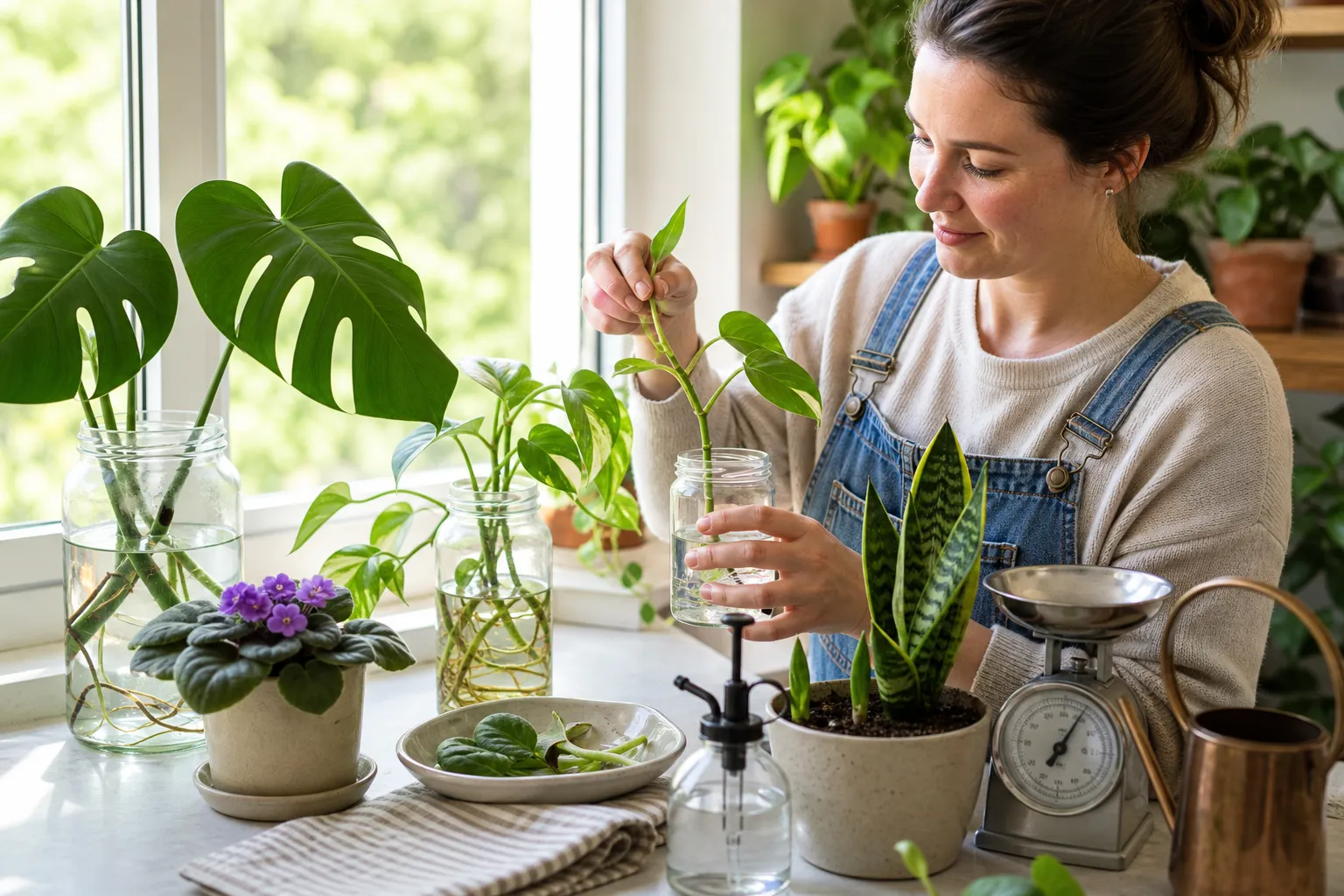
Stem cuttings work well for many vining and cane-forming houseplants, including pothos, philodendron, monstera and dracaena. Cut just below a node, remove leaves that would sit below the growing medium and place the cutting in water or a clean, airy rooting mix.
For a useful home experiment, take three similar cuttings from one healthy pothos vine. Place one in water, one in a mix of perlite and potting mix, and one in plain potting mix. Keep them in bright, indirect light and record root length once a week. You may find that the water cutting shows roots first, while the mix-grown cutting develops a more soil-ready root system.
Leaf cuttings
Leaf cuttings can work beautifully for African violets, some begonias and snake plants. The exact technique varies. An African violet leaf is usually attached to a short petiole, while snake plant leaves can be divided into sections.
Remember that a leaf cutting is not automatically a complete plant. It needs the right tissue and conditions to produce new roots and shoots. A detached leaf from a plant that does not naturally regenerate this way may simply decline.
Division
Use division for clump-forming plants with several crowns or leafy sections. Remove the plant from its pot, gently separate the clumps and make sure each division retains roots and active growth.
This method suits plants such as some ferns, peace lilies, calatheas and snake plants with multiple shoots. Division gives you a relatively mature start, but do not split a small or stressed plant just to make more pieces.
Offsets and plantlets
Offsets are small plants that develop beside the parent. Spider plants produce plantlets on runners, while many bromeliads form pups around the base. Wait until the offset has a reasonable root system before separating it.
Seed
Choose seed when you want to explore variation, grow a species that naturally reproduces well this way, or raise a large number of young plants. Seed is also valuable to breeders because genetic variation is exactly what they need when selecting new traits.
A simple watering test for new cuttings
Overwatering is one of the easiest ways to lose a cutting. The rooting medium should stay lightly and evenly moist, not saturated. A small measuring routine can make your care more consistent than guessing from the surface.
- Fill a small pot with your rooting mix and weigh it dry using a kitchen scale.
- Water slowly until a little excess drains from the bottom, then weigh the pot again.
- Write down the fully watered weight. For example, a 6-inch pot might weigh 1.8 pounds when dry and 2.3 pounds after watering.
- Check the pot daily. Water only when the weight has dropped noticeably and the upper layer feels just slightly dry.
The exact numbers will vary with pot size, plant type and mix, so do not treat 2.3 pounds as a universal target. The value of the test is that it shows how quickly your own setup dries. A cutting in a warm room near a bright window may need attention sooner than one in a cooler, lower-light corner.
Keep humidity reasonably steady, but allow air movement. A clear bag or propagation cover can reduce moisture loss, yet leaves should not press against wet plastic for long periods. Bright, indirect light is usually safer than hot direct sun while roots are forming.
Compare varieties before you propagate
If you grow several varieties of the same plant, use propagation as a chance to compare them. A solid-green pothos may root and grow faster than a highly variegated selection because green leaves generally provide more photosynthetic tissue. A compact cultivar may produce shorter internodes than a vigorous trailing type.
Record the variety, cutting length, number of nodes, date taken, rooting method and the date roots first appear. After six to eight weeks, compare:
- How quickly roots formed
- How many new leaves appeared
- Whether the new growth matches the parent pattern
- How much water each pot used
- Whether the cutting remained firm and healthy
This small trial turns propagation into a useful growing experiment. It also helps you discover which method works best in your home rather than relying on a generic timetable.
The practical takeaway
Popular houseplants are rarely grown from seed because seed often brings variation, takes longer to reach a useful size and may be difficult to produce indoors. Named cultivars, especially variegated forms, are usually propagated vegetatively so growers can preserve the exact traits people want to buy.
For your own collection, choose seed when you are happy to meet a new plant with its own personality. Choose cuttings, divisions or offsets when you want a dependable copy of a plant you already love.
Start with a healthy parent plant, use clean tools, label every experiment and keep your watering measured rather than automatic. With a little patience, propagation can turn one favorite houseplant into a small collection—without waiting years for flowers and seed.