
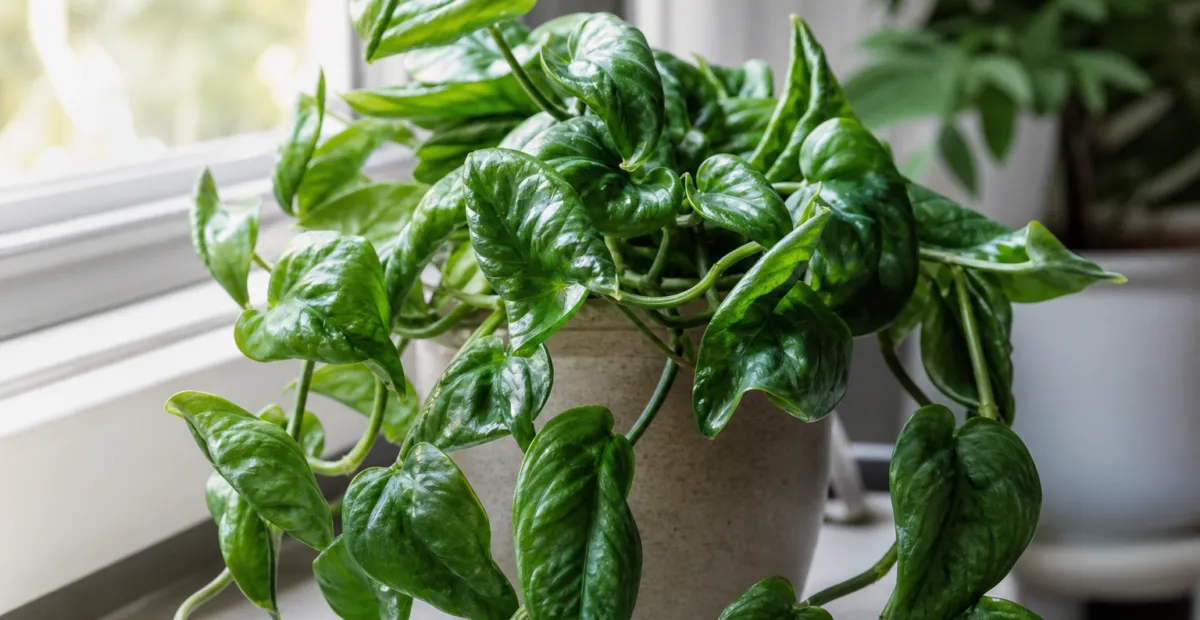
 AI-generated illustration
Shangri la (Epipremnum aureum ‘Shangri la’) short overview
Epipremnum aureum 'Shangri la' is a distinctive pothos cultivar prized for dark green leaves that stay tightly curled, folded, and crinkled instead of opening flat. Often marketed as Sleeping Pothos or Spinach Pothos, it grows more slowly than many common pothos forms and can trail, climb, or spread horizontally. Give it bright filtered light, an airy mix, careful watering, and protection from frost.
Taxonomic classification
Shangri la (Epipremnum aureum ‘Shangri la’) care guide
Light and placement
Give bright filtered or indirect light, such as near an east-facing window or several feet back from a south- or west-facing window. Gentle morning sun may be tolerated after acclimation, but harsh midday rays can scorch leaves. Too little light causes stretched stems, slower growth, and weaker foliage; excessive shade can reduce vigor and variegation.
Watering and humidity
Water thoroughly when the upper 1–2 inches of mix feel dry, then let excess drain completely. Adjust by season: water less often in winter or low light, and check more frequently during warm active growth. Do not keep the pot standing in water. Moderate humidity is helpful, but humidity does not replace good root aeration.
Soil and growing medium
Use a loose, airy container mix that drains quickly but retains a little moisture, such as peat-free potting mix amended with orchid bark and perlite. A slightly acidic to neutral reaction is suitable. Avoid dense, poorly aerated soil because persistent saturation can suffocate roots and encourage rot.
Feeding
Feed during spring and summer with a complete balanced houseplant fertilizer diluted to about half the label strength every four to six weeks. Water first if the mix is dry. Reduce or stop feeding in low-light winter conditions and after repotting until fresh growth resumes; excess fertilizer can cause salt buildup and brown margins.
Growth and habit
This is a slow-growing selection compared with many standard pothos cultivars. Stems can trail from containers, climb with aerial roots, or spread across a surface. A support can improve presentation and may encourage larger foliage, while periodic tip pruning keeps a container plant fuller.
Planting and repotting
Plant or pot up during active growth, ideally in spring or summer. Set the rooted cutting at the same depth it was previously growing, with nodes just above or at the surface when propagating. Leave room for trailing stems and provide a support if a climbing form is wanted.
Repot in spring or early summer when roots circle the pot, the mix breaks down, or watering becomes unusually rapid. Move up only one pot size and keep the crown at its previous depth. Refresh part of the mix rather than sharply disturbing healthy roots.
Propagation and pruning
Propagation
Propagate during active growth from stem cuttings containing at least one healthy node. Root in water, a moist airy medium, or by layering. Use clean tools and keep the node warm and lightly moist; leaf-only pieces cannot produce a new plant without a node.
Pruning
Trim long or bare stems just above a node to encourage branching and maintain the desired trail length. Remove yellow, damaged, or diseased leaves at the base with clean scissors. Pruned healthy sections can be used as cuttings.
Overwintering
Keep indoors before temperatures approach 50°F, and protect from drafts, cold windows, and heating vents. In winter, place it in the brightest available filtered light, reduce watering as growth slows, and stop routine fertilizing until active growth returns.
Uses
A foliage-focused indoor plant for shelves, hanging baskets, tabletops, and trellises. It can trail, climb, or spread horizontally, making it useful in small-space interiors. It is not edible and should not be used in culinary or medicinal preparations because the tissues contain irritating calcium oxalate crystals.
Appearance
The defining feature is the heart-shaped foliage that remains tightly folded, curled inward, and crinkled instead of opening flat. Leaves are usually dark green and may carry subtle gold or yellow variegation. Stems are flexible and capable of producing aerial roots, allowing the plant to trail or climb.
Flowering
The species produces a green spathe surrounding a fleshy flower spike, but flowering is rare in ordinary indoor cultivation. Reliable cultivar-specific flowering timing and flower details are not documented. Do not grow this selection primarily for blooms; its horticultural value is its unusual foliage.
Pollination and visitors
No reliable cultivar-specific record of animal pollinators or regular flower visitors was found. Because flowering is exceptionally uncommon in ordinary cultivation, pollinator value for a houseplant specimen is effectively undocumented.
Diseases and pests
Diseases
The main risk is root rot caused by chronically wet, poorly aerated media. Use a draining mix, empty saucers, and remove badly damaged roots when repotting. Leaf spots can follow prolonged wet foliage or poor airflow; improve ventilation and remove affected leaves with clean tools.
Pests
Watch for mealybugs, scale, spider mites, and thrips, especially on stressed or dusty foliage. Inspect leaf undersides and stem joints regularly. Isolate affected plants, wash foliage when practical, and use insecticidal soap or another labeled treatment according to its instructions.
Toxicity and pollen
Epipremnum aureum contains insoluble calcium oxalate crystals. Chewing or swallowing plant material can cause immediate oral pain, burning, swelling, drooling, vomiting, or difficulty swallowing. Sap may irritate skin and eyes. Keep cuttings and fallen leaves away from children and pets, and seek professional medical or veterinary advice after significant exposure.
- Pollination / pollen
- Flower pollen produced only if the plant blooms; airborne relevance is expected to be low
This plant rarely flowers in cultivation, so routine airborne pollen exposure from an indoor specimen is expected to be very low. No cultivar-specific airborne-allergy data were found. The more relevant exposure concern is irritating sap and calcium oxalate crystals in the tissues, not pollen.
Native habitat
The species is a tropical forest aroid associated with warm, humid conditions and climbing growth on vegetation. In cultivation, it prefers stable warmth, filtered light, and an oxygenated root zone rather than exposed cold or waterlogged soil.
Interesting fact
The cultivar is recognized by leaves that remain folded and curled inward rather than becoming flat. It is also sold under the informal names Sleeping Pothos and Spinach Pothos. Some plants show subtle yellow or gold variegation, but expression can vary between cuttings.
Frequently asked questions (FAQ)
The most relevant questions about this plant, with short and direct answers.
🌱Quick care
What is Epipremnum aureum 'Shangri la'?⌄
Epipremnum aureum 'Shangri la' is a distinctive pothos cultivar with dark green leaves that remain curled, folded, or partly closed. It is also sold as Sleeping Pothos or Spinach Pothos, although no common name is universally standardized.
Is Epipremnum aureum 'Shangri la' easy to grow?⌄
Yes, Epipremnum aureum 'Shangri la' is generally easy to grow indoors when given bright filtered light, moderate watering, and a well-drained aroid mix. It usually grows more slowly than many ordinary pothos cultivars.
How fast does Epipremnum aureum 'Shangri la' grow?⌄
Epipremnum aureum 'Shangri la' is typically a slow-growing pothos cultivar. Growth may be especially limited by low light, cool temperatures, dry air, or recently repotted roots.
🌤️Environment and placement
How much light does Epipremnum aureum 'Shangri la' need?⌄
Give Epipremnum aureum 'Shangri la' bright filtered or indirect light for the best growth. It can tolerate somewhat lower light, but growth may slow and any variegation may become less pronounced.
Can Epipremnum aureum 'Shangri la' tolerate low light?⌄
Epipremnum aureum 'Shangri la' can tolerate moderate or lower indoor light, but it will usually grow more slowly there. Avoid a very dark location if you want compact, healthy growth.
Can Epipremnum aureum 'Shangri la' grow in direct sunlight?⌄
Avoid strong, unfiltered direct sun because it can scorch the leaves. A few hours of gentle morning sun may be tolerated, but bright filtered light is safer.
What temperature is best for Epipremnum aureum 'Shangri la'?⌄
Keep Epipremnum aureum 'Shangri la' in a warm indoor location, ideally above 60°F. Protect it from cold drafts, frost, and sudden temperature drops.
Does Epipremnum aureum 'Shangri la' need high humidity?⌄
Epipremnum aureum 'Shangri la' grows well in moderate to higher humidity and may appreciate more humidity than ordinary pothos. Extra humidity is most helpful when indoor air is very dry, but good airflow is still important.
Is Epipremnum aureum 'Shangri la' suitable for a bathroom?⌄
Yes, a bright bathroom can suit Epipremnum aureum 'Shangri la' because humidity is often higher there. It still needs adequate filtered light and should not remain in constantly wet soil.
💧Care and problems
How often should I water Epipremnum aureum 'Shangri la'?⌄
Water Epipremnum aureum 'Shangri la' when the upper part of the potting mix has dried, then let excess water drain completely. The schedule varies with light, temperature, pot size, and season, so check the mix rather than watering by calendar.
Why are the leaves on my Epipremnum aureum 'Shangri la' curled?⌄
The curled or folded leaves are the defining feature of Epipremnum aureum 'Shangri la', not usually a sign of stress. Newly emerging leaves may look tighter and gradually develop their characteristic shape as they mature.
Why is my Epipremnum aureum 'Shangri la' not growing?⌄
Slow growth is normal for Epipremnum aureum 'Shangri la', but very limited growth often indicates insufficient light, cold conditions, overwatering, root problems, or a lack of active growing-season care. Check the roots and growing conditions before adding fertilizer.
Why are the leaves on my Epipremnum aureum 'Shangri la' turning yellow?⌄
Yellow leaves most often result from consistently wet soil, poor drainage, aging foliage, or insufficient light. Let the upper mix dry between waterings and inspect the roots if yellowing is widespread or accompanied by soft stems.
Should I fertilize Epipremnum aureum 'Shangri la'?⌄
Yes, feed Epipremnum aureum 'Shangri la' lightly during active growth with a balanced houseplant fertilizer diluted according to the label. Avoid fertilizing dry, stressed, newly repotted, or dormant plants.
Does Epipremnum aureum 'Shangri la' need a moss pole?⌄
A moss pole or other sturdy support is optional but useful if you want Epipremnum aureum 'Shangri la' to climb. It can also be grown as a trailing or horizontally spreading plant.
Should Epipremnum aureum 'Shangri la' trail or climb?⌄
Epipremnum aureum 'Shangri la' can trail from a hanging container or climb a support. Choose trailing for a cascading display and climbing for a more upright plant with better access to light.
🪴Planting and repotting
What soil is best for Epipremnum aureum 'Shangri la'?⌄
Use an airy, well-drained aroid mix containing materials such as potting mix, orchid bark, and perlite. The mix should hold some moisture while allowing air to reach the roots and excess water to escape quickly.
What type of pot does Epipremnum aureum 'Shangri la' need?⌄
Choose a pot with drainage holes that is only slightly larger than the root ball. An oversized pot stays wet longer and can increase the risk of root rot.
When should I repot Epipremnum aureum 'Shangri la'?⌄
Repot Epipremnum aureum 'Shangri la' when roots circle densely, emerge from drainage holes, or the mix breaks down and drains poorly. Moving up one pot size during active growth is usually sufficient.
Can Epipremnum aureum 'Shangri la' grow in water?⌄
Stem cuttings of Epipremnum aureum 'Shangri la' can root in water, but long-term water culture requires regular water changes and nutrient management. For sustained growth, a well-drained potting mix is generally more forgiving.
✂️Propagation and pruning
How do I propagate Epipremnum aureum 'Shangri la'?⌄
Propagate Epipremnum aureum 'Shangri la' from stem cuttings that include at least one healthy node. Root the cutting in water, moist propagation mix, or another clean rooting medium, then pot it after a useful root system develops.
Can I propagate Epipremnum aureum 'Shangri la' from a leaf?⌄
No, a leaf without a node will not normally produce a new Epipremnum aureum 'Shangri la' plant. Use a stem section with a visible node, because the node contains the growth point needed for propagation.
Why is Epipremnum aureum 'Shangri la' difficult to propagate?⌄
Epipremnum aureum 'Shangri la' may root more slowly than vigorous common pothos cultivars. Use warm conditions, bright filtered light, a healthy node, and a lightly moist but well-aerated rooting medium.
Can I prune Epipremnum aureum 'Shangri la'?⌄
Yes, prune Epipremnum aureum 'Shangri la' to control length, remove damaged growth, or encourage branching. Make clean cuts just above a node and use the healthy cuttings for propagation.
⚠️Toxicity and safety
Is Epipremnum aureum 'Shangri la' toxic to cats and dogs?⌄
Yes, Epipremnum aureum 'Shangri la' should be considered harmful if eaten by cats and dogs because its sap contains irritating calcium oxalate compounds. Keep it away from pets and contact a veterinarian if ingestion causes symptoms.
Is Epipremnum aureum 'Shangri la' poisonous to people?⌄
Epipremnum aureum 'Shangri la' is harmful if eaten and its sap may irritate skin, mouth, and eyes. Keep it away from children, avoid touching your face while handling it, and wash exposed skin after pruning.
What should I do if sap from Epipremnum aureum 'Shangri la' gets on my skin?⌄
Wash the affected skin promptly with soap and water. Avoid rubbing your eyes or mouth, and seek medical advice if significant irritation, swelling, or other symptoms develop.
🌸Flowering and special interest
Does Epipremnum aureum 'Shangri la' flower indoors?⌄
Epipremnum aureum 'Shangri la' rarely flowers indoors. Mature plants may flower only under unusually favorable conditions, and flowering is not a practical expectation for typical houseplant culture.
Similar plants
 Exotica (Epipremnum aureum ‘Exotica’)Epipremnum aureum 'Exotica'
 Glacier (Epipremnum aureum ‘Glacier’)Epipremnum aureum 'Glacier'
 Marble Queen pothos (Epipremnum aureum ‘Marble Queen’)Epipremnum aureum 'Marble Queen'
 Pearls and Jade (Epipremnum aureum ‘Pearls and Jade’)Epipremnum aureum 'Pearls and Jade'
 N Joy (Epipremnum aureum ‘N Joy’)Epipremnum aureum 'N Joy'
 Golden pothos (Epipremnum aureum ‘Golden’)Epipremnum aureum 'Golden'