
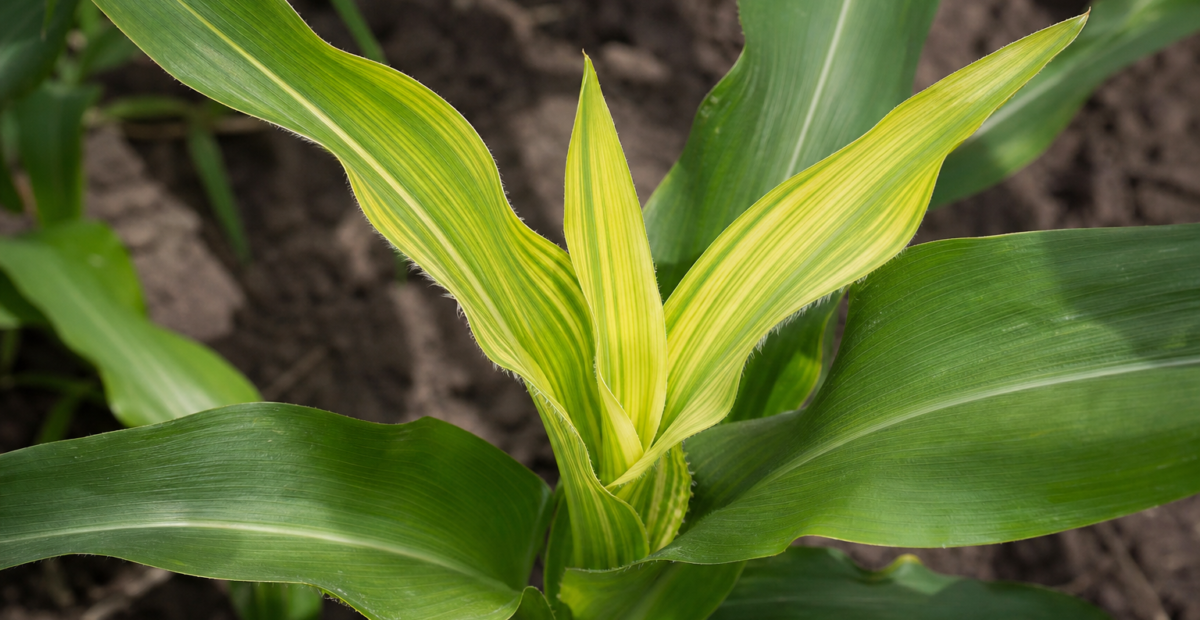
Sulfur deficiency
Sulfur deficiency overview
Sulfur deficiency is a nutrient disorder that reduces chlorophyll and protein formation, producing pale green to yellow new growth, weak stems and slow development. It is most likely in sandy, low-organic-matter soils, heavily irrigated beds, or systems receiving little sulfur from fertilizer or water. Because symptoms resemble nitrogen and iron deficiency, soil and tissue testing are important before treatment.
Typical conditions
Overview
Sulfur is an essential secondary macronutrient. Plants absorb it mainly as sulfate through their roots and use it to make sulfur-containing amino acids, proteins, vitamins and enzymes. Deficiency commonly causes reduced growth, delayed maturity, pale foliage and lower crop quality.
In the United States, the disorder is most often associated with coarse-textured soils, low organic matter, high rainfall or irrigation, high-yielding crops, and fertilizers that contain little or no sulfur. Legumes, onions and members of the cabbage family can have comparatively high sulfur demand. Visual diagnosis is not definitive because sulfur deficiency can resemble nitrogen, iron, zinc or root-related stress.
Symptoms and identification
- Youngest or newly emerged leaves become uniformly pale green, yellow-green or yellow, sometimes with yellow striping in grasses such as corn.
- Plants may be short, spindly, weak or slow-growing, with delayed maturity and reduced yield.
- Alfalfa and clover may develop an overall light-green appearance and weak growth.
- Severe deficiency can reduce protein content, nitrogen-fixation performance in legumes and crop quality.
Unlike nitrogen deficiency, which usually begins on older leaves because nitrogen is mobile within the plant, sulfur symptoms often appear first on newer growth because sulfur is only moderately mobile. This distinction is useful but not sufficient for diagnosis.
Causes and spread
The direct cause is insufficient sulfate available in the root zone or inadequate uptake by roots. Risk increases in sandy or excessively drained soils, soils with low organic matter, high-rainfall or heavily irrigated sites, and fields where sulfur-containing fertilizers or organic amendments are rarely used. Atmospheric sulfur deposition has also declined in many parts of the United States.
Cool, wet soil can temporarily limit sulfur release from organic matter and impair root activity. Waterlogged roots may produce deficiency-like symptoms even when sulfur is present. Elemental sulfur is not immediately plant-available; soil microorganisms must oxidize it to sulfate, and this process is slower in cold or dry conditions.
There is no biological spread from plant to plant. Symptoms may occur in patches corresponding to sandy soil, low organic matter, leached areas, drainage patterns or uneven fertilizer distribution.
Life cycle and persistence
Sulfur deficiency has no pathogen or pest life cycle. Soil sulfur occurs in organic forms, elemental sulfur and inorganic sulfate. Plants primarily absorb sulfate, while microorganisms gradually mineralize organic sulfur and oxidize elemental sulfur into plant-available sulfate.
Availability changes with temperature, moisture, aeration, soil texture and microbial activity. Sulfate can move below the root zone in coarse soils, whereas organic matter and some fertilizer materials can replenish it over time. Symptoms may lessen as soil warms and dries if the problem was temporary rather than a severe shortage.
Treatment and control
Confirm the diagnosis before applying sulfur. Submit representative soil samples and, when practical, matching tissue samples to a reputable laboratory or university Extension service. Compare results with crop-specific recommendations rather than relying on a single visual symptom.
If a shortage is confirmed, apply a fertilizer or amendment that supplies plant-available sulfate at the rate recommended for the crop, soil test and application timing. Common US materials include ammonium sulfate, gypsum and other registered sulfate-containing fertilizers. Apply according to the product analysis and avoid unnecessary nitrogen, acidity or salt loading. Elemental sulfur can be useful for longer-term soil acidification or sulfur supply, but it must oxidize before roots can use it and is not a rapid rescue treatment.
Place or incorporate amendments where roots can access them, follow local nutrient-management guidance, and reassess new growth rather than expecting damaged leaves to turn green. Correcting waterlogging, compaction or root injury may be necessary when uptake—not soil supply—is the main limitation.
Low-impact and biological control
Use mature compost, well-managed manure or approved organic fertilizers that contain measurable sulfur, but do not assume that every compost or manure source supplies enough. Check the product analysis when available and include its nitrogen, phosphorus and salt contribution in the nutrient plan.
Build organic matter gradually, maintain good drainage and use crop rotations that avoid excessive nutrient removal. For certified-organic production, use only inputs allowed by the applicable organic certification program and permitted for the crop and site. Organic amendments are preventive or corrective nutrient sources, not pesticides.
Prevention
- Test soil before planting and use plant tissue testing when symptoms are ambiguous, especially for high-value crops or field crops.
- Maintain soil organic matter with mature compost or suitable organic amendments, while avoiding excessive applications that create salt or nutrient imbalances.
- Choose a balanced fertilizer program that supplies sulfur only where crop need and testing support it. Sulfate-containing fertilizers can provide more immediately available sulfur than elemental sulfur.
- Improve drainage and avoid prolonged saturation; manage irrigation so soluble sulfate is not repeatedly leached below the root zone.
- Account for crop removal, irrigation-water chemistry, manure inputs and previous fertilizer applications when planning sulfur management.
- Scout new growth and compare affected areas with healthy areas of the same crop.
Interesting facts
- Sulfur is required for protein synthesis and is particularly important to legumes because it supports nitrogen fixation.
- Sulfur deficiency can closely resemble nitrogen deficiency, but sulfur symptoms commonly appear first on new leaves while nitrogen deficiency begins on older leaves.
- On corn, sulfur deficiency may appear as pale yellow-green striping on upper leaves.
- Sulfate is the principal form taken up by roots; elemental sulfur must first be microbially oxidized.
- Soil sulfur tests can be difficult to interpret because sulfate is mobile and sulfur release from organic matter varies with weather and microbial activity.
Sulfur fertilizers and soil amendments are nutrient products, not pesticide treatments. Use only products legally authorized for the specific crop, site and problem in the United States, and follow the current product label. Do not apply elemental sulfur or sulfate fertilizers at untested rates; excessive sulfur can acidify soil, increase soluble salts or create nutrient imbalances.