Autumn is often the most forgiving season for starting a lawn from seed. The soil is still warm from summer, daytime heat is easing, and cool-season grasses can put energy into roots instead of struggling through drought and extreme temperatures. Get the timing right, and a thin or tired lawn can become noticeably denser before winter.
The important detail is that “autumn” does not mean the same week everywhere in the United States. Your best sowing date depends on the grass you are growing, your local first-frost date, soil temperature, and how much growing time remains before winter.
The short answer: aim for late summer to early fall
For most cool-season lawns, the ideal autumn seeding window is late summer through early fall – generally about 45 to 60 days before your area’s first expected fall frost. This gives new seedlings time to germinate, develop roots, and survive their first winter.
In many northern and central parts of the country, that often means seeding from mid-August through mid-September. Farther south, the window may shift into September or October. In colder areas, you may need to finish earlier, while in milder coastal climates you may have more flexibility.
Do not rely on the calendar alone. A useful practical signal is soil temperature. Cool-season grasses usually germinate best when the upper soil is roughly 50°F to 65°F, although individual species differ. Air temperatures around the upper 50s to mid-70s are also favorable for active growth.
First, identify the kind of grass you are sowing
Autumn is the prime season for cool-season grasses, including Kentucky bluegrass, tall fescue, fine fescue, and perennial ryegrass. These grasses grow most actively during the cooler periods of spring and fall, then slow down during intense summer heat.
Warm-season grasses such as bermudagrass, zoysiagrass, centipedegrass, and buffalograss follow a different schedule. They need warm soil and active summer growth, so new seeding is usually better from late spring into early summer. Sowing warm-season grass in a cooling autumn soil can leave seed dormant or seedlings too small to withstand winter.
Quick grass-type guide
- Kentucky bluegrass: Dense, attractive turf with good recovery from wear, but it can take longer to germinate and establish.
- Tall fescue: A strong choice for many transition-zone and cool-season lawns. Its deeper roots can help it cope with dry periods, but it still needs adequate moisture while establishing.
- Fine fescue: Useful in cooler areas and some lightly shaded locations. It generally prefers well-drained soil and may not be ideal for heavy traffic.
- Perennial ryegrass: Germinates quickly and provides early cover, but it may be less winter-hardy than some fescues or bluegrass varieties in colder regions.
- Bermudagrass and zoysiagrass: Warm-season choices that are normally seeded when soil temperatures are consistently warm, rather than during autumn’s decline.
For many home lawns, a seed blend combines complementary species. A mixture of turf-type tall fescue with fine fescue or Kentucky bluegrass may suit a variable yard better than a single grass. Always match the blend to sunlight, drainage, traffic, and regional climate.
Regional timing across the United States
USDA hardiness zones can help describe winter conditions, but they do not provide an exact lawn-seeding date. Local frost timing, elevation, soil, rainfall, and the grass mixture matter just as much. Use these windows as starting points, then adjust according to local conditions.
Northern states and colder inland areas
In the northern Midwest, northern New England, and higher elevations, plan to seed from mid-August to early September. Some locations may need to begin in early August, especially where the first frost arrives early.
If you wait until late September or October, germination may be slow and seedlings may not develop enough roots before the ground freezes. A late attempt can still succeed during an unusually mild fall, but the odds become less dependable.
Midwest, Mid-Atlantic, and Northeast transition areas
Many lawns in these regions do well when seeded from late August through mid-September. In warmer portions of the Mid-Atlantic, the useful window may extend into late September or early October.
Try to complete the work before several weeks of cold weather arrive. Warm days and cool nights are excellent for cool-season grass, but persistent cold slows germination and leaf growth.
Upper South and transition-zone lawns
In parts of Oklahoma, Kansas, Missouri, Tennessee, Virginia, and nearby areas, timing can be more complicated because both warm-season and cool-season lawns are common. Cool-season seed is often sown from late September into October, depending on local temperatures and the first frost.
Some homeowners overseed dormant warm-season lawns with perennial ryegrass for temporary winter color. This is a different goal from establishing a permanent cool-season lawn, and the ryegrass may need additional mowing and irrigation through winter and spring.
Southern states and warm climates
If your permanent lawn is bermudagrass, zoysiagrass, centipedegrass, or another warm-season type, autumn is generally not the main seeding season. Late spring or early summer is usually more suitable because the soil needs to remain warm long enough for rapid germination and establishment.
Cool-season overseeding in the South can be possible, but follow regional recommendations carefully. A blend that performs well in the Northeast may not tolerate the heat, disease pressure, or winter conditions of a southern lawn.

Why autumn usually beats spring for cool-season grass
Timing matters because a newly seeded lawn is vulnerable. In spring, cool-season seedlings may germinate successfully but then face increasing heat, weeds, drought, and heavy competition as summer approaches.
Autumn offers a more favorable sequence:
- The soil retains summer warmth, helping seed germinate efficiently.
- Cooler air reduces heat stress on young plants.
- Annual weeds are often less aggressive than they are in spring and summer.
- Seedlings can establish through fall, then resume growth in spring.
- Roots have more time to develop before the next major period of summer stress.
This does not make autumn seeding automatic. A poor seedbed, compacted soil, inadequate watering, or unsuitable grass variety can still lead to patchy results.
A simple autumn seeding experiment
If you are unsure which week works best in your yard, try a small comparison rather than reseeding the entire lawn at once. Mark three nearby test squares, each about 2 feet by 2 feet, and sow the same seed blend at the same labeled rate on three dates spaced roughly one week apart.
Record the date, soil temperature, rainfall, watering, first germination, and the date each patch needs its first mowing. You may find that the earliest patch establishes fastest, while the middle patch develops the most evenly. The late patch may germinate, but its roots could remain less developed before winter.
This small experiment also reveals differences in shade and drainage. A patch beside a foundation may stay warmer, while one beneath a tree may remain damp or receive less light. Use those observations when planning the rest of the yard.
How to prepare before you sow
Good preparation often matters more than adding extra seed. Begin when the existing lawn and soil are workable – not saturated and not powder-dry.
- Mow slightly shorter than usual. Avoid scalping the lawn, but reduce excessive leaf cover so seed can reach the soil.
- Remove heavy thatch and debris. Seed needs contact with soil, not a cushion of dead stems, thick leaves, or clippings.
- Loosen compacted areas. Core aeration can help water and roots move through dense soil. Work when the soil is moist enough to penetrate but not muddy.
- Rake bare patches. Create a shallow, crumbly surface. Do not bury seed deeply.
- Use a soil test when renovating a large area. It can identify pH and nutrient issues before you spend money on seed and amendments.
- Choose quality seed. Check the label for the grass species, purity, germination percentage, and the recommended rate for your use.
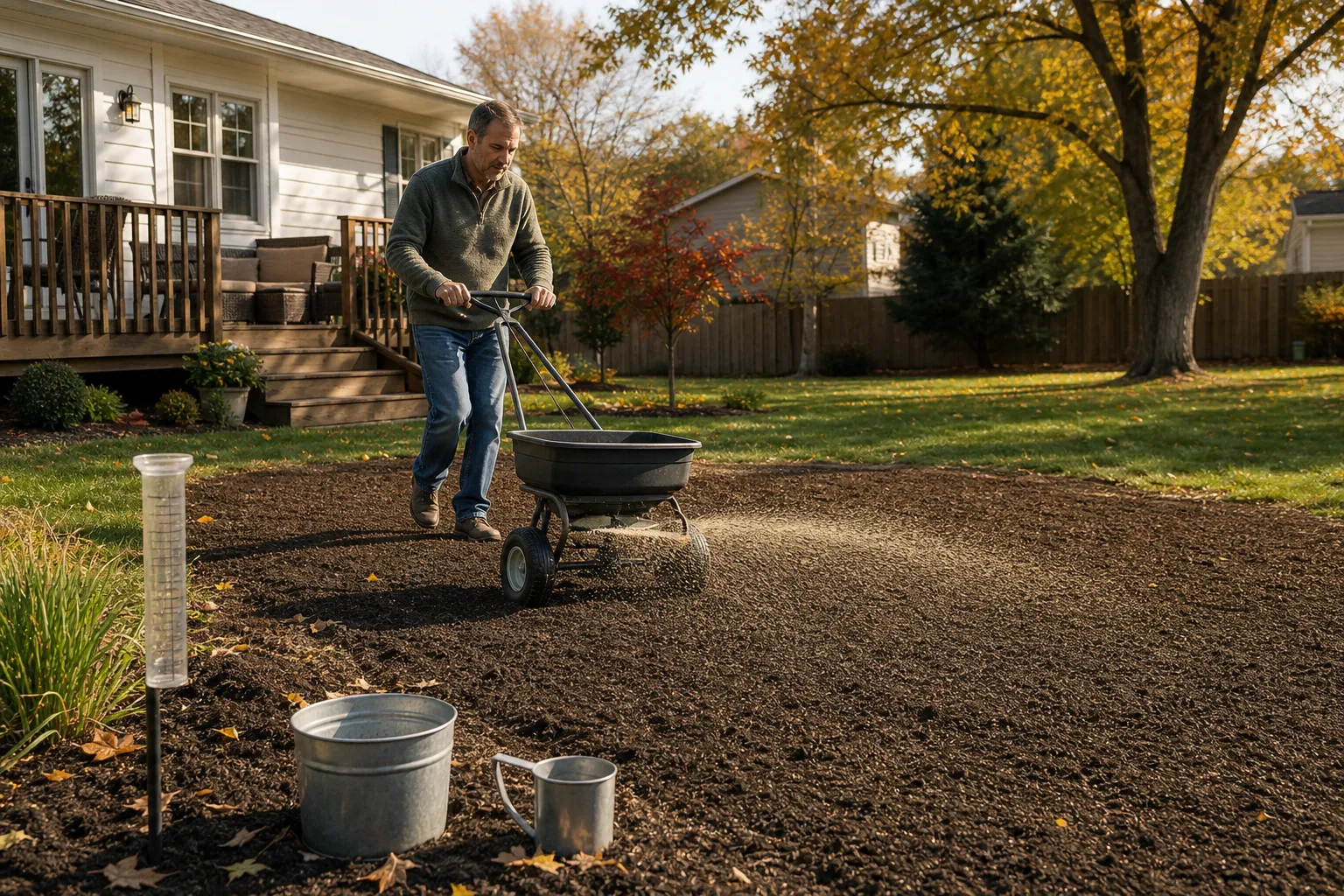
For even coverage, divide the seed into two equal portions. Spread one portion in one direction and the other at a right angle. This simple crossing pattern helps prevent obvious stripes and missed areas.
Cover seed lightly, but do not bury it
Most lawn seed should sit close to the surface. After spreading, lightly rake so seed is covered by approximately ⅛ inch of soil or less, depending on the species and soil texture.
A thin layer of clean straw or another suitable mulch can help reduce erosion and slow surface drying. Keep the layer light enough for sunlight and air to reach the seed. Heavy mulch can smother seedlings or hold too much moisture against the soil surface.
Watering: measure rather than guess
The goal during germination is consistent moisture in the upper seed zone. You do not need to flood the area, but you should avoid allowing the surface to crust or dry repeatedly.
For a typical autumn seeding, begin with short, gentle watering once or twice daily when weather is dry, adjusting for rainfall, wind, soil type, and shade. Sandy soil may need more frequent attention, while clay soil can remain damp longer.
A practical watering target
Place two or three shallow, straight-sided containers – such as tuna cans or small rain gauges – around the seeded area. Run the sprinkler and measure the collected water. A useful starting target is about ¼ inch of water per application, but the exact amount and frequency should depend on how quickly the surface dries.
Once most seed has germinated and the seedlings are visibly growing, gradually shift to less frequent, deeper watering. For example:
- Germination stage: Keep the top layer consistently moist with light applications; check the soil daily.
- Early seedling stage: Water less often but allow moisture to move deeper, while still preventing wilting.
- After the first mowing: Begin moving toward the lawn’s normal irrigation pattern, watering thoroughly when needed rather than keeping the surface constantly wet.
Rain counts toward your total. If a storm delivers ½ inch, you may not need to irrigate that day. Avoid walking across soggy soil, because footprints can compact the seedbed and disturb fragile roots.
When should you mow new autumn grass?
Wait until the seedlings are tall enough to mow safely and the soil is firm enough to support your mower without leaving ruts. A common first-mowing height is around 3 to 3½ inches, though the best height depends on the grass blend.
Set the mower high enough that you remove no more than one-third of the blade at a time. Use a sharp blade, avoid abrupt turns, and skip mowing when the ground is wet. Regular light mowing encourages the young lawn to fill in without placing unnecessary stress on it.
What if you missed the ideal window?
Do not panic, but be realistic. Seeding several weeks late may produce uneven germination or leave seedlings too small for winter. Increasing the seed rate is not a complete solution, because crowded seedlings can compete with one another and still lack time to mature.
If the ground is already cold and the forecast shows little suitable growing weather, consider waiting for the next reliable window rather than wasting seed. In some climates, a dormant seeding may be used, but it is less predictable for beginners and can result in uneven spring emergence.
For small bare spots, you can still prepare the soil and sow if moisture and temperatures remain favorable. Protect the area from leaves, erosion, pets, and foot traffic, and monitor it closely.
The autumn takeaway
For most cool-season lawns in the United States, the best time to sow grass seed is late summer to early fall, roughly 45 to 60 days before the first expected fall frost. Use soil temperature, local weather, and the grass type – not the name of the month – as your guide.
Choose a variety suited to your region, prepare the soil carefully, spread seed evenly, and measure your watering. Even a modest patch can teach you how your yard behaves. With a little planning, autumn seeding gives your lawn a head start on strong roots, better spring coverage, and a more resilient growing season ahead.