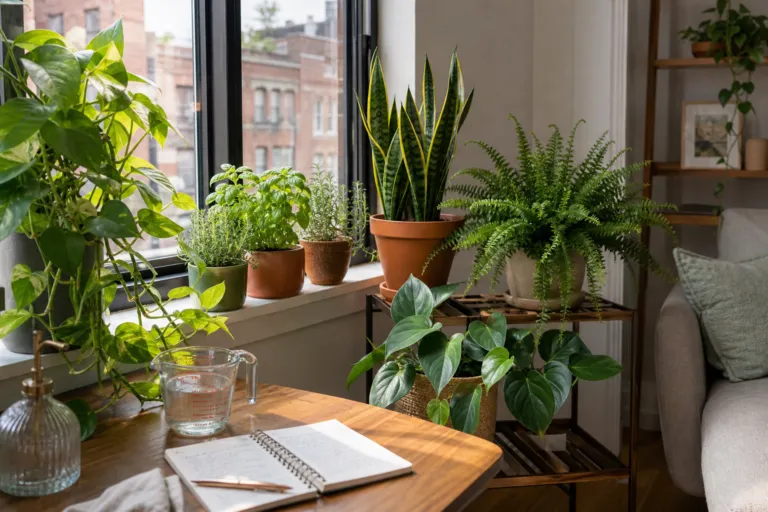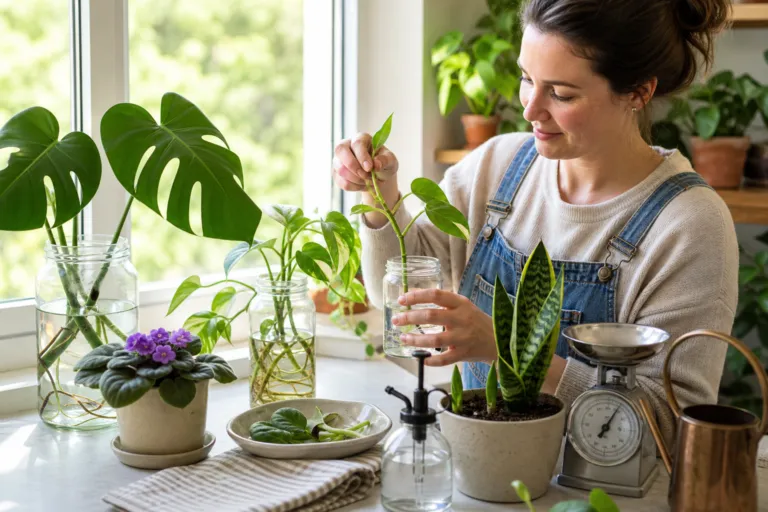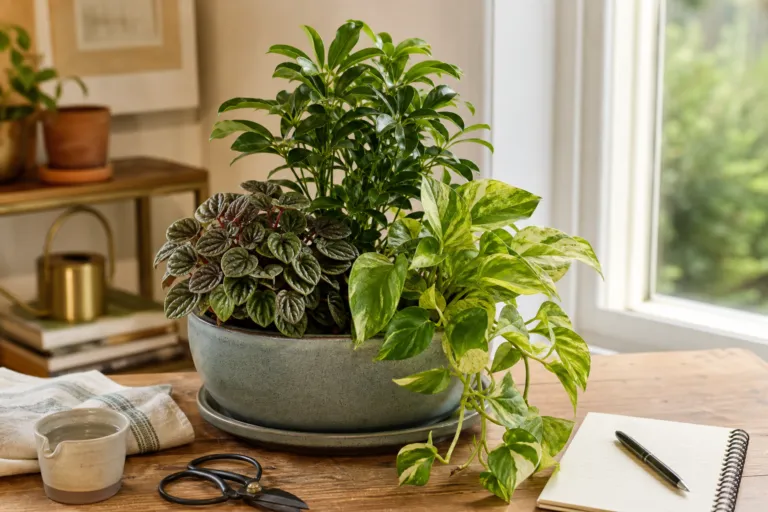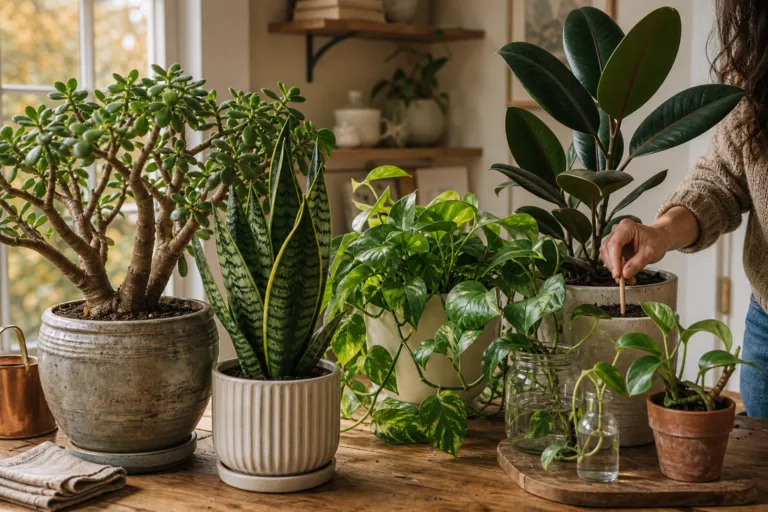
Want more houseplants without turning every shopping trip into a major expense? Propagation is one of the simplest ways to grow your collection. With a healthy parent plant, a clean pair of scissors, a glass or small pot, and a little patience, you can create new plants for windowsills, shelves, hanging baskets, and gifts.
The best plants for beginners are forgiving, inexpensive, and willing to produce roots from stems, leaves, runners, or natural offsets. Start with one or two varieties, observe how they respond in your home, and soon you’ll have a small propagation station of your own.
What makes a houseplant easy to propagate?
Easy-to-propagate plants usually have one or more useful traits: fast-growing stems, visible nodes, trailing runners, fleshy leaves, or naturally forming baby plants. A node is the small joint where a leaf, aerial root, or side shoot emerges from a stem. For many vining plants, roots develop most reliably from this point.
Propagation works best when you begin with a vigorous plant. Avoid taking cuttings from a plant that is badly wilted, heavily infested, or recovering from a major problem. Healthy stems have a much better chance of rooting quickly and continuing to grow.
A simple beginner’s propagation kit
- Sharp scissors or pruners
- Rubbing alcohol or soap and hot water for cleaning tools
- Small jars or clear cups for water propagation
- A light, airy potting mix for rooted cuttings
- Small pots with drainage holes
- Plant labels and a pencil
- A bright location away from harsh direct afternoon sun
For soil propagation, choose a fresh, well-draining mix rather than heavy garden soil. A combination made for seed starting or cuttings is usually easier to manage in containers because it stays airy while still holding some moisture.
1. Pothos: the dependable vine for water propagation
Pothos is one of the most popular starter plants for propagation because its flexible stems make the process easy to see. The familiar green-and-gold forms are often inexpensive, while marble, neon, and other cultivated varieties add color and contrast to a collection.
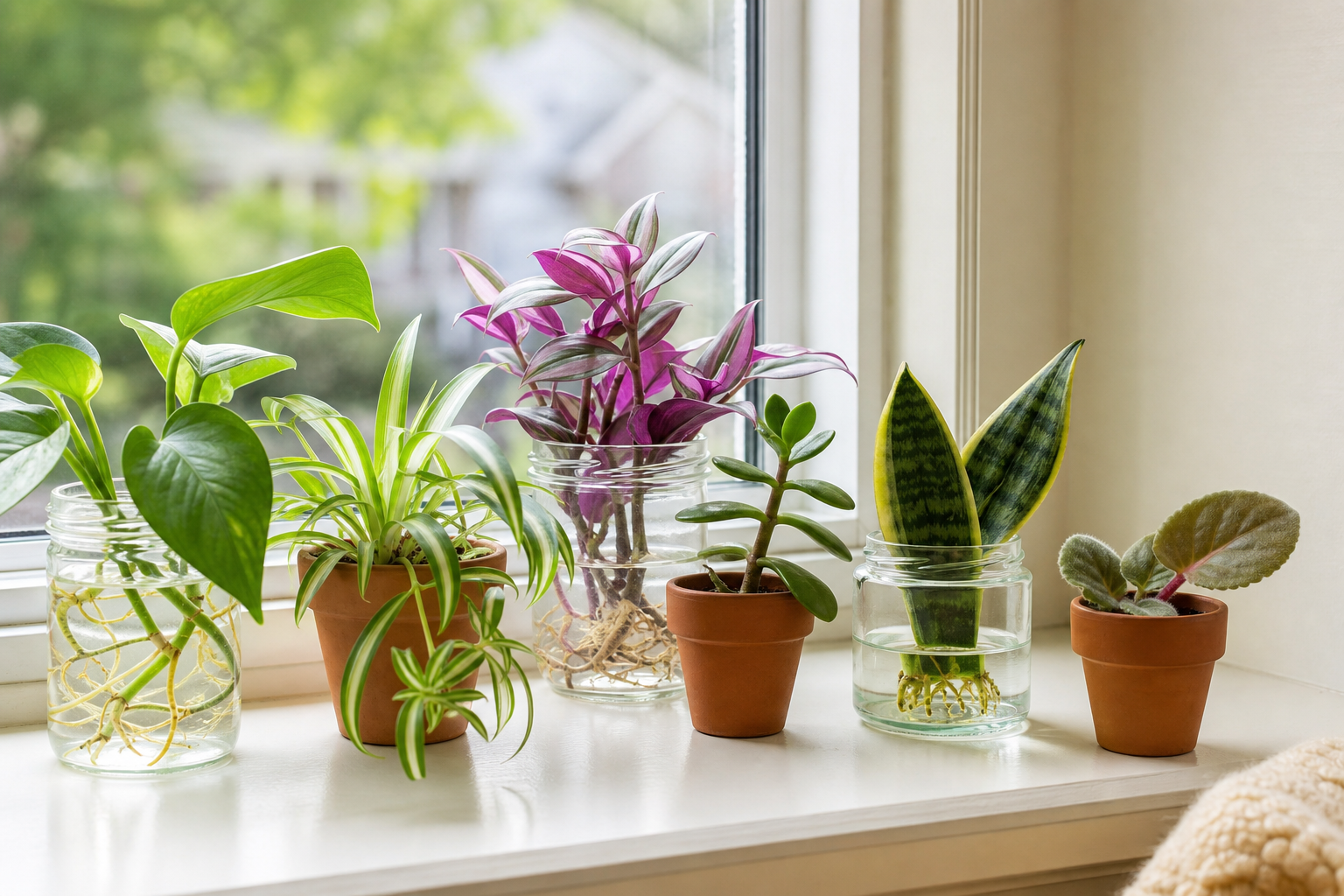
To propagate pothos, cut a stem just below a node. Each cutting should include at least one healthy leaf and one node; a longer piece with two or three nodes can produce a fuller new plant. Remove any leaf that would sit below the waterline, then place the node in water while keeping the leaf above the surface.
Which pothos varieties are easiest?
- Golden pothos: vigorous and usually quick to root.
- Green pothos: tolerant and useful for low-cost bulk planting.
- Neon pothos: bright chartreuse foliage, especially attractive in a group.
- Marble Queen pothos: beautiful variegation, though growth may be slower in dim light.
Place the jar in bright, indirect light. Refresh the water when it becomes cloudy or noticeably low, and pot the cutting once the roots are about 1 to 2 inches long. Water-rooted cuttings can be moved into soil, but they may need a gradual transition: keep the mix lightly moist for the first couple of weeks while the new plant adjusts.
2. Spider plant: the fastest route to baby plants
Spider plants are especially satisfying because mature plants often produce long flower stems carrying small plantlets, commonly called spiderettes. These babies may already have tiny roots, making them an excellent choice for a first propagation project.
If the plantlet has roots, you can snip it from the runner and pot it directly. If it has few or no roots, place the base in a small glass of water or set it on the surface of moist potting mix while it remains attached to the parent plant. Once roots develop, cut the connecting runner.
How to encourage a fuller collection
Give spider plants bright, filtered light and avoid keeping the soil constantly soggy. Mature plants often produce more offsets when they are growing actively and receiving enough light. Some cultivars may produce fewer plantlets than others, so don’t assume a quiet plant is unhealthy simply because it is not covered in babies.
For a useful comparison, try rooting three spiderettes in different ways: one in water, one directly in potting mix, and one while still attached to the parent. Label each one and check the roots weekly. You’ll learn which method works best in your home’s light and humidity.
3. Tradescantia: colorful cuttings for hanging baskets
Tradescantia, sometimes sold as inch plant or wandering dude, offers fast growth and attractive foliage in shades of green, silver, purple, pink, and cream. It roots readily from stem cuttings and can quickly fill a small pot.
Cut a 3- to 5-inch section just below a node, remove the lowest leaves, and place the bare nodes in water or moist potting mix. Several cuttings can share one container. Planting a group together gives you a fuller basket much sooner than waiting for one cutting to branch on its own.
Water or soil?
Water propagation lets you watch roots form, but direct planting often reduces the adjustment period later. If you use water, move the cuttings into soil when the roots are short and well formed rather than waiting until they become a tangled mass.
Tradescantia can become stretched and sparse in low light. If new growth looks widely spaced, move the plant closer to a bright window or trim the longest stems and root them back into the pot.
4. Heartleaf philodendron: an easy, elegant climber
Heartleaf philodendron is a graceful trailing plant with heart-shaped leaves and flexible stems. It is a strong candidate for node cuttings, especially when the parent plant has become long or bare near the pot.
Take a cutting with one or more nodes and at least one healthy leaf. Place the node in water, sphagnum moss, or a light propagation mix. Keep the cutting warm and evenly moist, but never submerged except for the node when using water.
Cuttings with several nodes can be divided into shorter sections, provided each section includes a node. This is a budget-friendly way to turn one overgrown vine into several starts. Keep the leaves above the surface and use bright, indirect light while roots develop.
5. Jade plant: propagate from stems or leaves
Jade plant is a succulent, so it follows a different rhythm from soft-stemmed vines. Its thick leaves and stems store water, and cuttings can rot if you keep them wet immediately after cutting.
For a stem cutting, remove a healthy 2- to 4-inch piece and let the cut end dry for several days in a warm, shaded spot. This drying period allows the wound to form a protective callus. Once the end feels dry, insert it into a well-draining succulent mix and water sparingly.
You can also try leaf propagation. Set a healthy leaf on top of dry or barely moist succulent mix, with the cut end touching the surface. Roots and a tiny new plant may eventually form, although leaf propagation generally takes longer than using a stem cutting.
Light and watering test
Jade plants need much brighter light than many tropical houseplants. For a simple home experiment, root two similar stem cuttings: place one near a bright window and one in a dimmer location. Check the potting mix with your finger every few days, but do not water by habit. Wait until the mix has dried substantially before watering again.
As a practical measurement, pour about 1/4 cup of water into a small 3-inch propagation pot only when the mix is dry several inches down, then record how long it takes to dry. Your schedule will vary with pot size, light, temperature, and the type of mix, so the measured observation matters more than a fixed calendar rule.
6. Snake plant: slow but remarkably economical
Snake plants are among the most economical houseplants because a mature clump can be divided, and some types can also grow from leaf sections. Division is usually the quickest method when the plant has several rosettes or crowded growth points.
Remove the plant from its pot and gently separate sections by hand. If the roots are tightly packed, use a clean knife to divide the clump. Each section should have roots and a growing point before you pot it separately.
Leaf propagation is possible with many green-leaved forms. Cut a leaf into sections, allow the pieces to dry briefly, and place them in a lightly moist, well-draining mix with the correct end facing downward. Variegated cultivars may not always produce plants that retain the parent’s striping, so division is the better choice when preserving a particular pattern matters.
Snake plants prefer drying between waterings. Overwatering is a more common obstacle than neglect, especially during the darker months in much of the United States.
7. African violet: small leaves, big rewards
African violets are compact, affordable, and rewarding to propagate from leaf cuttings. Choose a healthy, mature leaf with a firm petiole, the short stalk connecting the leaf blade to the plant.
Trim the petiole to roughly 1 to 1 1/2 inches, then insert it into a light, moist propagation mix. Keep the leaf upright, provide bright indirect light, and maintain gentle moisture without saturating the pot. New plantlets may form at the base after several weeks.
Once the young plants have a few leaves of their own, separate them carefully and pot them individually. Named cultivars can vary in how faithfully they reproduce from leaf cuttings, so treat each new plant as an enjoyable surprise rather than expecting every one to look exactly identical.
Common propagation mistakes to avoid
- Cutting without a node: many vines need a node to produce roots and new growth.
- Using dirty tools: clean scissors reduce the chance of spreading problems between plants.
- Starting with stressed material: take cuttings from healthy, actively growing parts whenever possible.
- Keeping everything soaking wet: moisture helps rooting, but saturated media can lead to rot.
- Giving intense direct sun: fresh cuttings can dry out or scorch before they establish.
- Checking too often: roots may develop slowly, particularly in cool or dim indoor conditions.
- Potting too soon: wait for a reasonable root system instead of moving a cutting after only a tiny root tip appears.
Build your collection one cutting at a time
Propagation is less about getting every cutting perfect and more about learning how plants respond. Start with pothos, spider plant, or tradescantia if you want quick visual results. Add jade, snake plant, or African violet when you’re ready to try different techniques.
Keep a small notebook with the plant name, propagation method, date, location, and watering observations. In a few months, you’ll know which windowsill gives the best results and which plants are most generous with new growth. Best of all, your expanding collection will reflect your own patience, experiments, and care – not just your shopping budget.