
 Source:
 Quadricolor (Agave lophantha ‘Quadricolor’) short overview
Agave lophantha 'Quadricolor' is a striking variegated agave with a compact evergreen rosette and sharply toothed leaves banded in several shades of green with broad yellow to cream margins. It is grown primarily for architectural foliage in sunny, sharply drained beds and containers. The plant is drought tolerant once established, but its tender variegated tissue benefits from protection in colder parts of the United States.
Taxonomic classification
Quadricolor (Agave lophantha ‘Quadricolor’) care guide
Light and placement
Give the plant several hours of direct sun, preferably with a south- or west-facing exposure outdoors. In very hot climates, bright afternoon shade can reduce scorch, especially after moving a plant from low light. Pale, stretched leaves indicate insufficient light; bleached patches or crispy tan areas indicate sun or heat stress. Acclimate gradually before placing it in intense outdoor sun.
Watering and humidity
Water thoroughly only when the mix has dried throughout, then allow excess water to drain completely. During warm active growth, this may be every 2–4 weeks depending on heat, pot size, and soil; reduce sharply in winter and keep the plant nearly dry in cold, cloudy conditions. Never leave the rosette standing in water, and avoid repeatedly wetting the crown.
Soil and growing medium
Use a porous cactus mix amended with extra pumice, perlite, or coarse grit. In the ground, plant on a raised or sloped site where rain drains quickly. The species tolerates a broad pH range, but compacted, constantly wet, or organic-heavy soil greatly increases root and crown-rot risk.
Feeding
Feed in spring and summer only, using a balanced or succulent fertilizer diluted to about one-quarter to one-half strength once every 4–6 weeks. Avoid high-nitrogen feeding, which can produce softer growth and weaker variegation. Do not fertilize newly repotted, dormant, stressed, or cold-wet plants.
Growth and habit
This cultivar grows as a tight, usually solitary to slowly offsetting rosette. Its variegation can make growth somewhat slower than in green forms. Remove dead lower leaves carefully and give offsets room to develop if a clumping display is desired. Sharp leaf teeth make placement and maintenance a safety consideration.
Planting and repotting
Plant during warm weather in a raised, gravelly, rapidly draining site. Handle the root ball rather than the leaves, and keep the crown clear of mulch or wet soil. Water once after planting, then wait for the soil to dry before watering again. Protect newly planted specimens from prolonged cold rain until established.
Repot in spring when roots fill the container or drainage slows. Choose a heavy pot with a drainage hole only slightly larger than the root ball, use a gritty succulent mix, and keep the plant dry for several days after handling roots. A top dressing of gravel helps keep leaves and crown away from wet mix.
Propagation and pruning
Propagation
Separate offsets in spring or early summer when they have formed roots or a short stem. Allow freshly cut surfaces to dry briefly before potting into a dry, porous mix, then water sparingly until rooting begins. Seed propagation is possible after flowering but is slower and will not reliably reproduce the cultivar’s variegation.
Pruning
Pruning is rarely needed. Remove completely dead lower leaves with clean, sturdy tools, working away from the spine and marginal teeth. Do not cut healthy leaves to reshape the rosette. After flowering, remove the spent stalk once it has dried, and wear gloves and eye protection during all cutting work.
Overwintering
In Zones 9–11, keep the plant outdoors in a dry, protected position during normal winter weather. In colder or wetter areas, move containers indoors before hard frost to a bright, cool window and water very sparingly. Avoid placing it beside heaters, and return it outdoors gradually in spring.
Uses
Useful as a specimen, rock-garden accent, xeric border plant, or container centerpiece. It works well in frost-limited regions of the United States and can be overwintered in a bright, cool room where outdoor temperatures are unsuitable. The sharp teeth and irritating sap mean it should not be placed beside paths, play areas, or frequent handling zones.
Appearance
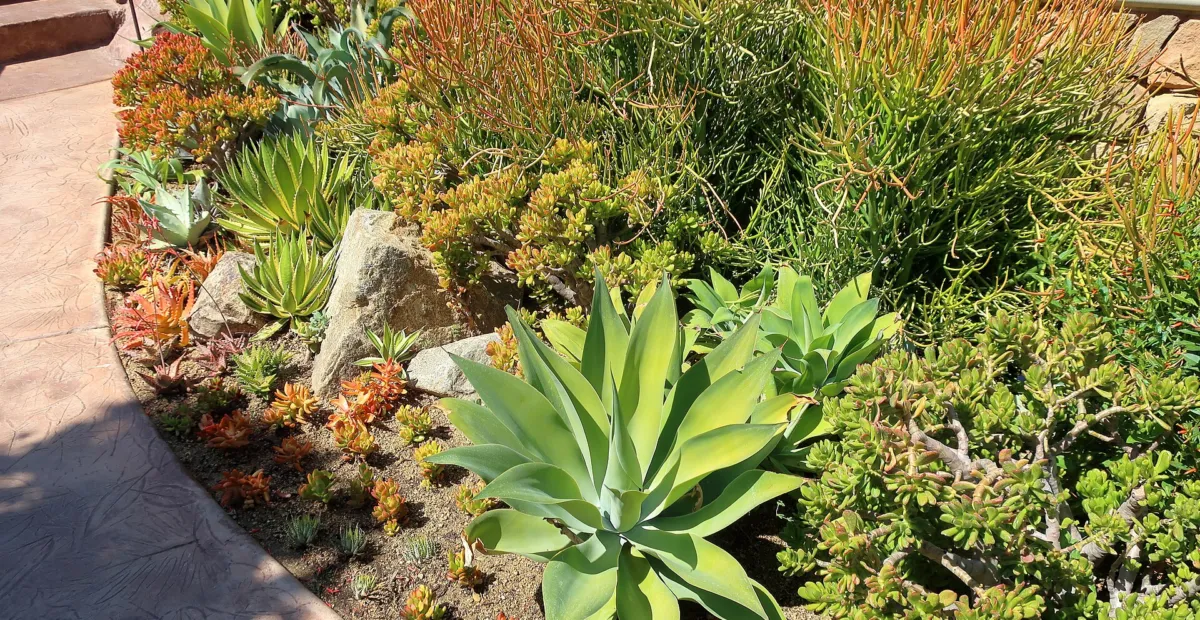
Leaves are thick, stiff, and narrowly lance-shaped, with a terminal spine and conspicuous teeth along the margins. 'Quadricolor' is recognized by longitudinal bands in dark green, light green, yellow, and cream, often with a broad pale margin. The architectural rosette remains evergreen and provides strong contrast in gravel gardens and containers.
Flowering
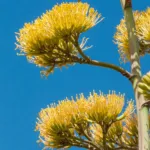
Flowering is infrequent and occurs only after substantial maturity. The rosette sends up a dramatic, leafless stalk that may reach roughly 15 feet or more in the species, bearing numerous greenish-white to yellow-green tubular flowers. After flowering and seed production, the original rosette commonly declines, while offsets may continue the clonal plant.
Pollination and visitors
Direct cultivar-specific pollinator records are limited. As an Agave, the flowers can provide nectar and pollen to visiting bees, moths, and other insects; visitor composition varies with region, flower timing, and inflorescence access. These ecological observations should not be confused with airborne allergy risk.
Agave lophantha 'Quadricolor' photos
Click any photo for a larger view. Source, author and license are shown separately.
Diseases and pests
Diseases
The main risks are root rot, crown rot, and fungal spotting caused by excess moisture or poor air circulation. Use a porous mix, water only after drying, and remove damaged tissue with sterilized tools. If the crown becomes soft or foul-smelling, unpot promptly, cut away rot, allow healthy tissue to dry, and re-root only if viable.
Pests
Scale, mealybugs, agave snout weevil, and occasional mites may occur. Inspect leaf bases and the crown regularly, isolate infested containers, and remove small colonies with a cotton swab or targeted horticultural treatment. Avoid routine broad-spectrum insecticides when flowers are present, and follow the product label carefully.
Toxicity and pollen
Agave sap contains irritating compounds and calcium oxalate-type crystals that can cause painful skin, eye, and mouth irritation in some exposures. The spines also cause puncture injuries. Wear gloves and eye protection when planting or pruning, wash exposed skin promptly, and seek medical or veterinary advice after significant ingestion or eye exposure.
- Typical season
- Late spring to summer when flowering
- Pollination / pollen
- Pollen released from exposed anthers during flowering
This cultivar is not documented well enough for a precise airborne-pollen risk rating. Agave pollen is produced only when the plant flowers, and the large inflorescence may expose pollen to insects and air. People with known pollen sensitivity should avoid handling flowering structures and monitor personal reactions.
Native habitat
The species occurs in dry shrubland and desert-edge habitats from southwestern Texas into northeastern and north-central Mexico. It is adapted to heat, seasonal drought, mineral soils, intense sun, and rapid drainage. The cultivar itself is of garden origin rather than a wild population.
Interesting fact
The cultivar name refers to its distinctly multibanded, multicolored foliage. Its species produces an exceptionally tall flower stalk compared with the compact rosette. Variegated foliage is caused by altered chlorophyll distribution, which can reduce vigor compared with fully green plants. The plant is monocarpic at the rosette level but may persist through offsets.
Frequently asked questions (FAQ)
The most relevant questions about this plant, with short and direct answers.
🌱Quick care
What is Agave lophantha 'Quadricolor'?⌄
Agave lophantha 'Quadricolor' is a compact, variegated agave with dark green leaves, pale green central striping, yellow margins, and reddish teeth. It forms a slow-growing architectural rosette suitable for containers, rock gardens, and warm-climate landscapes.
How much light does Agave lophantha 'Quadricolor' need?⌄
Give Agave lophantha 'Quadricolor' full sun to bright filtered light. Strong light helps maintain compact growth and vivid variegation, but provide some afternoon protection in extremely hot locations if the leaves scorch.
How often should I water Agave lophantha 'Quadricolor'?⌄
Water thoroughly only after the soil has dried completely. Water less often during winter or cool, cloudy weather, because consistently damp soil can cause root rot.
What soil is best for Agave lophantha 'Quadricolor'?⌄
Use a sharp-draining cactus or succulent mix amended with pumice, perlite, or coarse mineral grit if needed. The container or planting site must drain quickly and should never remain waterlogged.
Is Agave lophantha 'Quadricolor' easy to grow?⌄
Yes, Agave lophantha 'Quadricolor' is generally easy to grow when given strong light, excellent drainage, and restrained watering. Its main care risk is excess moisture, especially in cool conditions.
🌤️Environment and placement
Can Agave lophantha 'Quadricolor' grow indoors?⌄
Yes, it can grow indoors beside a very bright, sunny window or under a grow light. Indoor plants need especially careful watering because lower light and slower evaporation make wet soil persist longer.
Can Agave lophantha 'Quadricolor' grow in a container?⌄
Yes, it performs well in containers with drainage holes. Choose a stable pot only slightly larger than the root ball and use a very free-draining succulent medium.
Can Agave lophantha 'Quadricolor' be planted in the ground?⌄
Yes, plant it in the ground where summers are warm and the soil drains rapidly. A raised or gravelly site is preferable in regions with substantial rainfall or heavy clay soil.
What USDA hardiness zone is Agave lophantha 'Quadricolor'?⌄
Agave lophantha 'Quadricolor' is most reliably grown outdoors in warm USDA zones, commonly around Zones 8–11 when kept dry. Protect it from hard freezes because cultivar cold tolerance varies with moisture, exposure, and plant maturity.
How cold can Agave lophantha 'Quadricolor' tolerate?⌄
It may tolerate brief light freezes when established and kept dry, but hard freezes can damage or kill it. Move container plants under cover and protect in-ground plants before freezing weather arrives.
Does Agave lophantha 'Quadricolor' change color in cold weather?⌄
Yes, the leaf margins may develop stronger pink or red tones during cool weather and under bright light. This seasonal coloring is usually normal rather than a sign of disease.
💧Care and problems
Why are the leaves of my Agave lophantha 'Quadricolor' turning brown?⌄
Brown leaves can result from sun scorch, freeze damage, physical injury, or root problems caused by wet soil. Check the damaged area and growing conditions before increasing or reducing water.
Why is my Agave lophantha 'Quadricolor' turning green?⌄
Reduced variegation is commonly associated with insufficient light or the production of less-variegated growth. Move the plant gradually toward brighter light, but do not expect every leaf to display identical striping.
Why is my Agave lophantha 'Quadricolor' soft or mushy?⌄
Soft, mushy leaves usually indicate overwatering, poor drainage, or cold wet conditions. Remove the plant from saturated soil, inspect for rot, and replant healthy tissue in dry, sharply draining mix.
Does Agave lophantha 'Quadricolor' need fertilizer?⌄
It needs little fertilizer and can grow well without frequent feeding. If growth is active, apply a balanced fertilizer diluted to half strength once or twice in spring and summer, avoiding fertilizer during cold or dormant periods.
What pests affect Agave lophantha 'Quadricolor'?⌄
Scale insects are among the pests that may affect this agave, while overwatering can create more serious root problems. Inspect leaf bases and undersides regularly and address infestations promptly.
How fast does Agave lophantha 'Quadricolor' grow?⌄
Agave lophantha 'Quadricolor' is slow-growing and may take several years to reach its mature size. Growth is fastest in warm weather with strong light, good drainage, and appropriate watering.
🪴Planting and repotting
How should I plant Agave lophantha 'Quadricolor' in the ground?⌄
Set the rosette at the same depth it was growing in its container, keeping the crown and leaf bases above the soil line. Backfill with sharply draining soil and avoid heavy watering until the roots begin to establish.
What size pot does Agave lophantha 'Quadricolor' need?⌄
Use a pot only slightly wider than the root ball, with at least one drainage hole. Oversized pots hold excess moisture and increase the risk of root rot.
When should I repot Agave lophantha 'Quadricolor'?⌄
Repot it in spring or early summer when roots have filled the container or drainage has become poor. Handle the plant with thick gloves and allow damaged roots to dry before watering.
✂️Propagation and pruning
How do you propagate Agave lophantha 'Quadricolor'?⌄
Propagate Agave lophantha 'Quadricolor' primarily from offsets, or pups, produced around the mother plant. Separate a rooted offset with a clean tool, let any cut surface callus briefly, and plant it in dry, well-drained mix.
Does Agave lophantha 'Quadricolor' produce pups?⌄
Yes, it can produce offsets around the base as it matures. These pups can be left to form a clump or removed for propagation when they are large enough to handle.
Can Agave lophantha 'Quadricolor' be grown from seed?⌄
It can be grown from seed, but seed propagation is slower and less commonly used for preserving this named cultivar. Offsets are the more practical method when you want plants matching the parent.
Should I prune Agave lophantha 'Quadricolor'?⌄
Regular pruning is unnecessary. Remove only completely dead or badly damaged outer leaves with a clean, sharp tool, and wear gloves because the leaf margins and sap can injure skin.
⚠️Toxicity and safety
Is Agave lophantha 'Quadricolor' toxic?⌄
Its sap can irritate skin and eyes, and the sharp leaf teeth and terminal points can cause puncture injuries. Wear gloves and protective eyewear when handling, pruning, or repotting it.
Is Agave lophantha 'Quadricolor' safe around dogs and cats?⌄
No, it should be kept away from pets because the sap may irritate and the plant can cause injury if chewed or contacted. Place it where animals and children cannot reach the spiny leaves.
How should I handle Agave lophantha 'Quadricolor' safely?⌄
Wear thick gloves, long sleeves, and eye protection when moving or pruning it. Keep the pointed leaves away from walkways, play areas, and other places where people may brush against the plant.
🌸Flowering and special interest
Does Agave lophantha 'Quadricolor' flower?⌄
Yes, it can eventually produce a tall flowering stalk with yellowish flowers, but flowering may take many years. As with other agaves, the flowering rosette may decline afterward, while offsets can continue the plant’s lineage.
How long does Agave lophantha 'Quadricolor' take to flower?⌄
It is a slow-growing agave that may take a decade or longer to mature enough to flower. The timing is variable and depends on climate, light, plant age, and growing conditions.
What should I do after Agave lophantha 'Quadricolor' flowers?⌄
After flowering, remove the spent stalk once it has dried and become manageable, using protective clothing. Preserve any offsets at the base because the flowering rosette may gradually die.
Similar plants
 Thorn-crested Agave (Agave lophantha) care guideAgave lophantha
 Caribbean Century Plant (Agave angustifolia) care guideAgave angustifolia
 Mediopicta Alba (Agave americana ‘Mediopicta Alba’)Agave americana 'Mediopicta Alba'
 Twin-flowered Agave (Agave geminiflora) care guideAgave geminiflora
 Black-spined agave (Agave macroacantha) care guideAgave macroacantha
 He century pla (Agave americana) care guideAgave americana