
 Source:
 Western Corn Rootworm
Diabrotica virgifera virgifera LeConteWestern Corn Rootworm overview
Western corn rootworm, Diabrotica virgifera virgifera, is a major insect pest of corn in the United States. Its larvae feed underground on corn roots, weakening plants, reducing water and nutrient uptake, and causing lodging or “goosenecking.” Adults feed on pollen, silks, leaves and occasionally kernels. Crop rotation, field scouting, resistant hybrids and carefully targeted IPM are central to management.
Typical conditions
Overview
Western corn rootworm is primarily a pest of corn (Zea mays). The most damaging stage is the larva, which lives in the soil and feeds on young and nodal roots. Severe injury reduces anchorage and the plant’s ability to absorb water and nutrients.
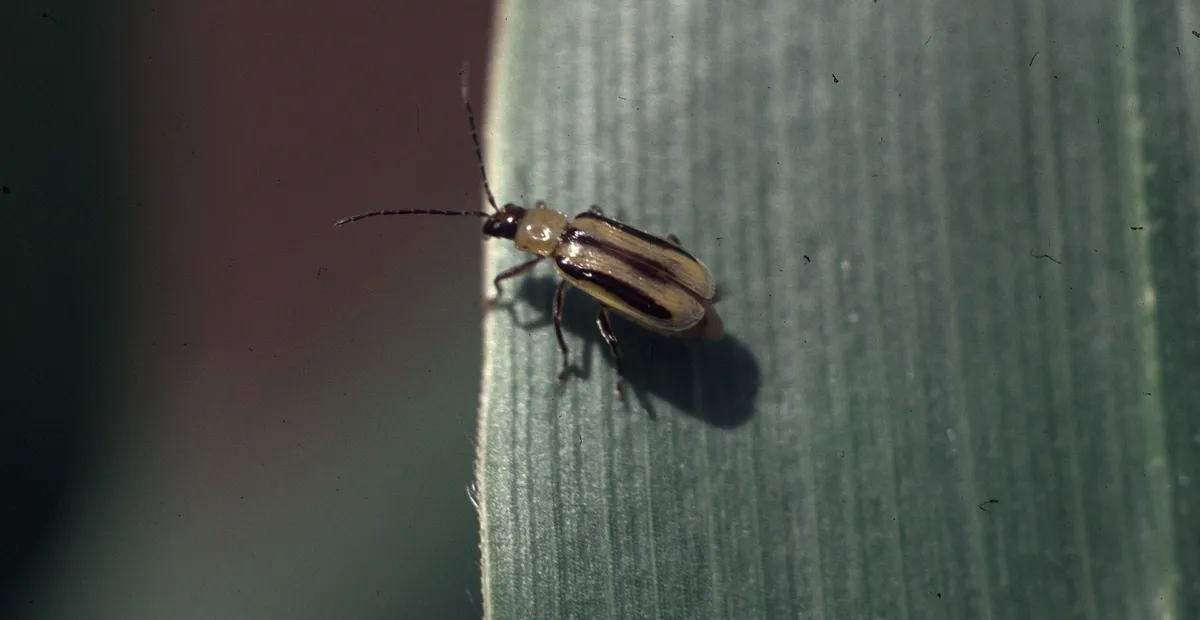
Adults are about 1/4 inch long and commonly yellow-green with darker markings on the wing covers. They are found on corn foliage, tassels and silks during summer. Adult feeding is usually less damaging than larval root feeding, although heavy silk feeding can interfere with pollination.
Identification should be confirmed when practical because several Diabrotica species and other causes of lodging or silk injury can look similar. Digging and washing roots, examining adults, and using local Extension scouting protocols improve diagnosis.
Symptoms and identification
Typical symptoms of larval feeding include:
- Shortened, brown or missing root tips and feeding scars on corn roots.
- Roots pruned back toward the stalk, sometimes with one or more complete root nodes destroyed.
- Plants that wilt more readily during hot, dry weather because the damaged root system cannot supply adequate water.
- Root lodging followed by curved, upright “goosenecked” stalks after wind or heavy rain.
- Reduced grain or silage yield and difficult harvest in severely affected fields.
Adults may leave linear feeding scars or small holes on leaves, feed on tassel pollen, and clip green silks. Extensive silk clipping during pollination can result in missing kernels, but this is generally less common than economically important root injury.
Causes and spread
Damage is caused by larvae hatching from eggs deposited in or near the soil. Females usually lay eggs in late summer, often several inches below the soil surface. The risk is highest where corn follows corn or where large numbers of adults were present during the previous summer.
Western corn rootworm has adapted to annual corn-soybean rotation in parts of Illinois, Iowa, Indiana, Michigan and Ohio. In these areas, soybean-associated or “rotation-resistant” populations may lay eggs in soybean fields, allowing larvae to attack corn planted there the next year. Local occurrence varies, so rotation should not be assumed to provide complete protection everywhere.
Adults can move between fields, and volunteer corn or weedy flowering plants may provide feeding sites. Cucurbit crops can attract adults and, if planted before corn, may increase the risk of egg deposition in some situations.
Life cycle and persistence
Western corn rootworm has one generation per year and undergoes complete metamorphosis: egg, larva, pupa and adult.
- Eggs overwinter in the soil and usually hatch from late spring into early summer, depending on temperature and location.
- Larvae pass through three instars and feed on corn roots for approximately four to six weeks.
- Larvae pupate in the soil near the host plant.
- Adults commonly emerge from late June through August, with timing varying by latitude and growing conditions.
- Adults feed, mate and begin laying eggs roughly two weeks after emergence. Most egg laying occurs during mid- to late summer, and the eggs remain dormant until the following season.
Treatment and control
Once extensive root pruning and lodging are visible, rescue options are limited because larvae are protected in the soil and much of the yield loss may already be determined. Remove or harvest lodged plants promptly when practical and document root injury to guide next-season decisions.
For the following crop, select measures based on confirmed field risk: crop rotation where effective, a locally appropriate rootworm-protection hybrid, or a legally labeled soil-applied treatment. In sweet corn, manage adult beetles only when scouting shows damaging silk clipping or substantial populations; treatment timing and harvest intervals are crop- and product-specific.
Do not treat solely because a few beetles are present. Follow state Extension thresholds, resistance-management recommendations and current product labels.
Low-impact and biological control
Nonchemical management is the foundation of control. Rotate out of corn where local populations have not adapted to rotation, remove volunteer corn, manage weeds, and use summer scouting to identify fields at risk. These measures reduce egg deposition and disrupt the rootworm life cycle.
Predators such as ground beetles, rove beetles, ants, spiders and centipedes attack soil-dwelling stages, while entomopathogenic fungi, nematodes and bacteria may contribute to natural suppression. Their effectiveness in a home garden or field is variable, so conserve beneficial habitat and avoid broad-spectrum sprays when they are unnecessary.
Hand removal of adult beetles from a small sweet-corn planting can reduce silk feeding, but it is labor intensive and will not reliably eliminate eggs already present in the soil.
Prevention
Use a field-specific IPM plan rather than automatic insecticide applications.
- Rotate corn with a nonhost crop when local western corn rootworm populations remain rotation-susceptible. Verify local risk because rotation-resistant variants occur in parts of the Corn Belt.
- Scout adults in corn and adjacent soybean fields during summer using locally recommended visual counts or yellow sticky traps. Adult abundance helps estimate risk for the following corn crop.
- Dig and wash roots in late June through July to verify larval injury and evaluate the performance of management tactics.
- Choose corn hybrids with appropriate, locally effective rootworm-protection traits only where their use is justified, and rotate or pyramid traits according to current resistance-management guidance.
- Control volunteer corn and manage weeds that provide additional feeding or pollen resources.
- Planting earlier or using an earlier-maturing hybrid may allow stronger root development before peak larval feeding and may reduce the period of silk exposure, but this is not a stand-alone control.
- Maintain balanced fertility, adequate moisture and good soil structure so plants can better tolerate root pruning.
Interesting facts
Western corn rootworm is often called the “billion-dollar pest” as part of the broader corn-rootworm complex because of crop losses and control costs.
Adult beetles are strongly associated with corn, but rotation-resistant populations can lay eggs outside cornfields, undermining a simple corn-soybean rotation. Adult counts in one season can therefore be useful for predicting rootworm risk in the next corn crop.
Root injury can make plants more vulnerable to drought and wind. The characteristic curved “gooseneck” appearance is a response of lodged plants attempting to resume upright growth, not a disease symptom by itself.
Use only insecticides, seed treatments, Bt traits or other products legally authorized for western corn rootworm on the specific crop in your state and country. Follow the current label exactly, including application timing, rate, personal protective equipment, pollinator precautions, reentry interval and preharvest interval. Do not rely repeatedly on the same mode of action; suspected control failures should be documented and reported to local Extension or agricultural authorities.