
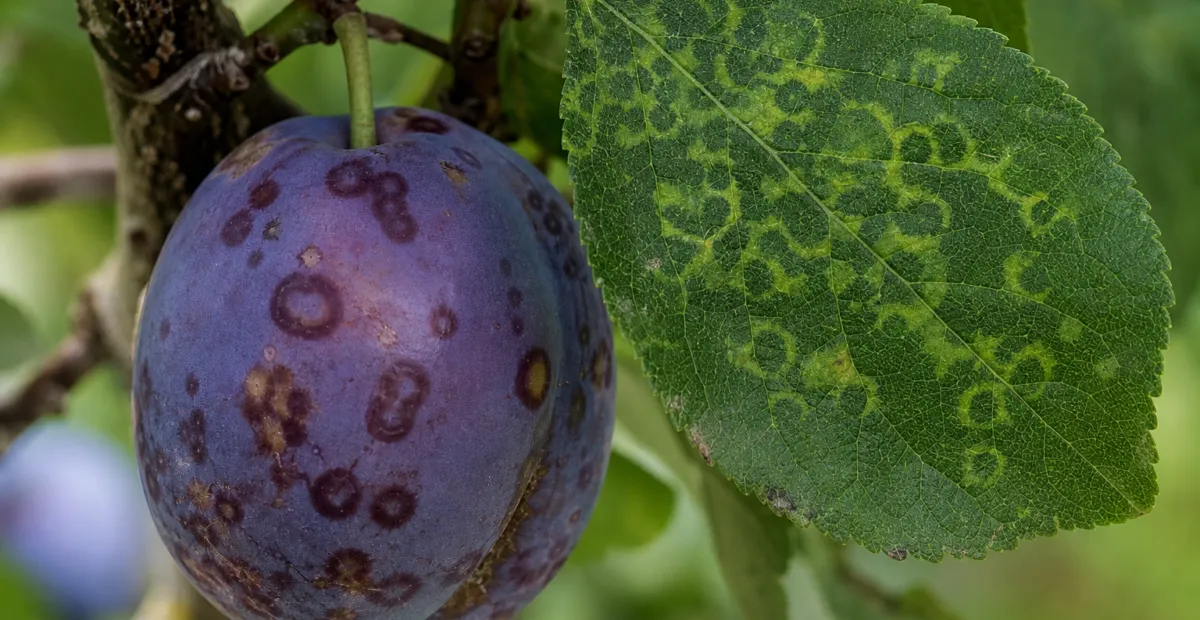
Plum pox (Sharka)
Plum pox virus (PPV), genus PotyvirusPlum pox (Sharka) overview
Plum pox, also called Sharka, is a serious viral disease of peaches, plums, apricots, nectarines, cherries, almonds and some ornamental Prunus. Infected trees may show pale rings or mottling on leaves, deformed or prematurely dropping fruit, and discolored flesh or pits. Symptoms can be mild, delayed or absent, so laboratory confirmation is essential. The disease is currently considered eradicated from the United States, but reintroduction remains a regulatory concern.
Typical conditions
Overview
Plum pox is caused by Plum pox virus, an RNA virus in the genus Potyvirus. It primarily affects trees in the genus Prunus, including peach, nectarine, plum, apricot, sweet cherry, tart cherry and almond, as well as some wild and ornamental relatives.
Symptoms and severity vary with the virus strain, host species, cultivar, season and tree age. Newly infected trees may show no visible symptoms, and visual diagnosis is not reliable. In the United States, suspected infections should be reported to the state department of agriculture or USDA plant-health authorities rather than managed as an ordinary backyard disease.
Symptoms and identification
Symptoms may occur on leaves, fruit, flowers and seeds, and can be unevenly distributed through the canopy.
- Peach and nectarine leaves may develop chlorotic spots, vein yellowing, pale rings, mottling or distortion.
- Plum leaves may show diffuse olive-green rings, bands or mottling.
- Apricot leaves may develop pale green rings and lines.
- Fruit may have yellow or brown rings, blotches, grooves, depressions, bumps, distortion or premature drop.
- Fruit flesh may be reddish-brown or otherwise discolored, and pits or seeds may show brown spotting or deformation.
- Some infected trees remain symptomless, particularly early in infection or under conditions unfavorable for symptom expression.
Similar symptoms can result from other viruses, herbicide injury, nutrient problems, insect feeding or environmental stress. Confirmation requires specialized laboratory testing, commonly molecular testing such as RT-PCR, often supported by serological assays.
Causes and spread
PPV is introduced and moved long distances mainly through infected vegetative propagation material, including nursery trees, rootstocks, budwood and grafting material. Shorter-distance spread within and between nearby trees occurs through aphids that acquire the virus during brief feeding probes and transmit it to another susceptible Prunus plant.
The green peach aphid, Myzus persicae, is an important vector, but several other aphid species may transmit PPV. Because transmission can occur rapidly and the virus is not dependent on prolonged aphid colonization, insecticide treatments alone are not a dependable eradication strategy. Grafting and budding are efficient means of transmission. Seeds and ordinary harvested fruit are not the principal regulated pathways under current U.S. APHIS guidance.
Life cycle and persistence
After entering a susceptible Prunus plant, PPV replicates in living cells and moves systemically through plant tissues. Virus concentration and symptom expression fluctuate with host, cultivar, strain, temperature, season and tree age. Infection can persist through winter dormancy and resume movement when the tree becomes physiologically active.
Aphids acquire virus from infected phloem-associated tissues during feeding and can transmit it during subsequent probes on healthy trees. Infected budwood or graft tissue establishes the virus directly in a new tree. Because latent infections are possible, several seasons of observation may not be sufficient without laboratory testing.
Treatment and control
There is no practical cure that removes PPV from an infected tree. Do not attempt to save a confirmed infected tree by pruning out symptomatic branches; systemic virus can occur beyond visibly affected tissue.
Confirmed trees and associated plant material may need to be removed and destroyed under instructions from state or federal plant-health authorities. Nearby Prunus plants may require official inspection and testing. Avoid transporting prunings, budwood, cuttings, nursery stock or grafting material from a suspect site.
Aphid control may reduce some secondary spread pressure but cannot be relied upon to eliminate PPV transmission. Eradication, certified propagation material, surveillance and regulatory controls are more important than routine pesticide use.
Low-impact and biological control
No organically approved product or home remedy is known to cure or eradicate PPV from an infected tree. Practical nonchemical measures are exclusion, sanitation, surveillance and official removal.
- Use certified virus-tested planting stock and avoid exchanging scionwood from private trees.
- Remove and destroy confirmed infected trees as directed by plant-health officials.
- Sanitize grafting and pruning equipment between trees, especially when handling propagation material.
- Monitor aphids and maintain orchard weeds and volunteer Prunus hosts so they do not create unmanaged reservoirs.
- Support beneficial insects and overall orchard biodiversity, while recognizing that biological aphid control does not replace PPV testing or eradication.
Prevention
Prevention is the primary management strategy because there is no curative treatment for an infected tree.
- Purchase nursery trees, rootstocks and budwood from reputable suppliers using certified virus-tested or pathogen-tested material.
- Do not bring unverified Prunus cuttings, scionwood or budwood into an orchard or home landscape.
- Inspect new trees and established stone-fruit plantings during active growth for characteristic rings, mottling and fruit deformation.
- Manage volunteer, abandoned or wild Prunus plants near production areas where they could serve as virus reservoirs, following local regulatory guidance.
- Use clean propagation tools and avoid grafting from trees of unknown health status.
- If symptoms are suspicious, mark the tree, avoid moving plant material, and contact the state department of agriculture or USDA APHIS/state plant health director for instructions.
In the United States, quarantine and eradication measures may apply to confirmed findings. Requirements can differ by state and may change with an official detection.
Interesting facts
- Plum pox is also known as Sharka, a name derived from a Slavic word associated with mottled or spotted symptoms.
- PPV is one of the most damaging viral diseases of stone fruit worldwide because fruit blemishes and distortion can make crops unmarketable even when trees survive.
- The United States detected PPV in North America in 1999 and declared the disease eradicated from the country in 2019 after coordinated surveys and removal programs.
- Host susceptibility is not uniform: virus strains and individual cultivars can differ greatly in symptom severity and detectable infection.
- Some wild and ornamental Prunus, including American plum, may be epidemiologically important because they can maintain infection and potentially support aphid transmission.
- Plum pox virus does not infect people or animals.
No pesticide cures plum pox virus. Use only products legally authorized for the specific crop, pest and use site in your country and state, and follow the current product label. Aphid insecticides are not a substitute for certified planting material, laboratory diagnosis, quarantine or removal of confirmed infected trees; consult state or federal plant-health authorities before treating or destroying a suspect tree.