
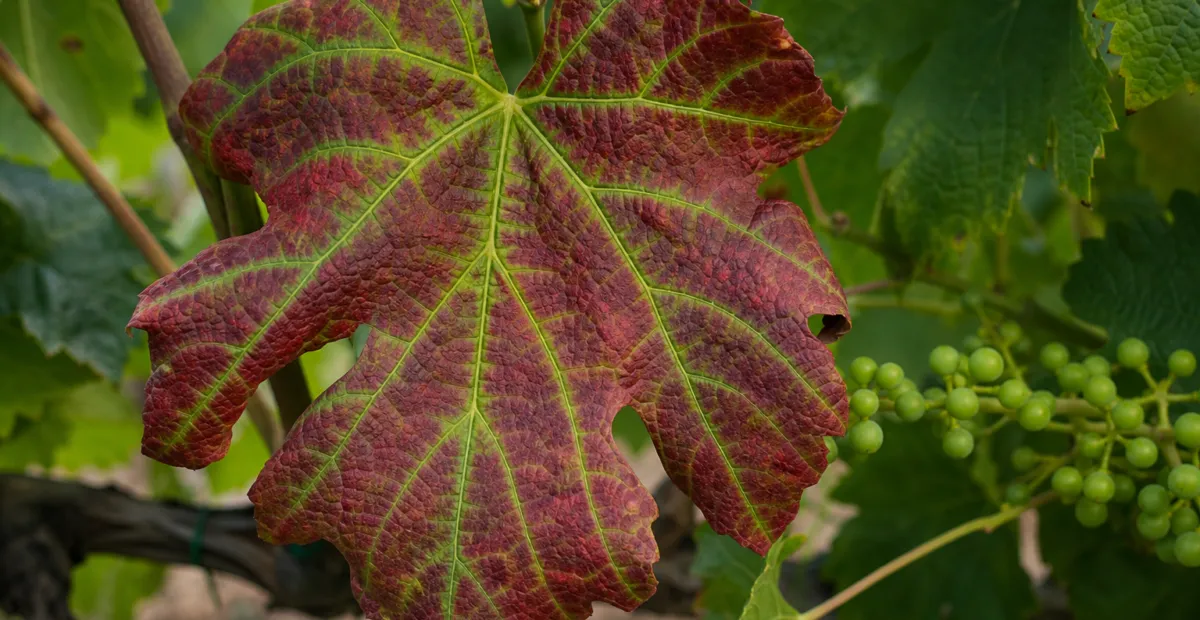
Grapevine leafroll disease associated with GLRaV-3
Ampelovirus trivitis (grapevine leafroll-associated virus 3; GLRaV-3)Grapevine leafroll disease associated with GLRaV-3 overview
Grapevine leafroll-associated virus 3 (GLRaV-3) is the principal virus associated with grapevine leafroll disease, a serious disorder of wine, table, raisin, and juice grapes. Infected vines may show downward-rolling leaves, red or yellow interveinal discoloration, delayed ripening, reduced sugar accumulation, lower yield, and poor fruit quality. Symptoms vary by cultivar and require laboratory confirmation.
Typical conditions
Overview
GLRaV-3 infects grapevines and is associated with grapevine leafroll disease in wine, table, raisin, and juice cultivars. Its impact depends on cultivar, virus variant, vine age, rootstock, climate, and coinfection. Red-fruited cultivars commonly develop red to reddish-purple areas between major veins, while white-fruited cultivars more often show yellow or pale-green interveinal tissue. Leaf margins typically roll downward.
Symptoms are not sufficiently specific for diagnosis. Grapevine red blotch-associated virus, nutrient imbalance, water stress, herbicide injury, and other leafroll-associated viruses can produce overlapping symptoms. Confirm infection with laboratory testing, preferably using properly timed petiole or cane samples collected according to the diagnostic laboratory’s instructions.
Symptoms and identification
Symptoms often become clearer from veraison through harvest and may intensify after harvest. Common signs include:
- Downward rolling or cupping of leaf margins, usually beginning on older basal leaves.
- Red, reddish-purple, or brown interveinal areas on red-fruited cultivars, with major veins often remaining green.
- Yellow or pale-green interveinal discoloration on white-fruited cultivars.
- Delayed bud break, reduced shoot growth, smaller vines, and uneven canopy development.
- Delayed fruit maturity, lower soluble solids, higher acidity, reduced berry color in some cultivars, reduced yield, and poorer wine or fruit quality.
- Leaves that remain attached unusually late or after frost.
Symptoms may be mild, absent, delayed, or atypical in some cultivars and GLRaV-3 variants. A symptomatic vine may be infected with more than one virus, so visual diagnosis alone is unreliable.
Causes and spread
GLRaV-3 is introduced primarily through infected propagation material, including cuttings, graftwood, grafted plants, and nursery stock. In vineyards it is transmitted by sap-feeding mealybugs and some soft scale insects in a semipersistent manner. Reported vectors include vine mealybug (Planococcus ficus), citrus mealybug (Planococcus citri), longtailed mealybug (Pseudococcus longispinus), grape mealybug (Pseudococcus maritimus), obscure mealybug (Pseudococcus viburni), and certain soft scales including grape scale (Pulvinaria vitis) and cottony maple scale (Neopulvinaria innumerabilis).
Small mealybug crawler and early immature stages can be especially important for acquisition and transmission. Ants may protect mealybugs from natural enemies and promote their movement within vines. Wind, equipment, and workers do not normally transmit the virus directly, but can contribute indirectly by moving infested plant material or vectors.
Life cycle and persistence
GLRaV-3 persists systemically in infected grapevines and can move into new propagation material. After a vector feeds on an infected vine, it may acquire virus particles and transmit them during subsequent feeding on a healthy vine. The virus is retained for a relatively short period and is generally lost after molting, so repeated movement and feeding by vectors are important to vineyard spread.
Newly infected vines may remain symptomless for part or all of the first season. Visible leafroll symptoms often develop during late summer, around veraison, or after harvest, and expression may vary substantially among cultivars. Virus concentration and detectability also vary with tissue and season; diagnostic laboratories commonly recommend postharvest petiole or dormant cane sampling.
Treatment and control
There is no proven field treatment that eliminates GLRaV-3 from an established infected grapevine. Pruning off symptomatic leaves or canes does not remove the systemic virus. Confirm suspected infection with a plant diagnostic laboratory before making expensive removal decisions, particularly because symptoms overlap with grapevine red blotch disease, other leafroll viruses, nutrient disorders, and environmental injury.
For individual infected vines, the practical management choices are usually continued monitoring when infection is uncertain or removal and replacement with tested material when infection is confirmed. In commercial blocks, map positive vines, prioritize removal where incidence is low, and combine removal with area-wide control of mealybug and soft-scale vectors to reduce secondary spread.
Low-impact and biological control
Organic and low-input management focuses on preventing new infections and reducing vector movement rather than curing infected vines. Use certified virus-tested planting material, remove confirmed infected vines, and physically eliminate heavily infested plant debris or vine sections where appropriate. Encourage natural enemies such as parasitoid wasps and predatory beetles by reducing broad-spectrum insecticide use and maintaining suitable habitat.
Control ants around trunks and trellises so they cannot protect mealybugs. Use monitoring, trunk and canopy inspection, targeted washing or physical removal of accessible colonies on small plantings, and sanitation of tools and propagation material. Biological control can suppress vectors but should not be treated as a guarantee against GLRaV-3 transmission because even low vector densities may spread the virus.
Prevention
Prevention is more reliable than attempting to cure an infected vine:
- Plant only certified or otherwise virus-tested nursery stock and graftwood from reputable suppliers.
- Do not propagate from vines with unexplained leafroll symptoms or from blocks of uncertain virus status.
- Inspect new plants, trunks, cordons, and root areas for mealybugs and scale insects before planting.
- Scout vineyards and home vines regularly, especially under bark, in leaf axils, and around fruit clusters.
- Manage ants because they can shelter and redistribute honeydew-producing mealybugs.
- Remove confirmed infected vines when incidence is low and replant with tested material. Remove the entire vine, including roots and graft union where practical, rather than repeatedly pruning symptomatic shoots.
- Coordinate vector management and infected-vine removal across neighboring vineyards when possible; isolated action may be less effective where nearby virus sources remain.
- Clean pruning and grafting tools between plants and avoid moving potentially infested cuttings, bins, or equipment.
Interesting facts
- GLRaV-3 is one of several viruses associated with grapevine leafroll disease, but it is generally regarded as the predominant and most economically important member of the complex.
- The virus has substantial genetic diversity, and some variants can produce weak or delayed foliar symptoms.
- Red- and white-fruited grape cultivars may show distinctly different leaf colors even when affected by the same virus.
- GLRaV-3 has been documented in cultivated and wild grapevine backgrounds within the genus Vitis, including American Vitis types and hybrids.
- Transmission can occur at vector densities that would not necessarily appear economically damaging based only on feeding injury.
- Recent U.S. reports include detections in several grape-growing regions, and a first report from Alabama was published in January 2026.
No pesticide cures GLRaV-3 or removes it from an infected vine. If insecticide treatment is considered for mealybugs, soft scales, or ants, use only products legally authorized and currently labeled for the crop, pest, and use site in the United States; follow the current label exactly, including personal protective equipment, application timing, reentry interval, and preharvest interval. Prefer monitoring-based, targeted integrated pest management and protect pollinators and natural enemies.