
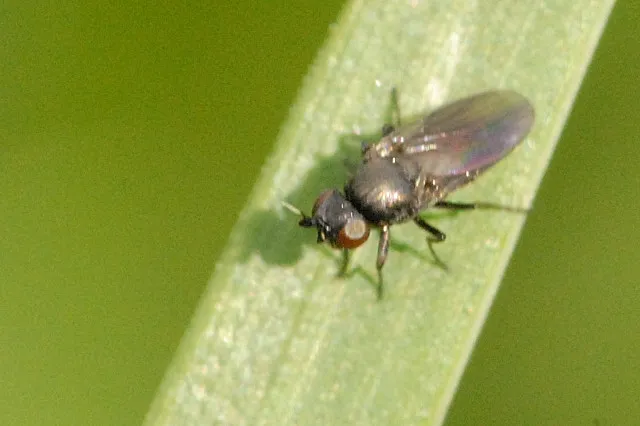
Frit Fly
Oscinella fritFrit Fly overview
Frit fly, Oscinella frit, is a small chloropid fly whose larvae tunnel into young grass and cereal shoots. Oats, wheat, barley, rye, corn, turfgrasses and several forage grasses may be affected, although susceptibility and economic importance vary by crop and region. Typical injury includes a dead central shoot, brown turf patches, weak establishment and occasional damage to developing cereal heads.
Typical conditions
Overview
Frit fly, also called European frit fly, is an internal-feeding pest of Poaceae rather than a plant disease. Adults are tiny, shiny black flies with small yellow markings on the legs. Larvae are legless, pale yellow to whitish maggots with dark mouth hooks and develop inside grass stems or young cereal shoots.
In the United States, the pest is documented but is not uniformly important in every region or crop. UC IPM describes injury especially on turfgrass, where bentgrasses and bluegrasses can be vulnerable. Cereal and forage-grass hosts are documented internationally and should be confirmed locally before assuming economic risk.
Symptoms and identification
- Young cereal plants may develop a yellowing or dead central shoot while outer leaves remain green.
- The affected central leaf or shoot may pull out easily, sometimes revealing a tunnel, feeding cavity or larva near the soil surface.
- In turf, upper portions of grass blades or tillers turn brown and die; injury may begin on collars or higher sections of golf greens and spread inward.
- Seedling stands can be thin or uneven, and damaged plants may produce weak or unproductive tillers.
- On oats and occasionally other cereals, larvae may attack developing heads or grains, but head injury is less consistently reported than shoot injury.
Distinguish frit fly from Hessian fly, seedcorn maggot, crane fly larvae and fungal seedling diseases by inspecting the basal shoot for a small chloropid larva or tunneling, rather than relying on foliar color alone.
Causes and spread
Damage is caused by larvae feeding inside young grass shoots, leaf sheaths, coleoptiles, stems or, in some cases, cereal heads. Adults lay eggs on suitable grass foliage or within leaf sheaths. Larvae can be carried into a new planting by infested volunteer grasses, pasture plants, turf or nearby unmanaged Poaceae.
Risk generally increases where susceptible grasses are continuous across turf, pasture and crop margins, where young plants coincide with adult flight and egg laying, or where dense, lush growth provides suitable oviposition sites. Species identification is important because other Oscinella flies can produce similar symptoms but differ in host preference.
Life cycle and persistence
Frit fly commonly overwinters as a larva inside a grass stem or shoot. Pupation occurs within the plant or nearby plant material, followed by adult emergence in spring. Adults lay small white, finely ridged eggs on leaves, leaf sheaths or young shoots. Larvae enter the plant and feed internally, often with several larvae in one plant. They later pupate, and multiple generations may occur during a season; UC IPM reports at least three broods in suitable areas, with late-season activity extending into October in warmer locations.
Timing varies substantially with latitude, temperature, host growth and local climate. Scout during periods of adult activity and during the early establishment of cereals, turf or forage grasses rather than applying a calendar treatment automatically.
Treatment and control
Confirm the pest before treating. Pull several symptomatic plants and split the basal shoot or examine it with a hand lens or dissecting microscope. Look for the small pale larva, feeding tunnel and characteristic dark mouth hooks. In turf, inspect the stem bases near the soil surface, especially at the advancing edge of brown injury.
Remove and dispose of badly infested seedlings or turf plugs where feasible, correct establishment or mowing problems, and reduce nearby volunteer grass hosts. Treatments are often unnecessary when injury is light or localized. For commercial crops, use scouting records, crop value, stand loss and locally validated thresholds rather than treating solely because adults are present.
Low-impact and biological control
Prioritize cultural and biological IPM. Remove severely infested shoots, mow or renovate badly affected small turf areas, eliminate volunteer grasses and improve stand vigor. Avoid unnecessary broad-spectrum sprays that can disrupt parasitoids and other natural enemies. Parasitic Hymenoptera have been recorded attacking frit fly, but biological-control effectiveness is variable and commercially available releases are not a standard treatment for home landscapes or field crops.
In organic production, rely on prevention, crop rotation where agronomically appropriate, weed and volunteer-grass management, timely establishment and repeated scouting. Any material used in certified organic production must also comply with the applicable organic standard and the product label.
Prevention
- Use clean, high-quality seed and establish a vigorous, uniform stand.
- Remove or manage volunteer cereals and heavily infested grass shoots near new plantings when practical.
- Control grassy weeds and avoid maintaining a continuous bridge of susceptible Poaceae between turf, pasture and cereal fields.
- Use locally adapted cultivars and planting dates recommended by the state Cooperative Extension service; avoid late or weak establishment when local monitoring indicates high frit fly pressure.
- Maintain balanced fertility, irrigation and mowing. Excessively lush growth can provide attractive oviposition sites, while drought-stressed plants may tolerate less injury.
- Inspect suspected plants at the soil line and record infestation levels before deciding whether intervention is justified.
Interesting facts
- The adult is only a few millimeters long, but its larva can kill the central shoot of a much larger grass plant.
- Frit fly is not the same as a fruit fly; it is a chloropid grass fly whose larvae live inside grasses.
- UC IPM reports that all turfgrass species may be susceptible, with bentgrass and bluegrass often showing greater injury.
- Host preference is not uniform: studies have found strong preference for oats and some ryegrasses or fescues, with comparatively little egg laying on certain other grasses.
- Several Oscinella species can look similar and cause related injury, so a reliable diagnosis may require larval or adult identification.
Chemical control is crop-, state- and label-specific, and larvae protected inside shoots may be difficult to reach. Use only a pesticide product legally authorized in the United States and registered for the specific crop, site and pest; follow the current label exactly, including rate, timing, preharvest interval, reentry interval, worker protection, pollinator and environmental precautions. Confirm current recommendations with your state Cooperative Extension service or state pesticide-regulatory agency. Do not use older literature recommendations or an off-label product program.