
 Source:
 Armenian Crane’s-bill (Geranium psilostemon) short overview
Geranium psilostemon, Armenian Crane's-bill, is a striking herbaceous perennial from northeastern Turkey and the western Transcaucasus. It forms a substantial mound of deeply divided green foliage and produces vivid magenta-crimson flowers with dark centers in early to midsummer. Grow it in sun or light partial shade, fertile well-drained soil, and consistent moisture. It is especially effective in perennial borders, cottage gardens, and pollinator-friendly plantings.
Taxonomic classification
Armenian Crane’s-bill (Geranium psilostemon) care guide
Light and placement
Grow in full sun for the strongest flowering, or in partial shade where summers are hot. An east- or west-facing border is suitable; in hot southern locations, afternoon shade can reduce stress. Too little light produces lanky stems and fewer flowers, while intense reflected heat combined with dry soil can scorch foliage.
Watering and humidity
Water deeply when the upper inch of soil begins to dry, keeping moisture reasonably even during active growth. Increase frequency during hot, dry spells and reduce it after dormancy begins, while never allowing containers to remain waterlogged. Good drainage is more important than unusually high humidity.
Soil and growing medium
Use fertile, humus-enriched soil that drains freely but does not dry rapidly. A loam-based bed is ideal. The plant tolerates mildly acidic to neutral conditions; avoid persistently waterlogged ground, especially in hot climates, where poor drainage can weaken the crown.
Feeding
Apply a balanced, slow-release perennial fertilizer or a thin layer of compost in spring as growth begins. Avoid heavy nitrogen feeding, which can produce excessive foliage and weaker stems. Do not fertilize drought-stressed, newly divided, or winter-dormant plants until active growth resumes.
Growth and habit
This vigorous clump-forming perennial expands from a crown and may arch outward as flowering stems lengthen. Provide room around neighboring plants and support only if stems flop in rich soil or exposed sites. Cutting back after flowering keeps the planting tidier and encourages fresh basal growth.
Planting and repotting
Plant nursery specimens in spring or early fall, setting the crown at the same depth as in its pot. Allow about 24–36 inches between plants so the clumps can broaden without immediate crowding. Water deeply during the establishment season and mulch lightly, keeping mulch away from the crown.
Container-grown plants can be shifted in spring or early fall when roots fill the pot. Use a quality potting mix amended for drainage, choose a container with generous drainage holes, and avoid excessive root disturbance. In containers, divide or refresh the plant when the crown becomes crowded.
Propagation and pruning
Propagation
Sow fresh seed in containers in fall or give stored seed a cool period before moving it to warmer conditions. Division is practical in spring or early fall for established clumps. Seedlings may vary somewhat in vigor and flowering performance.
Pruning
After the main flowering display, cut stems back to the basal foliage or near ground level if the plant becomes untidy. Remove damaged leaves during the season and clear dead material in late winter or early spring. Avoid repeated hard cutting during active flowering if seed production is desired.
Overwintering
Plants established in the ground generally overwinter outdoors in USDA Zones 5–8. Leave a light mulch over the crown in colder areas, but do not bury it deeply or keep it wet. Container plants have less root insulation and should be moved to a sheltered location or protected with additional insulation.
Uses
Use as a dramatic flowering perennial in mixed borders, cottage gardens, shrub underplantings, and large containers. Its vivid flowers and substantial foliage provide summer color and structure. It is also suitable for pollinator-oriented plantings where well-drained, moderately moist soil is available.
Appearance
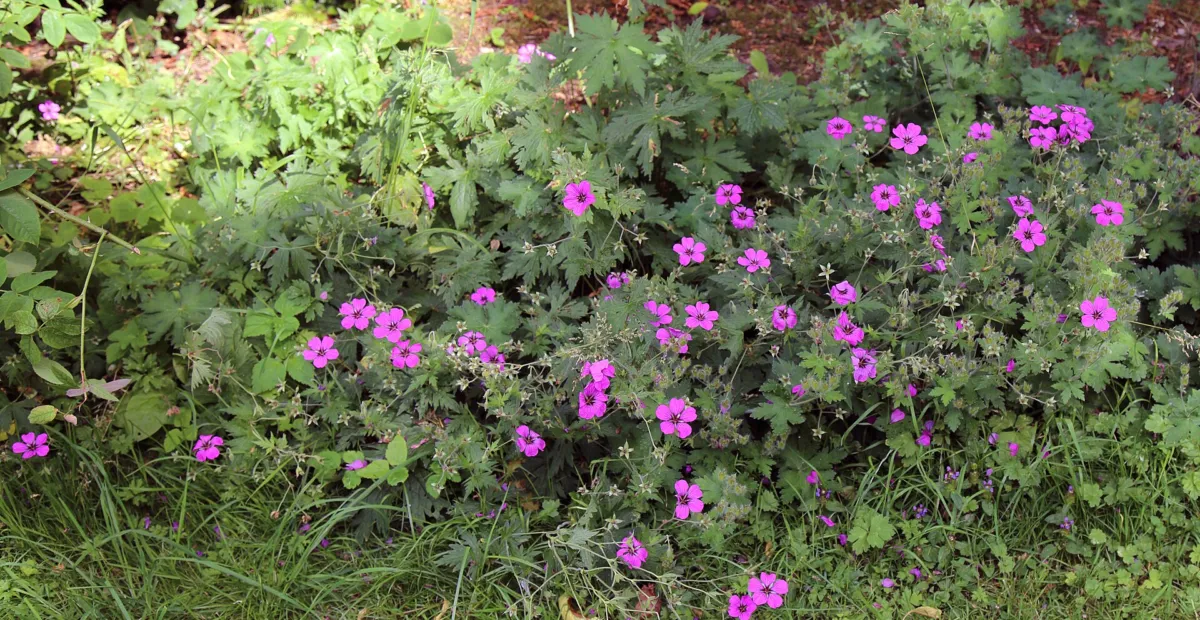
The plant forms a broad mound of large, opposite, palmately divided leaves with five to seven principal lobes and further toothed divisions. Upright to arching stems carry branched clusters of saturated magenta-crimson flowers, each with conspicuous dark veins and a near-black center. Autumn foliage may develop red tones.
Flowering
Flowers are produced in branched clusters above the foliage, generally from late spring into summer in temperate U.S. gardens. Each bloom has five vivid petals with dark veining and a strongly contrasting dark center. Cutting the plant back after the first flush can encourage fresh foliage and, in favorable conditions, additional flowering.
Pollination and visitors
The open, pollen- and nectar-bearing flowers are visited by bees, bumblebees, and hoverflies. The dark-centered blooms provide a strong visual target for insect visitors, although the species is not documented here with a single consistently reported pollinator species.
Geranium psilostemon photos
Click any photo for a larger view. Source, author and license are shown separately.
Diseases and pests
Diseases
Good drainage and air circulation help prevent crown and root problems. Watch for gray mold or leaf spotting during prolonged wet weather; remove affected foliage, water at the soil line, and avoid overhead irrigation. Discard severely rotted crowns rather than propagating from them.
Pests
Slugs and snails may damage young foliage, particularly in damp, shaded beds. Inspect new growth, reduce hiding places, and use proportionate controls where necessary. Vigorous plants are usually resilient to minor feeding damage.
Toxicity and pollen
No reliable species-specific evidence was found establishing significant toxicity to people or pets. As with many ornamental plants, sap or plant material may cause minor skin or stomach irritation in sensitive individuals if handled or eaten. Do not ingest unidentified plant material; supervise children and pets around garden plants.
- Typical season
- May–July
- Pollination / pollen
- Insect-dispersed pollen
This is an insect-pollinated flowering perennial, so its pollen is generally not released as a major airborne cloud. Nevertheless, sensitive people may react to pollen or plant contact, and individual allergy responses vary. Avoid handling flowering plants when symptoms are active and wash hands after garden work.
Native habitat
The species is native from northeastern Turkey through the Caucasus and western Transcaucasus. It occurs in temperate mountainous regions and is associated with open, seasonally moist habitats rather than permanently saturated soils. Garden performance is best where summers are not excessively hot and the soil remains evenly moist but well drained.
Interesting fact
The specific epithet psilostemon means “smooth-stamened.” The species is valued for unusually intense magenta-crimson flowers with dark centers. Its divided foliage can develop attractive reddish tones in autumn. It has received the Royal Horticultural Society’s Award of Garden Merit.
Frequently asked questions (FAQ)
The most relevant questions about this plant, with short and direct answers.
🌱Quick care
What is Armenian Crane's-bill?⌄
Armenian Crane's-bill is the hardy herbaceous perennial Geranium psilostemon, a clump-forming cranesbill known for magenta flowers with dark centers. It is not the tender bedding geraniums commonly sold as Pelargonium.
How big does Geranium psilostemon get?⌄
Geranium psilostemon typically grows about 2.5–4 feet tall and 3–4 feet wide. Its stems can become loose or arching, especially in rich soil or partial shade.
Is Geranium psilostemon perennial?⌄
Yes, Geranium psilostemon is a long-lived herbaceous perennial. Its foliage may die back or decline in winter, then return from the crown in spring.
What USDA hardiness zones are suitable for Armenian Crane's-bill?⌄
Armenian Crane's-bill is generally suitable for USDA Zones 5–7, with reported hardiness to approximately -20°F. Performance can vary with winter exposure, drainage, and local climate.
🌤️Environment and placement
Does Geranium psilostemon need full sun or shade?⌄
Geranium psilostemon grows best in full sun but tolerates partial shade. In hot summer climates, some afternoon shade can help reduce stress while maintaining good flowering.
Where should I plant Armenian Crane's-bill?⌄
Plant Armenian Crane's-bill in a sunny or lightly shaded perennial border where it has room to spread. It works well in cottage gardens, informal borders, mass plantings, and pollinator-friendly beds.
What soil does Geranium psilostemon prefer?⌄
Geranium psilostemon prefers fertile, moderately moist, well-drained loam. Improve poor soil with organic matter, but avoid sites that remain waterlogged in winter.
Can Armenian Crane's-bill grow in clay soil?⌄
Armenian Crane's-bill can grow in clay soil if it drains adequately and is amended with organic matter. Heavy, persistently wet clay can cause weak growth or crown problems.
How much water does Geranium psilostemon need?⌄
Provide moderate, consistent moisture, especially during the first growing season and during prolonged summer drought. Once established, it may tolerate short dry periods but performs best without severe water stress.
Can Geranium psilostemon tolerate hot and humid summers?⌄
Geranium psilostemon may struggle in hot, humid summers, particularly in climates warmer than USDA Zone 7. Good air circulation, afternoon shade, and evenly moist but well-drained soil improve its chances.
💧Care and problems
How do I care for Geranium psilostemon?⌄
Give Geranium psilostemon sun to partial shade, fertile well-drained soil, and moderate moisture. Remove tired foliage after flowering or in fall, and support stems if the plant becomes floppy.
Does Geranium psilostemon need staking?⌄
Staking is sometimes helpful because the tall flowering stems can lean or spread. Grow it in full sun and avoid excessive nitrogen to encourage a more compact habit.
Why is my Armenian Crane's-bill falling over?⌄
Armenian Crane's-bill may fall over because of partial shade, rich moist soil, wind, or naturally tall stems. Move divisions toward more sun, avoid excessive fertilizing, and use discreet plant supports when needed.
Should I fertilize Geranium psilostemon?⌄
Fertilize only if the soil is poor or growth is weak; a spring application of compost or a balanced slow-release fertilizer is usually sufficient. Excess fertilizer can produce leafy, floppy growth with fewer flowers.
What problems affect Geranium psilostemon?⌄
Geranium psilostemon is generally trouble-free and has no major routinely reported insect or disease problems. Powdery mildew can occur in dry conditions or where air circulation is poor.
Why is my Geranium psilostemon not blooming?⌄
The most common causes are insufficient light, excessive nitrogen, drought stress, or a plant that is still becoming established. Provide more sun, maintain moderate moisture, and avoid heavy feeding.
🪴Planting and repotting
When is the best time to plant Armenian Crane's-bill?⌄
Plant Armenian Crane's-bill in spring or early fall while temperatures are moderate. Spring planting gives roots a full season to establish before winter, while fall planting should be completed early enough for rooting.
How far apart should I plant Geranium psilostemon?⌄
Space Geranium psilostemon about 3–4 feet apart for individual plants to accommodate its mature spread. Closer spacing can be used for a quicker mass effect, but it may increase crowding and reduce air circulation.
Can Geranium psilostemon be grown in a container?⌄
Geranium psilostemon can be grown in a large container with fertile, well-drained potting mix and regular watering. Choose a heavy pot because mature plants are tall and broad, and protect container roots from severe winter cold.
Does Armenian Crane's-bill need winter protection?⌄
Established plants usually need little winter protection in suitable USDA Zones 5–7. A light mulch over the root zone can help in exposed sites, but avoid covering the crown with wet, compact material.
✂️Propagation and pruning
How do you propagate Geranium psilostemon?⌄
Propagate Geranium psilostemon by division or seed. Division is usually the simplest method for established clumps, while seed-grown plants may vary and can take longer to reach flowering size.
Can Armenian Crane's-bill be propagated by division?⌄
Yes, divide Armenian Crane's-bill clumps in spring as new growth begins. Replant vigorous sections with roots and growing points, then keep them evenly moist while they establish.
Can you grow Geranium psilostemon from seed?⌄
Yes, Geranium psilostemon can be grown from seed, although germination may be uneven and young plants take time to mature. Sow fresh seed in a protected setting and avoid burying it deeply.
When should I cut back Geranium psilostemon?⌄
Cut Geranium psilostemon back after its main flowering period, often in early to midsummer, if the foliage becomes untidy or the stems flop. Cutting it near ground level can encourage fresh foliage and sometimes additional flowers.
Should I deadhead Armenian Crane's-bill?⌄
Deadheading is optional but can improve appearance and reduce self-seeding. Remove spent flower stems after blooming, or cut the whole plant back if it has become tired or sprawling.
Does Geranium psilostemon self-seed?⌄
Geranium psilostemon can produce seed, but it is not generally regarded as an aggressively invasive garden perennial. Remove developing seed capsules if you want to limit volunteer seedlings.
⚠️Toxicity and safety
Is Geranium psilostemon toxic to dogs or cats?⌄
Species-specific toxicity information for Geranium psilostemon is limited, so it should be treated cautiously around pets. Do not rely on toxicity listings for Pelargonium, the tender bedding geranium, as proof of this species’ safety or toxicity.
Is Armenian Crane's-bill safe for people to handle?⌄
Armenian Crane's-bill is commonly handled as an ornamental garden perennial, but definitive species-specific human toxicity information is limited. Wear gloves if you have sensitive skin, and do not ingest any part of the plant.
🌸Flowering and special interest
When does Geranium psilostemon bloom?⌄
Geranium psilostemon usually blooms from late spring into summer, commonly from June through August depending on climate. Flowering may be shorter in hot conditions or longer when the plant is cut back after its first flush.
What color are Geranium psilostemon flowers?⌄
The flowers are vivid magenta to reddish-purple, typically with dark veins and a contrasting black or very dark central eye. Each flower is roughly 1¼–1½ inches across.
Does Armenian Crane's-bill attract pollinators?⌄
Yes, Armenian Crane's-bill attracts pollinating insects, including butterflies and bees. Its open, brightly colored flowers are especially useful in sunny perennial borders.
Does Geranium psilostemon have attractive foliage?⌄
Yes, its broad, deeply lobed foliage provides strong texture throughout the growing season and can turn red in fall. Young leaves may also show attractive pink or reddish tones.
Is Geranium psilostemon deer resistant?⌄
Geranium psilostemon is often considered relatively resistant to deer and rabbits, but no plant is completely browse-proof. Pressure can vary substantially with local wildlife populations and available food.
Similar plants
 Geranium ‘Cinereum’Geranium 'Cinereum'
 Cranesbill (Geranium ‘Johnson’s Blue’)Geranium 'Johnson's Blue'
 Geranium ‘Phaeum’Geranium 'Phaeum'
 Himalayan Crane’s-bill (Geranium himalayense) care guideGeranium himalayense
 Geranium ‘Summer Skies’Geranium 'Summer Skies'
 Geranium x magnificum (Geranium magnificum) care guideGeranium magnificum