
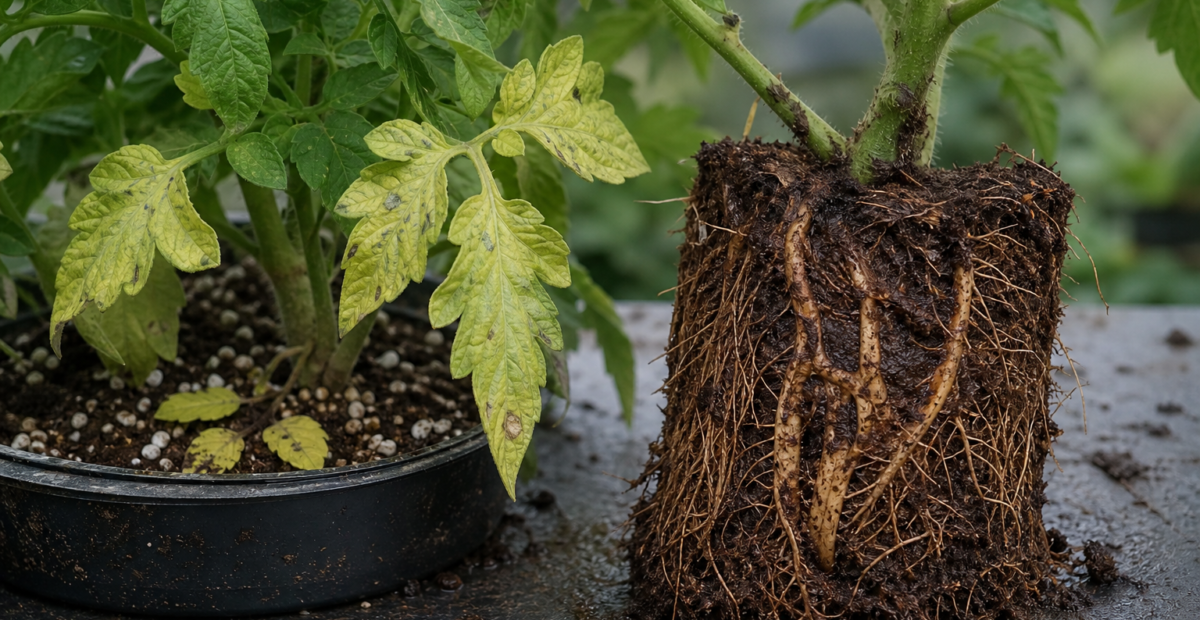
Nutrient Deficiency Caused by Root Damage
Nutrient Deficiency Caused by Root Damage overview
Root damage can make a plant look nutrient-starved even when the soil contains adequate nutrients. Injured, rotted, compacted, drought-stressed, or poorly distributed roots cannot absorb and transport water and minerals normally. Symptoms commonly include pale foliage, stunting, wilting, premature leaf loss, poor flowering or fruiting, and dieback. Diagnosis requires examining roots and, when possible, testing soil or plant tissue.
Typical conditions
Overview
Roots supply most of the water and mineral nutrients used by plants. When feeder roots are killed, severed, compacted, desiccated, flooded, burned by salts, or damaged by pathogens, nutrient uptake and transport decline. The foliage may then resemble nitrogen, potassium, magnesium, iron, or calcium deficiency even when those nutrients are present in the root zone.
This disorder is especially difficult to diagnose because root injury produces nonspecific symptoms. Affected plants may be scattered, confined to wet or compacted areas, or associated with recent transplanting, construction, digging, drought, overwatering, or root disease. Correct diagnosis depends on inspecting the root system and considering soil moisture, drainage, pH, salinity, pests, pathogens, and recent cultural practices.
Symptoms and identification
- Overall pale green or yellow foliage, often beginning on older leaves.
- Small leaves, short shoots, slow growth, weak stems, or reduced canopy density.
- Wilting during heat or midday despite moist soil, sometimes followed by leaf drop.
- Poor flowering, fruit set, berry or fruit size, runner production, or seed development.
- Premature senescence, marginal scorch, interveinal chlorosis, or tip dieback that can mimic a specific nutrient deficiency.
- Roots that are sparse, broken, girdled, darkened, soft, dry, or lacking healthy white or cream-colored feeder roots.
Symptoms are not diagnostic by themselves. Similar patterns can result from true soil nutrient deficiency, unsuitable pH, salinity, drought, overwatering, root pathogens, nematodes, insects, or herbicide injury.
Causes and spread
Common causes include transplant shock, digging or trenching through root zones, mechanical compaction, pot-bound roots, poor drainage, prolonged saturation, drought, excessive fertilizer salts, construction damage, girdling roots, and root-feeding pathogens or nematodes. Waterlogging reduces oxygen around roots and can cause root asphyxiation and decay. Root injury can also reduce the plant's ability to transport calcium and other relatively immobile nutrients.
This disorder does not spread as a single contagious condition. However, the underlying cause may affect neighboring plants when it is associated with shared saturated soil, contaminated irrigation water, a common compacted layer, soilborne pathogens, or plant-parasitic nematodes. Localized patches and repeated symptoms in the same bed indicate that the root-zone environment should be investigated.
Life cycle and persistence
There is no biological lifecycle for the disorder itself. Symptoms generally develop in stages: root injury first reduces water and nutrient uptake; above-ground growth then slows or becomes chlorotic; heat, drought, fruiting, or other demand can intensify wilting and deficiency-like symptoms; prolonged injury may lead to root loss, dieback, collapse, or death.
Recovery depends on the amount of living root tissue remaining and whether the cause is corrected. New root growth may gradually restore function, but severely decayed or structurally damaged root systems may not recover fully.
Treatment and control
- Inspect roots by carefully removing soil from a representative plant. Compare symptomatic and healthy plants when possible.
- Check drainage, irrigation frequency, soil compaction, pH, soluble salts, and recent fertilizer or construction activity.
- Correct the root-zone problem: improve drainage, stop chronic overwatering, irrigate droughted plants deeply and appropriately, remove competing or girdling roots where feasible, and avoid further root disturbance.
- Prune dead or severely damaged top growth selectively to reduce water demand, but do not remove large amounts of foliage from a stressed plant.
- After root function begins to recover, use a balanced fertilizer only if testing or a reliable crop diagnosis confirms a nutrient need. Avoid high-rate fertilizer applications to weak or damaged roots.
- Submit samples to a county Extension office, diagnostic laboratory, or qualified plant clinic when roots are rotted, nematodes are suspected, or symptoms persist.
Plants with extensive root loss, a girdled trunk or crown, severe root rot, or prolonged collapse may be uneconomical or unable to recover and should be replaced after the underlying cause is corrected.
Low-impact and biological control
Organic management focuses on restoring the root environment rather than supplying repeated foliar or soil fertilizers. Remove severely decayed roots during repotting when appropriate, discard contaminated potting media, and replant in clean, well-drained medium. Use mature compost only where it improves soil structure without creating a saturated root zone. Mulch can moderate moisture and temperature, but keep it away from crowns and stems. Encourage biological resilience with good drainage, sanitation, crop rotation where practical, and healthy plant material.
Biological products or microbial inoculants may have crop- and site-specific value, but they are not substitutes for correcting waterlogging, compaction, salinity, or physical root injury. Use them only according to a product label and local Extension guidance.
Prevention
- Plant in well-drained soil and avoid routine irrigation that leaves the root zone saturated.
- Improve structure with appropriate organic matter before planting, while avoiding heavy amendments that impede drainage.
- Protect established root zones from vehicle traffic, trenching, grade changes, and deep cultivation.
- Transplant with minimal root disturbance, keep roots evenly moist during establishment, and avoid burying the crown or stem.
- Use containers with adequate drainage holes and a porous, crop-appropriate potting medium; repot plants that are severely root-bound.
- Apply fertilizer according to a soil or plant-tissue test rather than treating yellow foliage automatically.
- Manage irrigation so that the root zone is thoroughly watered when needed and allowed to drain appropriately between waterings.
- Purchase healthy nursery stock and sanitize tools when root diseases are suspected.
Interesting facts
Root injury can create a “hidden deficiency”: a nutrient may be present in the soil but unavailable to the plant because damaged roots cannot absorb or transport it efficiently. Calcium deficiency-like symptoms are particularly associated with disrupted water movement because calcium depends strongly on transpiration and vascular transport.
Above-ground symptoms often appear after substantial root loss has already occurred. For that reason, examining roots is frequently more informative than applying fertilizer based only on leaf color.
Waterlogged soil can cause both direct oxygen starvation and secondary root decay. Plants growing in the same bed may show different severity because root depth, species tolerance, rootstock, and timing of injury vary.
Do not use a pesticide or fungicide solely because a plant shows deficiency-like symptoms. If a specific root pathogen, nematode, or insect is confirmed, use only products legally authorized for that crop and problem in the United States, and follow the current label exactly. Observe all restrictions on crop, site, rate, personal protective equipment, reentry, and preharvest interval. Cultural and diagnostic measures are usually more important than chemical treatment for this disorder.