
 Source:
 Ergot
Claviceps purpureaErgot overview
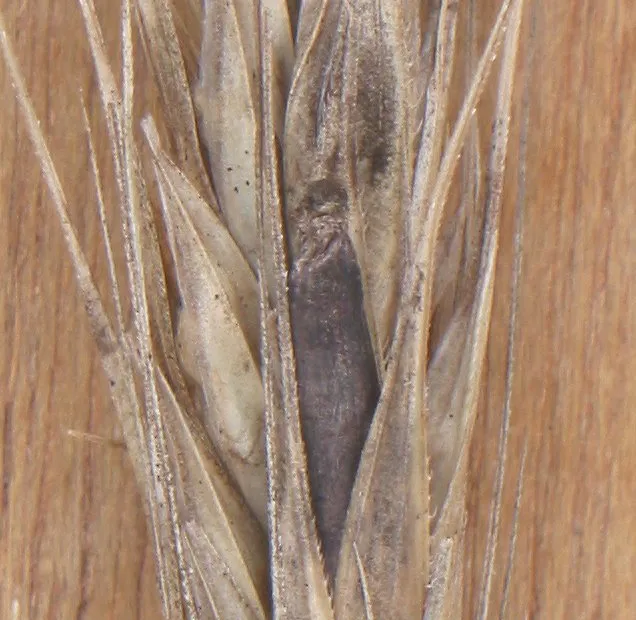
Ergot is a fungal disease of flowering grasses and cereal crops caused by Claviceps purpurea. The fungus replaces individual ovaries with elongated, hard purple-black sclerotia, often preceded by sticky honeydew on the seed head. Rye is the principal economic host, but wheat, barley, oats, perennial ryegrass, Kentucky bluegrass and other cool-season grasses may also be affected. The sclerotia can contain toxic ergot alkaloids.
Typical conditions
Overview
The disease is most important on rye, but it also occurs on wheat, barley, oats, triticale, perennial ryegrass, Kentucky bluegrass, fescues, bentgrasses and other cool-season grasses. Individual florets may first exude sticky, yellowish honeydew containing fungal spores. Later, the ovary is replaced by an elongated purple-black sclerotium that projects from the seed head.
In the United States, the greatest practical concerns are yield and seed-quality losses, contaminated grain or forage, and exposure of people or livestock to ergot alkaloids. The presence of an ergot-like body should be confirmed before assigning the species, because several Claviceps species affect different grass hosts.
Symptoms and identification
- Early infection produces glossy, sticky yellow or amber honeydew between the glumes of flowering grass florets.
- Honeydew may attract flies and other insects and can spread spores to nearby flowers.
- As the ovary is consumed, a firm, elongated, dark purple to nearly black sclerotium develops in place of the grain.
- Sclerotia are commonly larger and more conspicuous than normal seed; on rye they may project conspicuously from the ear.
- Leaves and stems usually remain apparently healthy because infection is concentrated in the ovary and developing seed.
Causes and spread
Claviceps purpurea survives primarily as sclerotia in or on soil and in contaminated harvested seed. In spring, overwintered sclerotia germinate and produce small stalked stromata that release airborne ascospores. These spores infect open or recently flowering florets.
After primary infection, the fungus produces honeydew containing conidia. Insects, rain splash, contact between heads and moving equipment can transfer conidia to additional flowers. Cool, wet weather during flowering increases risk by delaying or interfering with pollination and extending the period during which florets are susceptible. Wild and volunteer grasses near a crop can provide inoculum.
Life cycle and persistence
- Sclerotia remain dormant through winter in soil, crop residue or contaminated seed.
- A period of several weeks of cool temperatures, commonly about 32–50°F, followed by adequate moisture promotes germination.
- Stromata arise from sclerotia and produce sexual fruiting bodies containing asci and ascospores.
- Windborne ascospores reach flowering grass florets and infect the ovary.
- The infected ovary passes through a honeydew or sphacelial stage with abundant conidia.
- Fungal tissue replaces the ovary and hardens into a dark sclerotium, which is shed or harvested with seed.
Treatment and control
Once a sclerotium has formed, it cannot be cured within that floret. In home landscapes or small plantings, remove and bag infected seed heads before maturity and dispose of them without spreading the sclerotia. Mow susceptible grass areas before seed heads mature when this can be done without creating additional dispersal.
For field crops, prioritize sanitation, rotation, control of volunteer and wild grass hosts, timely harvest and postharvest seed cleaning. Where a crop is grown commercially for seed, consult local Extension recommendations because fungicide performance is generally limited by the narrow flowering infection window and products may not be registered for every crop or use.
Low-impact and biological control
- Use clean planting seed and physically remove contaminated seed lots.
- Mow or hand-remove flowering infected heads before sclerotia mature and fall to the soil.
- Control volunteer cereals and susceptible grass weeds along field edges, ditches and fence rows before flowering.
- Rotate out of susceptible cereal or grass seed crops and incorporate or otherwise manage fallen sclerotia where appropriate for the production system.
- Use mechanical cleaning and reject contaminated grain or forage rather than relying on home processing to make it safe.
No broadly reliable homeowner biological treatment should be assumed for established ergot infection.
Prevention
- Plant clean, tested or certified seed and avoid planting lots containing ergot sclerotia.
- Remove volunteer rye, weedy grasses and infected grass seed heads around production areas before they flower or shed inoculum.
- Use crop rotation and avoid repeatedly growing rye or susceptible grass seed crops in the same field.
- Improve stand uniformity and flowering synchrony where practical so florets are exposed for a shorter, less favorable infection window.
- Harvest promptly and clean grain or grass seed with equipment capable of separating larger, lighter or differently shaped sclerotia.
- Do not feed or mill visibly contaminated grain, hay or grass seed until it has been evaluated under applicable feed and food-safety procedures.
Interesting facts
- The disease name comes from the conspicuous sclerotium, traditionally called an ergot, which replaces a seed.
- Claviceps purpurea has a broad documented host range among cool-season grasses, with reports spanning hundreds of grass species, although host specialization and species identification can vary.
- Rye is the principal economic host, and rye ergots may reach roughly 0.4–2 inches long depending on the host and conditions.
- Ergot sclerotia can contain ergot alkaloids that are toxic to humans and livestock; contaminated grain, hay and pasture seed heads require food- and feed-safety attention.
- Not every dark structure on a grass head is necessarily C. purpurea; other Claviceps species and unrelated fungi can produce similar-looking symptoms on different grasses.
Do not apply a pesticide solely on the basis of a photograph or generic ergot advice. Use only products legally authorized and currently labeled for the specific crop, site and disease in the United States, and follow the current label, state requirements, preharvest intervals and grazing or feed restrictions. Because infection occurs during flowering and product efficacy varies, obtain crop-specific guidance from your state Extension service or a licensed crop adviser.