
 Source:
 American Grapevine Leafhopper
Scaphoideus titanusAmerican Grapevine Leafhopper overview
The American grapevine leafhopper, Scaphoideus titanus, is a specialized sap-feeding insect associated mainly with grapevines (Vitis). In the United States it is native and often occurs on wild grapes, while in Europe it is important because it transmits flavescence dorée phytoplasma. Feeding can cause leaf stippling and honeydew, but accurate identification and disease-risk assessment are essential before treatment.
Typical conditions
Overview
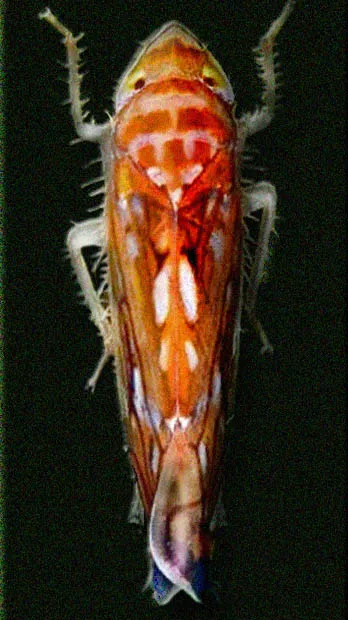
The American grapevine leafhopper is a small, wedge-shaped, brown to ocher leafhopper about 5–6 mm long as an adult. Nymphs are wingless or have developing wing pads, move sideways or backward when disturbed, and are commonly found on the undersides of basal grape leaves and near shoots or suckers.
It is primarily associated with grapevines in the genus Vitis. In the United States, documented preferred hosts include native grapes such as riverbank grape (Vitis riparia) and fox grape (Vitis labrusca); cultivated grape species and hybrids may also be used, but abundance and suitability vary. Records from non-grape plants should not automatically be interpreted as complete hosts capable of supporting the full life cycle.
Feeding removes phloem sap and can cause pale stippling, reduced leaf quality and honeydew deposits. The major plant-health concern is its ability to acquire and transmit flavescence dorée phytoplasma, a serious grapevine disease in affected regions. Presence of the insect alone does not prove that the phytoplasma is present.
Symptoms and identification
Low to moderate populations may cause fine pale stippling or scattered chlorotic feeding marks, especially on older or basal leaves. Heavy feeding can reduce photosynthetic area and may be accompanied by sticky honeydew, ants or dark sooty mold on leaf surfaces and fruit-supporting tissues.
Nymphs and adults may be visible on leaf undersides, shoots and suckers. The insect’s feeding injury is often subtle and can resemble damage from other grape leafhoppers, mites or environmental stress.
Symptoms of flavescence dorée are not symptoms of leafhopper feeding itself. In infected grapevines, possible disease signs include uneven shoot ripening, leaf discoloration or curling, poor fruit development and cluster decline. These symptoms are nonspecific and require laboratory confirmation and official diagnostic guidance.
Causes and spread
Populations increase when wild or abandoned Vitis, dense foliage and unsprayed vines provide continuous feeding and egg-laying sites. Adults can move between nearby vines, while infested nursery stock, cuttings or transported vine material can move eggs or insects to new locations.
Flavescence dorée spreads when a competent leafhopper acquires the phytoplasma from an infected grapevine and later feeds on a healthy vine. The disease is not caused by the leafhopper alone, and the vector cannot create flavescence dorée where the phytoplasma is absent.
Long-distance spread of the insect or pathogen is more likely through movement of infested plant material than through ordinary short-distance adult flight. Report unusual grapevine decline, suspected flavescence dorée or an unfamiliar leafhopper to the state department of agriculture or university diagnostic service.
Life cycle and persistence
Scaphoideus titanus normally has one generation per year. Females lay eggs from late summer into fall in cracks or crevices of grapevine bark, commonly on older shoots or canes. Eggs overwinter and hatch in spring, generally around grape bud break; the exact calendar varies with climate and vine phenology across the United States.
Nymphs pass through five immature stages. Early stages are small, wingless and pale, while later nymphs develop wing pads and stronger markings. They feed mainly on the undersides of young or basal leaves. Adults appear later in the season, mate and continue feeding until females deposit overwintering eggs.
A nymph or adult can acquire flavescence dorée phytoplasma while feeding on an infected grapevine. After an internal latency period, an infected adult can transmit the phytoplasma during later feeding for the remainder of its life. Transmission is therefore an epidemiological concern rather than an inevitable consequence of every bite.
Treatment and control
Confirm the insect before taking action. Collect a specimen or obtain clear photographs showing the head, wings and dorsal markings; several grape-associated leafhoppers look similar. For isolated vines, remove excess suckers and heavily infested lower foliage, then reassess the population with repeated inspections.
Where monitoring indicates damaging numbers, prioritize control of young nymphs because they are less mobile and more exposed than adults. Any insecticide decision should be based on the crop’s growth stage, local pest pressure, pollinator activity and the current grape label. Rotate insecticide modes of action when treatment is justified and avoid unnecessary broad-spectrum applications that disrupt natural enemies.
If flavescence dorée is suspected, do not rely on home treatment. Contact the state plant-health authority or an accredited diagnostic laboratory promptly. Confirmed cases may trigger mandatory surveys, vine removal, vector suppression or quarantine measures, depending on the jurisdiction.
Low-impact and biological control
Begin with monitoring rather than routine spraying. Inspect the undersides of basal leaves and suckers weekly during the growing season, use a sweep net or tapping method, and record nymphs separately from adults. A hand lens or clear close-up photographs can help distinguish this species from other leafhoppers.
- Remove or manage neglected grapevines and dense wild grape growth near valuable vines where permitted, while considering wildlife habitat and local conservation rules.
- Prune and dispose of dead or severely infested vine material during dormancy; do not move potentially infested cuttings or woody material between locations.
- Maintain open vine structure and remove excessive suckers so leaf undersides can be inspected and natural enemies can reach the crop.
- Conserve spiders, lacewings, minute pirate bugs, predatory bugs and parasitic insects by reducing broad-spectrum insecticide use and protecting flowering noncrop habitat.
- In small plantings, a strong water spray directed at leaf undersides may dislodge nymphs, although repeat applications are necessary and this will not address pathogen transmission risk.
Insecticidal soaps or horticultural oils may suppress exposed young stages when a product is labeled for grapes and the target pest, but coverage must reach the leaf undersides and applications can injure foliage under hot, dry or stressful conditions. These materials do not reliably control protected eggs or eliminate a phytoplasma already inside a vine.
Prevention
Buy grapevines and cuttings from reputable, inspected sources and avoid moving unverified grape material across state lines. Keep records of plant origins and inspect new vines before planting.
- Survey wild, abandoned and volunteer grapevines around vineyards or valuable home vines, especially in spring and summer.
- Monitor for nymphs soon after grape bud break, when young stages are easier to target than mobile adults.
- Remove severely declining or officially confirmed phytoplasma-infected vines only according to state or federal guidance; do not compost suspicious infected material.
- Prune during dormancy and dispose of infested cuttings responsibly rather than leaving them near vines.
- Use resistant or tolerant grape cultivars where appropriate for the site and production goal, recognizing that cultivar response to the insect and to phytoplasma disease are separate issues.
- Coordinate management with neighboring vineyards when a vector-borne disease is suspected, because untreated nearby vines can act as sources of both insects and inoculum.
Interesting facts
- The species is native to North America but became an important invasive disease vector after introduction into European vineyards.
- In its native range, wild American grapes can support larger populations than many cultivated grapevines.
- The species is specialized on grapevines for completion of its life cycle, although adults may occasionally be observed on other nearby plants.
- Leafhoppers use substrate-borne vibrational signals during courtship; this behavior has been investigated as a possible nonchemical management tool.
- Scaphoideus titanus should not be confused with other grape leafhoppers, which differ in appearance, seasonal biology and disease-vector importance.
Use insecticides only when monitoring shows a justified need and only if the product is currently labeled and legally authorized for grapevines and this pest in your state and country. Follow the current label exactly, including rate, timing, personal protective equipment, re-entry interval, preharvest interval, pollinator precautions and restrictions on repeated modes of action. Do not treat solely because a leafhopper is present; distinguish Scaphoideus titanus from other grape leafhoppers and follow any state or federal plant-health instructions where flavescence dorée is suspected.