
 AI-generated illustration
Ophrys speculum short overview
Ophrys speculum is a small Mediterranean terrestrial orchid best known for its extraordinary glossy blue flower lip, edged in yellow and fringed with reddish-brown hairs. This tuberous geophyte grows through the cool season, flowers mainly in March and April, then retreats underground for summer dormancy. Its flowers use visual and chemical mimicry to attract male Dasyscolia ciliata wasps, making it one of the most specialized examples of orchid pollination.
Taxonomic classification
Ophrys speculum care guide
Light and placement
Provide bright outdoor light, ideally full morning sun with some protection from intense late-afternoon heat in hot climates. A south- or east-facing position with excellent air circulation is suitable. Weak, elongated growth and poor flowering suggest insufficient light; bleached foliage, scorched leaves or rapidly drying containers indicate excessive heat or exposure. In the United States, use a bright, cool greenhouse or protected alpine-style container where summer heat is severe.
Watering and humidity
Water when the growing medium is approaching dryness but not completely desiccated during autumn, winter and spring growth. Wet the root zone thoroughly, then allow excess water to drain away. Reduce watering sharply after flowering as the leaves yellow and the plant enters summer dormancy; keep the dormant tuber nearly dry, with only occasional moisture if it shrivels severely. Good airflow is more important than high humidity.
Soil and growing medium
Use a sharply draining mineral substrate built from grit, pumice, coarse sand and a modest amount of low-organic loam or leaf mold. Calcareous, rocky soils suit the species in nature, while dense peat-rich mixes can retain too much moisture around the tubers. Containers must have generous drainage holes, and the medium should dry relatively quickly after irrigation without becoming hydrophobic.
Feeding
Feed sparingly while leaves and flower spikes are actively developing, using a dilute, balanced fertilizer no more than once every three to four weeks. Stop feeding after flowering as foliage begins to die back. Avoid heavy compost applications, strong fertilizer and high-nitrogen formulas, which can encourage soft growth and increase the risk of tuber or root problems in a wet medium.
Growth and habit
This perennial geophyte grows during the cooler part of the year and survives summer as an underground tuber. Leaves emerge in an autumn rosette, followed by a slender flowering stem; the plant naturally disappears after seed maturation and summer drying. Mark the container or planting spot during dormancy so the tuber is not disturbed or overwatered.
Planting and repotting
Plant dormant tubers in late summer or early fall, before the autumn rosette develops. Set them in gritty, alkaline-leaning soil with the crown covered by roughly 1–2 inches of medium. Choose a site that receives strong light in the cool season and dries naturally in summer. Do not plant where summer irrigation keeps the soil continuously moist.
Repot only during summer dormancy or just before autumn growth begins, using a fresh, sharply draining mineral mix. Handle the tuber carefully and replant at its previous depth. Choose a relatively deep container with excellent drainage, and avoid unnecessary root disturbance once the seasonal rosette has emerged.
Propagation and pruning
Propagation
Propagation is mainly by seed under sterile laboratory conditions with suitable orchid mycorrhizal support. Germination and subsequent acclimatization are difficult, so division of wild or established tubers is not a dependable routine method and should not be attempted on plants collected from nature.
Pruning
No routine pruning is needed. Allow the leaves and flower stem to yellow and dry naturally after flowering so resources can return to the tuber. Remove only fully dead material, using clean scissors, and avoid disturbing the plant during summer dormancy.
Overwintering
In much of the United States, overwinter the plant in a bright, cool, frost-protected greenhouse or cold frame. Keep the active-season medium lightly and evenly moist but never waterlogged. Protect dormant tubers from hard freezes and prolonged winter wet; in mild Mediterranean-like climates, outdoor culture is possible only in exceptionally well-drained sites.
Uses
Primarily a specialist botanical and ornamental plant for protected containers, cool greenhouses, alpine-style displays and educational collections. It is not a practical culinary or medicinal plant, and wild-collected specimens should be avoided because terrestrial orchids can depend on complex soil fungi and may be regulated by conservation laws.
Appearance
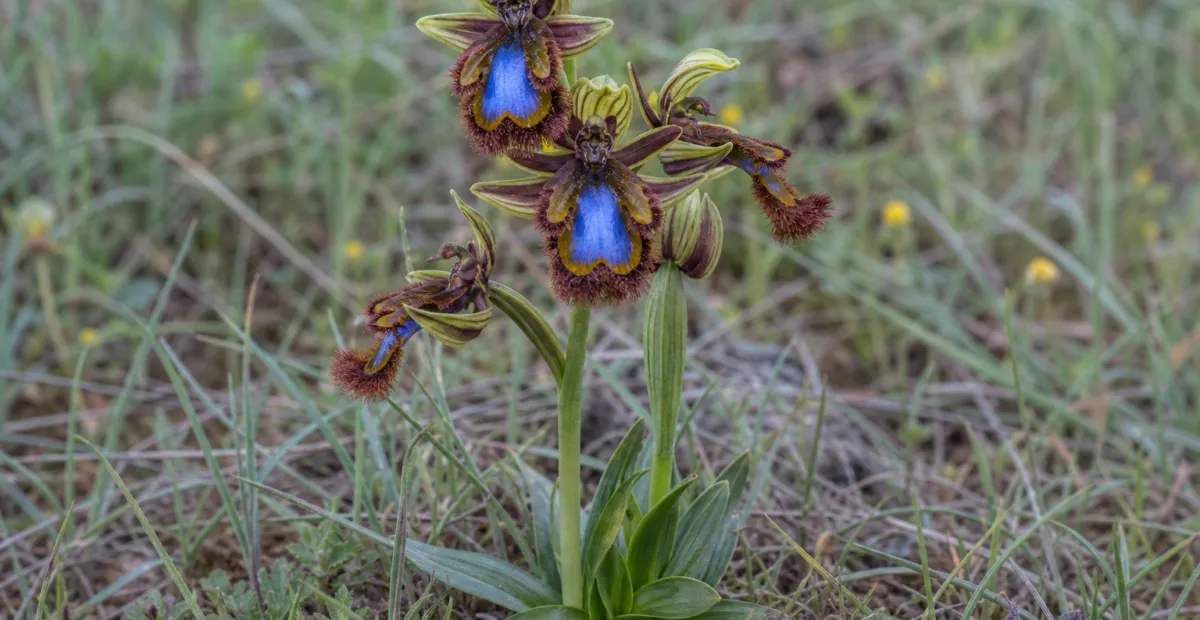
The plant forms a low basal rosette with narrow green leaves and a slender, leafy flowering stem. Flowers typically have pale green sepals marked with reddish stripes, much smaller dark brown petals that bend backward, and a distinctive three-lobed lip. The central lip is glossy mid-blue, yellow-edged and fringed with long red-brown hairs, creating the characteristic mirror-like appearance.
Flowering
Flowering stems commonly carry three to six flowers, although larger numbers are possible. The glossy blue lip is surrounded by a yellow margin and reddish-brown hairs, while the sepals are pale green with reddish markings. Flowering occurs before summer dormancy, and the species' floral scent and visual pattern contribute to its highly specialized reproductive strategy.
Pollination and visitors
The flowers are documented as being pollinated exclusively by male Dasyscolia ciliata wasps. The lip resembles aspects of the female wasp, and the floral odor mimics female sex pheromones. Males attempt mating behavior on the flower, during which pollinia can attach and later be transferred to another flower.
Ophrys speculum photos
Click any photo for a larger view. Source, author and license are shown separately.
Diseases and pests
Diseases
The principal risks are tuber and root rots caused by excessive moisture, poor drainage or stagnant air. Use sterile pots and fresh substrate, water only during active growth, and remove decayed tissue promptly if rot appears. Avoid overhead irrigation that keeps the crown and foliage wet for long periods.
Pests
Slugs and snails may damage emerging leaves and flower stems, while aphids or other sap-feeders can occasionally colonize tender growth. Inspect plants regularly, improve sanitation and airflow, and use physical slug barriers or locally approved controls when necessary. Avoid broad-spectrum insecticides during flowering because the species has a specialized wasp interaction.
Related diseases and pests
Only Plant Doctor profiles whose host data indicate this plant may be affected are shown here.
Toxicity and pollen
Reliable species-specific human and companion-animal toxicity information was not located in the reviewed authoritative sources. Do not eat the plant or use it medicinally. Keep tubers and planting material away from children and pets, label containers clearly, and seek professional advice if ingestion causes symptoms.
- Typical season
- Primarily during spring flowering, usually March–April in the native range
- Pollination / pollen
- Pollinia held in compact masses rather than freely airborne grains
Ophrys speculum produces orchid pollinia, compact pollen masses adapted for insect transfer rather than free release into the air. This suggests limited airborne dispersal compared with wind-pollinated plants, but species-specific clinical allergy evidence was not found. Sensitive people should still avoid rubbing flowers and wash hands after handling.
Native habitat
The species occurs in Mediterranean grassland, scrub, open woodland and rocky places, generally on dry to seasonally moist calcareous soils. It may grow from near sea level to approximately 3,900 feet in elevation. Its annual cycle follows Mediterranean seasonality: leafy growth in the cool, wetter period, spring flowering and summer dormancy underground.
Interesting fact
The Latin word speculum means mirror, referring to the reflective blue area of the lip. The plant is not a conventional bee-pollinated orchid: its documented pollinator is a male scoliid wasp. Kew describes the species as a tuberous geophyte that can reach about 10 inches in height. Laboratory propagation is possible, but acclimatizing plantlets after sterile culture is difficult.
Frequently asked questions (FAQ)
The most relevant questions about this plant, with short and direct answers.
🌱Quick care
What is Ophrys speculum?⌄
Ophrys speculum is a Mediterranean terrestrial orchid in the Orchidaceae family, recognized for its glossy blue, mirror-like lip and hairy reddish-brown edging. It grows from underground tubers rather than the thick aerial roots typical of many tropical orchids.
Is Ophrys speculum easy to grow?⌄
No, Ophrys speculum is generally a specialist orchid rather than an easy beginner plant. Its seasonal growth cycle, summer dormancy, precise drainage needs, and dependence on suitable soil fungi make long-term cultivation challenging.
How much light does Ophrys speculum need?⌄
Give Ophrys speculum full sun to light shade, with strong natural light during its cool-season growth. In hot climates, light afternoon shade can help prevent excessive heat stress while retaining good flowering conditions.
How often should I water Ophrys speculum?⌄
Water Ophrys speculum moderately while it is actively growing, keeping the gritty mix lightly and evenly moist but never soggy. Reduce watering as the foliage dies back and keep the plant nearly dry during summer dormancy.
Does Ophrys speculum need a dry dormancy?⌄
Yes, Ophrys speculum normally undergoes a dry summer dormancy after flowering and leaf dieback. Resume careful watering when new leaves appear in fall, rather than keeping the dormant tuber continuously wet.
🌤️Environment and placement
Where should I grow Ophrys speculum in the United States?⌄
In the United States, Ophrys speculum is best grown in a pot, cold greenhouse, alpine house, or protected Mediterranean-style garden rather than treated like a typical indoor orchid. Choose a location with bright light, excellent drainage, cool-season growth, and a reliably dry summer rest.
Can Ophrys speculum grow outdoors?⌄
Ophrys speculum can grow outdoors where winters are mild and the soil drains rapidly, but it needs protection from hard freezes and prolonged winter saturation. In colder USDA-style climates, container culture with seasonal shelter is safer.
What temperatures does Ophrys speculum prefer?⌄
Ophrys speculum prefers cool to mild conditions while producing leaves and flowers, followed by a warm, dry summer dormancy. Exact temperature limits are not well established for cultivated plants, so protect tubers from hard freezes and wet cold.
What soil is best for Ophrys speculum?⌄
Use a very well-drained, gritty, mineral-rich soil that is often calcareous or alkaline in character. A loam-based mix amended with fine bark and porous clay granules is one documented cultivation approach, provided it does not remain waterlogged.
Can Ophrys speculum grow in regular orchid bark?⌄
Regular chunky orchid bark alone is not ideal for Ophrys speculum because this terrestrial orchid needs a more mineral, soil-like, well-drained medium. Incorporate gritty loam or other mineral material, with only modest amounts of fine bark or organic matter.
💧Care and problems
Why is my Ophrys speculum dying back?⌄
Summer dieback is usually normal for Ophrys speculum because the plant retreats to an underground tuber during dormancy. Stop or sharply reduce watering once the leaves naturally yellow and wither, but investigate root or tuber rot if dieback occurs while the mix is wet.
How do I prevent root rot in Ophrys speculum?⌄
Prevent root and tuber rot by using a sharply draining mix, a pot with ample drainage, and a dry summer rest. Avoid standing water, frequent irrigation during dormancy, and heavy organic soil that stays wet around the tuber.
Should I fertilize Ophrys speculum?⌄
Fertilization should be minimal and conservative because Ophrys speculum is adapted to lean Mediterranean soils and has specialized relationships with soil fungi. If fertilizer is used at all, apply a very dilute formulation only during active growth and never to a dormant, stressed, or recently repotted plant.
🪴Planting and repotting
When should I repot Ophrys speculum?⌄
Repot Ophrys speculum during summer dormancy or just before new autumn growth begins, when handling the plant is least disruptive. Replant the tuber in fresh, gritty, well-drained medium and water cautiously after growth resumes.
How deep should I plant an Ophrys speculum tuber?⌄
Plant the tuber only deep enough to remain stable and covered by a shallow layer of gritty medium, avoiding excessive depth or compaction. A precise universal depth is not well established, so follow the supplier’s planting instructions when available.
✂️Propagation and pruning
How is Ophrys speculum propagated?⌄
Ophrys speculum is primarily propagated from seed through laboratory micropropagation because orchid seeds require specialized fungal or sterile culture conditions. Kew reports that transferring laboratory-grown plantlets to normal growing conditions can be difficult.
Can I divide Ophrys speculum?⌄
Division is generally unreliable because Ophrys speculum rarely multiplies vegetatively. Do not cut or split the underground tuber unless an experienced specialist has confirmed that the plant has suitable offsets.
⚠️Toxicity and safety
Is Ophrys speculum toxic to people or pets?⌄
The toxicity of Ophrys speculum has not been established, so treat it as unsuitable for consumption and keep it away from children and pets. Avoid using any part of the plant medicinally or as food without authoritative species-specific safety evidence.
Can I collect Ophrys speculum from the wild?⌄
Do not collect wild Ophrys speculum plants or tubers, because orchid collection can harm native populations and international trade may be regulated under CITES. Obtain cultivated material only from reputable, legally compliant sources and check current import requirements before ordering internationally.
🌸Flowering and special interest
When does Ophrys speculum bloom?⌄
Ophrys speculum usually flowers in March and April in its Mediterranean growth cycle, although cultivated plants may vary with climate and greenhouse conditions. The flower stem commonly carries several distinctive blue-lipped flowers.
What does an Ophrys speculum flower look like?⌄
The flower has pale green sepals, small dark brown petals, and a glossy mid-blue lip edged in yellow and fringed with shaggy red-brown hairs. The blue lip gives the species its mirror-like appearance and makes it one of the most distinctive Ophrys orchids.
Does Ophrys speculum need a specific pollinator to set seed?⌄
Yes, Ophrys speculum is reported to be pollinated exclusively by the wasp Dasyscolia ciliata in its native range. Because that wasp is not generally present in the United States, reliable seed production in cultivation should not be assumed.
Similar plants
 Yellow lantern chili (Capsicum chinense) care guideCapsicum chinense
 Capsicum baccatum care guideCapsicum baccatum
 Serrano (Capsicum annuum ‘Serrano’)Capsicum annuum 'Serrano'
 Purple Beauty (Capsicum annuum ‘Purple Beauty’)Capsicum annuum 'Purple Beauty'
 Numex Twilight (Capsicum annuum ‘Numex Twilight’)Capsicum annuum 'Numex Twilight'
 Explosive Ember Chili Pepper (Capsicum annuum ‘Explosive Ember’)Capsicum annuum 'Explosive Ember'