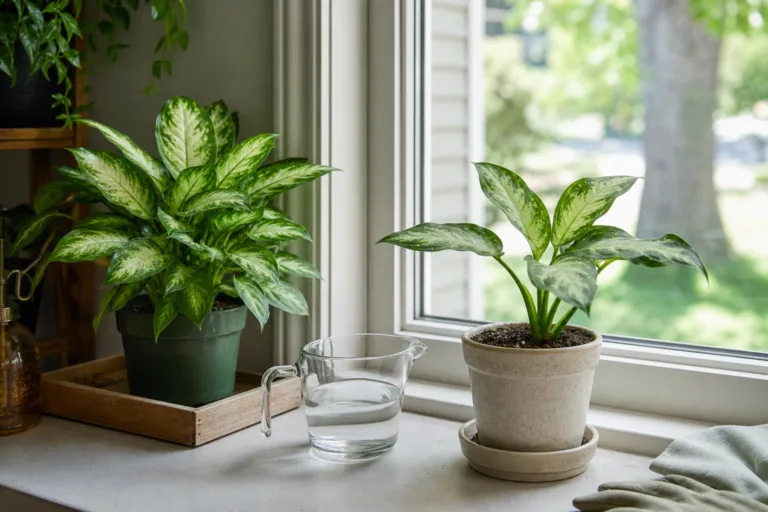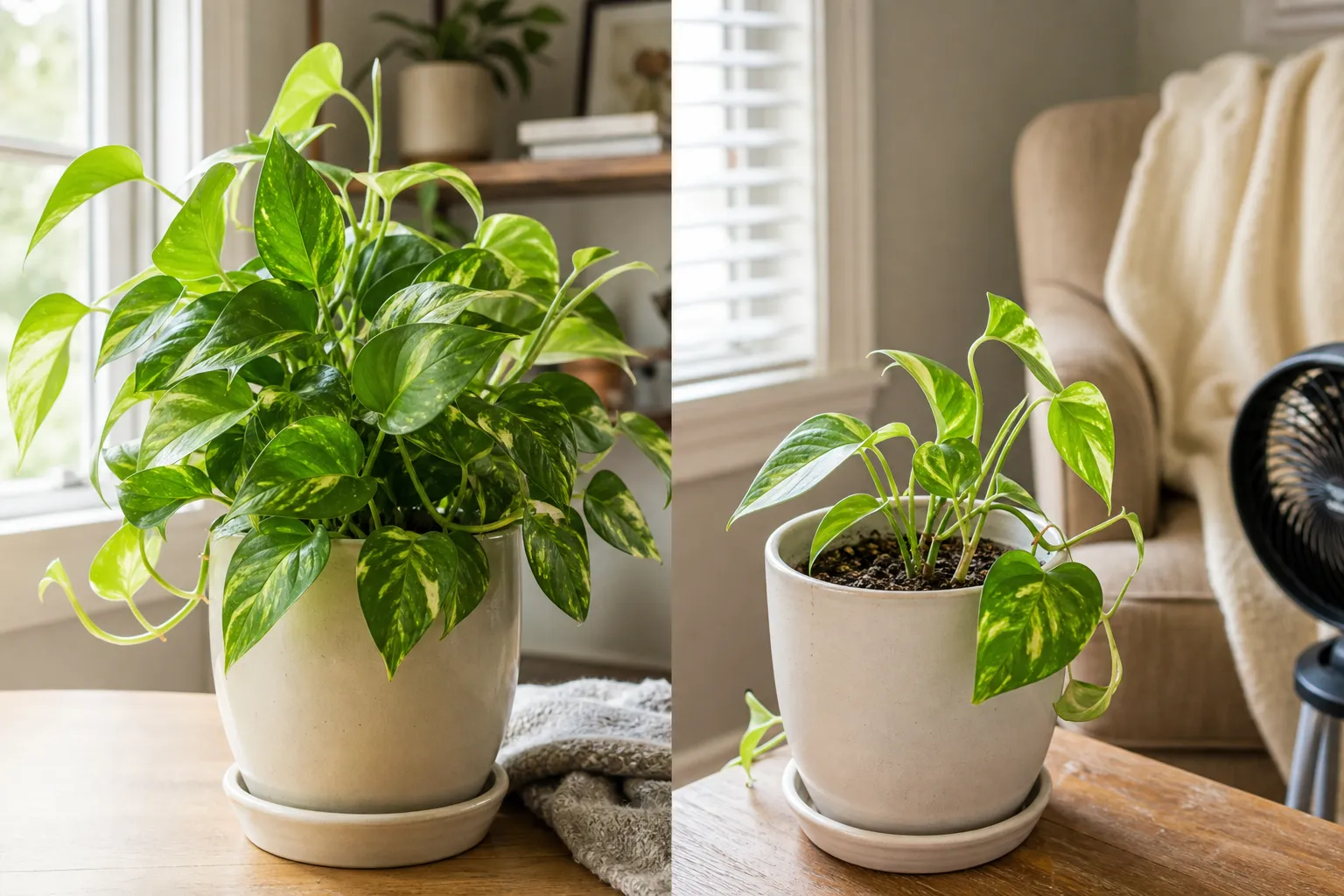
You place two pothos, snake plants or fiddle-leaf figs side by side. They came from the same store, went into matching pots and receive what seems to be the same care. Yet one grows quickly while the other sulks. One drinks its pot dry in days; the other stays damp. One develops large, glossy leaves while its “twin” produces smaller, paler growth.
This is not your imagination—and it does not necessarily mean you are a bad plant parent. Plants respond to the conditions they actually experience, not the conditions we think we have provided. A few inches of distance from a window, a different root system or a small pest population can change the entire picture.
The good news is that these differences offer useful clues. Once you learn to compare the plants rather than simply treating them identically, you can usually discover what each one needs.
“Same room” does not mean “same growing conditions”
Indoor spaces contain many small microclimates. A microclimate is simply a local pocket where light, temperature, airflow or moisture differs from the surrounding room.
Two plants on the same shelf may experience different conditions because one sits closer to the window, one is shaded by furniture, or one faces the glass while the other faces into the room. Even a small change in position can affect growth over several weeks.
Look for these hidden differences
- Light angle: Sunlight moves across the room during the day and changes with the season. A plant may receive a bright patch of morning light that its neighbor misses.
- Leaf shadow: A larger plant, curtain or nearby building can shade one pot for part of the day.
- Air movement: A heating vent, air-conditioning register, ceiling fan or frequently opened door can dry leaves and potting mix faster.
- Temperature: Glass can become hot in direct summer sun and chilly on winter nights. A plant against an exterior wall may also experience more temperature fluctuation.
- Water drainage: A pot with a partially blocked drainage hole can remain wet much longer than an identical pot.
- Potting mix: Two bags labeled for the same purpose may contain slightly different textures, and one plant may have a denser root ball that changes how water moves through the pot.
Try rotating the pots 180 degrees every week, but do not keep moving them from bright light to deep shade. The goal is to reveal uneven exposure gradually, not to create another source of stress.
The plants may not be genetically identical
“The same plant” can mean several different things. Two plants may share a common name but belong to different cultivars, or cultivated selections. They may have been grown from different cuttings, divisions or seeds. They may also have been raised in different nurseries before reaching your home.
Plants grown from seeds inherit a mixture of genes, so siblings can vary in height, leaf size, color and growth rate. Plants produced from cuttings or divisions are usually genetic clones of the parent plant, but even clones can develop differently because their starting tissues and growing histories are not identical.
Some variegated plants are especially variable. Variegation can be influenced by unstable mutations or by different types of tissue within the same plant. One cutting may retain a strong pattern while another produces mostly green leaves—or may gradually change over time.
A useful cultivar comparison
Consider two popular rubber plants. A standard Ficus elastica may produce broad green leaves and tolerate a range of indoor conditions. A variegated cultivar, such as ‘Tineke’ or ‘Ruby,’ generally needs brighter light to maintain its pattern and may grow more slowly. If you compare the two as though they were interchangeable, the variegated plant can appear “unhealthy” when it is simply following a different growth pattern.
The same principle applies to pothos. A mostly green cultivar, such as ‘Jade,’ often grows more vigorously in moderate indoor light than a highly variegated selection. A plant with less green tissue has less chlorophyll available for photosynthesis, so it may need brighter conditions to produce comparable growth. That does not make one plant better; it means the care target is different.
Before changing your routine, check the plant tag or nursery label for the exact cultivar name. A shared common name is not always enough.
Roots explain more than leaves do
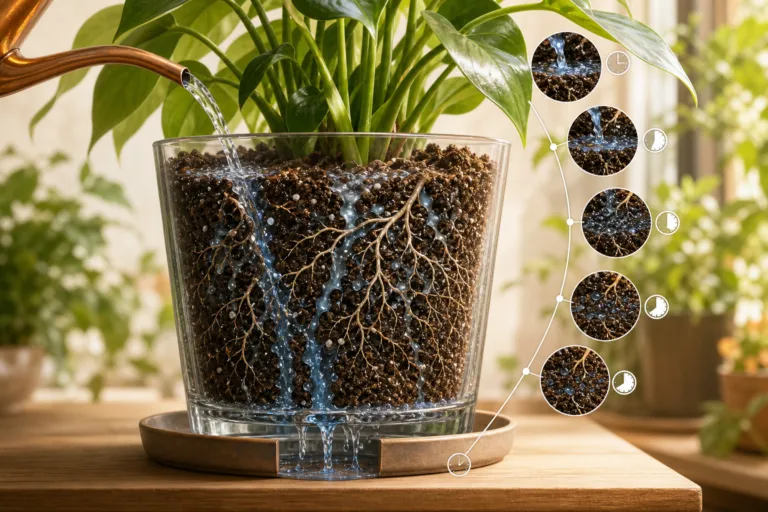
Healthy-looking foliage can hide very different root conditions. One plant may have filled its pot with active roots, while the other may still have a small root system. The larger-rooted plant can use water quickly and may need more frequent watering. The smaller-rooted plant may remain wet for days.
Rootbound plants can also behave unpredictably. A dense root ball may cause water to run down the sides of the pot instead of soaking evenly into the mix. In contrast, a recently repotted plant may sit in a large volume of damp soil that its roots cannot yet use.
Check the pot, not just the calendar
- Confirm that each pot has an open drainage hole.
- Lift the pots and compare their weight immediately after watering and again several days later.
- Push a finger about 1 inch into the potting mix, or use a wooden chopstick to check deeper moisture.
- Look through the drainage hole for circling roots, but do not pull apart the root ball unnecessarily.
- Notice whether water drains freely or pools on the surface.
Most houseplants prefer steady moisture rather than a cycle of constant saturation followed by severe drying. However, “steady moisture” does not mean watering every plant on the same day. A plant in brighter light, a warmer spot or a larger root system may use water at a different rate from its neighbor.
Measure your watering instead of guessing
A simple home experiment can make watering differences visible. Choose two plants that appear similar and measure both the amount of water you give them and the time it takes the pots to dry to your chosen threshold.
A two-week watering test
- Label the pots Plant A and Plant B. Record their pot diameter, plant size, window direction and exact location.
- Weigh each dry pot Use a kitchen scale if the pots are small enough. Record the weight in ounces. If a scale is impractical, lift each pot and describe its weight as light, medium or heavy.
- Check the soil When the top 1 inch feels dry, record the date and soil condition.
- Water consistently Give each plant enough water to moisten the root ball and allow a small amount to drain from the bottom. For a 6-inch pot, you might begin with 12 fluid ounces, then adjust based on drainage and soil dryness—not as a universal rule.
- Measure runoff Place a measuring cup beneath the drainage hole. If you apply 12 fluid ounces and collect 2 fluid ounces, the pot retained roughly 10 fluid ounces at that watering.
- Repeat the check Test the pots every day or two. Record how many days pass before each plant again reaches the “top 1 inch dry” point.
Imagine your notes show that Plant A needs watering after 5 days, while Plant B takes 9 days. That difference is valuable information. It may reflect stronger light, more roots, warmer airflow or a different potting mix. It also tells you why a fixed “water every Sunday” routine may work for one plant and fail for the other.
Do not force both plants to receive the same volume simply to keep the experiment fair. The fair comparison is to give each plant what its soil and roots indicate it needs, then track the result.
Light is often the biggest difference
Plants use light as their energy source, so even a modest difference can affect leaf size, color and growth speed. A plant near an unobstructed east- or south-facing window may receive much more usable light than one just a foot or two farther away.
Bright light does not always mean harsh direct sun. Many foliage plants prefer bright, indirect light, especially when strong sunlight passes through glass in summer. A plant that receives too little light may stretch toward the window, produce wider gaps between leaves or grow slowly. Too much intense sun can lead to bleached or crispy patches on sensitive foliage.
Compare the plants at three times of day
Stand where the plants are located and observe the shadows in the morning, around midday and in the afternoon. Note whether each plant receives a sharply defined beam of sun, bright light without direct rays or dull shade.
If one plant clearly receives less light, move it in small steps over several days. Sudden changes—from a dim corner to intense sun—can scorch leaves. If natural light remains weak, a full-spectrum LED grow light with a timer can provide a more consistent option. Follow the fixture’s distance recommendations, because light intensity falls quickly as the bulb moves farther away.
Temperature, humidity and airflow add another layer
Indoor plants lose water through tiny openings in their leaves. This process, called transpiration, helps move water through the plant but can increase when the air is warm, dry or moving quickly.
That is why a plant near a furnace register may wilt or dry out faster than one across the room. Winter heating can lower indoor humidity, while summer air-conditioning creates cool, dry airflow. Tropical plants often show the difference first through brown edges, curling leaves or slower expansion of new foliage.
Humidity is worth monitoring, but you do not need to chase a perfect number for every plant. A small hygrometer can tell you whether the air is consistently very dry. Grouping plants, using a room humidifier and keeping plants away from direct vents can help. Pebble trays and occasional misting may have limited or short-lived effects, so prioritize better light, appropriate watering and stable temperatures.
One plant may have pests or past damage
A plant that struggles alone may be carrying a problem its neighbor does not have. Spider mites, thrips, scale and mealybugs can arrive on a single plant or develop more quickly on a stressed specimen.
Inspect both plants closely, especially on the undersides of leaves and around new growth. Look for fine webbing, stippling, silvery scars, sticky residue, cottony clusters or small moving insects. Yellow leaves by themselves do not prove a pest problem; aging leaves, overwatering, low light and root stress can look similar.
If you find suspicious signs
- Move the affected plant away from other plants while you inspect it.
- Check neighboring plants every few days.
- Remove badly damaged leaves with clean scissors if appropriate for the plant.
- Use only products labeled for indoor plants and follow the label exactly.
- Avoid treating a plant “just in case,” especially when the symptoms do not clearly indicate pests.
Plants under stress from poor light, overly wet soil or unsuitable temperatures can also become less resilient. Correcting the growing conditions is often as important as addressing the visible symptom.
Try a fair side-by-side experiment
If you want to discover the main cause, change one factor at a time. Put both plants on the same table for two weeks, but keep their pots separate and continue checking each individually. Measure light with a phone app only as a rough comparison, since readings vary by device; use it to compare positions rather than to chase an exact number.
Next, standardize the pots and potting mix only if repotting is genuinely needed. Repotting healthy plants can create unnecessary stress and may erase useful clues. Instead, begin with simple observations: pot weight, soil moisture, new leaf size and the position of the newest growth.
Take one photograph from the same angle every week. A visual record often reveals gradual changes that are hard to notice day by day.
What to do when the difference is real
Once you identify the likely cause, give each plant individualized care. “Identical treatment” is not the same as fair treatment in gardening. Fair treatment means matching care to the plant’s light, roots, cultivar and current moisture level.
- If one plant dries much faster, check its light, airflow and root density before simply watering more often.
- If one stretches, increase light gradually rather than adding fertilizer first.
- If one stays wet, inspect drainage and consider whether the pot is too large for its root system.
- If variegation fades, provide brighter indirect light and check whether the plant is reverting to greener growth.
- If only one plant shows leaf damage, inspect it for pests and physical injury before changing the whole room.
The reassuring conclusion
Two plants can share a room without sharing the same experience. Small differences in light, roots, airflow, temperature, moisture and genetics can produce dramatically different results—and those differences are normal enough to expect.
Start with observation rather than blame. Weigh the pots, check the soil, compare light at different times of day and inspect the roots and leaves carefully. Keep simple notes for two weeks, change one variable at a time and let the plants show you what is happening.
With practice, you will stop asking why one plant refuses to behave like the other. You will begin asking the more useful question: What is this particular plant telling me?