
 Source:
 Plains coreopsis (Coreopsis tinctoria) short overview
Plains coreopsis is a cheerful annual wildflower native to much of North America, valued for its airy foliage and yellow, red-marked flower heads. It grows quickly in full sun and handles heat, drought, poor soil, and dry conditions better than many garden annuals. Use it in meadow plantings, borders, containers, or pollinator gardens, and expect flowering from early summer into fall when spent blooms are removed.
Taxonomic classification
Plains coreopsis (Coreopsis tinctoria) care guide
Light and placement
Give full sun, ideally 6 or more hours of direct light with open southern or western exposure. Morning sun with afternoon sun is suitable, but deep shade produces weak, stretched stems and fewer flower heads. In very hot regions, some late-afternoon protection can reduce wilting, though insufficient light may reduce flowering.
Watering and humidity
Water after sowing and during establishment whenever the top inch of soil begins to dry. Once established, allow the soil to dry somewhat between thorough waterings; this species prefers an even but not constantly wet root zone. Increase watering during prolonged heat, container culture, or drought, and reduce it in cool weather and after flowering.
Soil and growing medium
Use a loose, well-drained soil, especially sandy, gravelly, or moderately loamy ground. Plains coreopsis tolerates clay and poor fertility, but waterlogged soil can weaken roots. A slightly acidic to slightly alkaline reaction is suitable; documented tolerance is approximately pH 5.2–7.8.
Feeding
Fertilizer is usually unnecessary in average soil. Excess nitrogen can produce floppy foliage and fewer flowers. If the planting site is extremely poor, incorporate a modest amount of finished compost before sowing or use a dilute, balanced fertilizer once during early growth. Do not repeatedly feed drought-stressed plants.
Growth and habit
This quick-growing annual forms upright, branching stems and may become somewhat open or top-heavy in rich soil or exposed sites. Lean soil usually produces sturdier, more floriferous growth. Deadheading extends the display, while leaving some heads intact supports self-seeding and late-season seed value.
Planting and repotting
Sow outdoors after the danger of hard frost has passed, or start seed indoors about 6–8 weeks before the expected last spring frost. Cover seed lightly, since strong light can help germination. Thin or set plants about 12–18 inches apart for good air movement and branching.
Usually grown as a seasonal annual and not worth overwintering in containers. If transplanting young plants, move them before they become root-bound and disturb the root ball as little as possible.
Propagation and pruning
Propagation
Propagate from seed. Direct-sow after the last spring frost or sow in late summer or fall where natural overwintering and spring germination are suitable. Seedlings transplant best while young. The plant can self-seed freely in favorable sites.
Pruning
Deadhead regularly to encourage continued flowering and reduce unwanted self-seeding. At the end of the season, cut back spent stems after seed collection or leave some standing for birds and winter structure. Remove diseased material promptly.
Overwintering
The species is normally grown as an annual. In mild climates it may overwinter as a small rosette or return from dropped seed, while in colder areas the foliage is killed by frost. Leave selected seed heads in place for natural reseeding, then clear excess debris in late winter if needed.
Uses
Useful in annual borders, cottage gardens, naturalized plantings, prairie and meadow gardens, roadside-style landscapes, pollinator plantings, and informal cut-flower beds. It can perform well in poor or dry soils. Seeds may benefit birds, while flowers provide documented resources for a broad range of insect visitors. Do not treat it as an established medicinal or edible crop.
Appearance
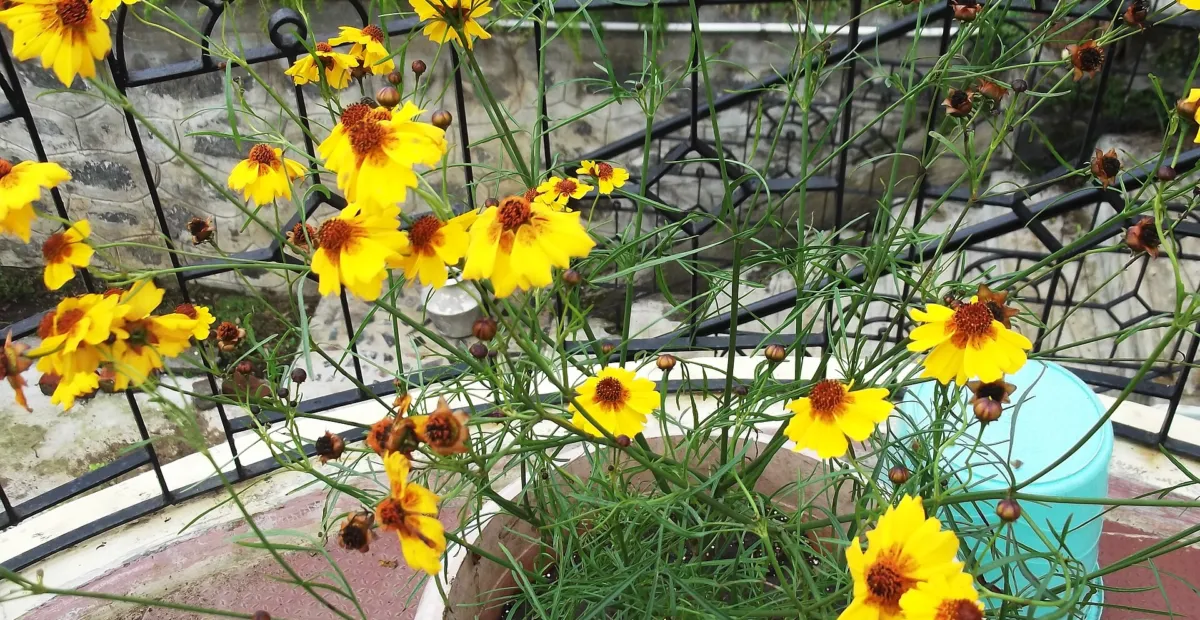
Smooth, stiff, branching stems carry mostly lower-stem leaves that are one- or two-pinnately divided into narrow linear to lance-shaped segments. The airy foliage and solitary flower heads help distinguish it from broader-leaved perennial tickseeds. Ray florets are typically yellow with reddish-brown basal markings.
Flowering
Flower heads are composed of yellow ray florets surrounding a reddish-brown to dark center disk. Individual heads are commonly about 1–2 inches across, and flowering can continue from June into September or until frost, especially when old flowers are removed.
Pollination and visitors
USDA conservation resources document visits by long- and short-tongued bees, wasps, flies, butterflies, skippers, and beetles. The flower heads offer accessible nectar and pollen, while mature seeds may be used by birds. Overall pollinator value is commonly rated low to medium depending on the planting context and abundance.
Coreopsis tinctoria photos
Click any photo for a larger view. Source, author and license are shown separately.
Diseases and pests
Diseases
Generally trouble-free. Poor drainage and crowded, persistently wet growth can encourage root or crown problems and foliar disease. Provide air circulation, water at the soil line, avoid excessive nitrogen, and remove badly affected debris.
Pests
Aphids, leafhoppers, and occasional caterpillars may appear, but serious infestations are uncommon. Inspect new growth, encourage beneficial insects, and use a strong water spray for minor aphid outbreaks. Avoid broad-spectrum insecticides during bloom.
Toxicity and pollen
ASPCA lists tickseed, including Coreopsis, as non-toxic to dogs and cats. Human toxicity is not well documented for ordinary garden contact, but ingestion of any unfamiliar plant may cause stomach upset or an individual reaction. Avoid using it medicinally or as food without specialist identification and evidence.
- Typical season
- June through September during flowering
- Pollination / pollen
- Mostly insect-carried pollen; limited airborne exposure
Although the plant is insect-pollinated, its pollen is not automatically irrelevant to allergy concerns. Coreopsis-specific airborne allergy data are limited, and the pollen is generally less likely to become widely airborne than pollen from wind-pollinated plants. People with known Asteraceae sensitivity should use ordinary caution during heavy bloom.
Native habitat
Naturally associated with prairies, plains, meadows, dry fields, roadsides, pastures, bottomlands, and other open disturbed habitats. It tolerates heat, periodic drought, poor soils, and a range of drainage conditions from dry to moderately moist, but performs best where roots do not remain saturated.
Interesting fact
The species is also known in horticulture as calliopsis and golden tickseed. Its finely cut foliage gives the plant a light, airy texture. The epithet tinctoria refers to dyeing, reflecting historical interest in the plant’s coloring potential. Its seeds can attract birds after flowering.
Frequently asked questions (FAQ)
The most relevant questions about this plant, with short and direct answers.
🌱Quick care
What is Coreopsis tinctoria commonly called in the United States?⌄
Coreopsis tinctoria is commonly called plains coreopsis. It is also sometimes sold as garden coreopsis, golden tickseed, goldenwave, or calliopsis.
Is plains coreopsis an annual or a perennial?⌄
Plains coreopsis is usually grown as a flowering annual. It readily reseeds, so it can return year after year without surviving as a perennial crown.
How much sun does plains coreopsis need?⌄
Plains coreopsis grows best in full sun, meaning at least 6 hours of direct sunlight daily. More sun generally produces sturdier stems and heavier flowering.
How often should I water plains coreopsis?⌄
Water plains coreopsis lightly to moderately, allowing the soil to dry somewhat between waterings. It tolerates drought once established but does not tolerate consistently wet soil.
How tall does Coreopsis tinctoria grow?⌄
Plains coreopsis typically grows about 2 to 4 feet tall and 1 to 1½ feet wide. Plants grown in rich, moist soil may become taller and benefit from support.
🌤️Environment and placement
What is the best location for plains coreopsis?⌄
Choose a sunny location with well-drained soil, such as a meadow edge, pollinator garden, rock garden, border, or dry slope. It is especially useful where other plants struggle with heat, drought, or poor soil.
What type of soil does plains coreopsis prefer?⌄
Plains coreopsis prefers well-drained sandy, loamy, rocky, or moderately clay-containing soil. It tolerates poor soil, but heavy or waterlogged ground can cause weak growth and root problems.
Can plains coreopsis grow in clay soil?⌄
Plains coreopsis can tolerate clay soil if drainage is adequate. Improve heavy clay by avoiding low wet spots and, where practical, incorporating organic matter without creating a water-retentive planting basin.
Is plains coreopsis drought tolerant?⌄
Plains coreopsis is drought tolerant after establishment. Provide regular water during prolonged dry spells in its first season, then reduce watering as the roots develop.
Can plains coreopsis grow in partial shade?⌄
Plains coreopsis may tolerate light shade, but full sun is preferable. Too little light can lead to lanky stems, fewer flowers, and more need for staking.
Is plains coreopsis native to the United States?⌄
Yes, plains coreopsis is native to parts of the central and western United States and northern Mexico. It has also naturalized in other regions, so check local guidance before using it in natural areas.
Does plains coreopsis attract pollinators?⌄
Yes, plains coreopsis provides nectar and pollen for bees, butterflies, wasps, flies, beetles, and other pollinators. Its seeds can also attract birds.
💧Care and problems
Does plains coreopsis need fertilizer?⌄
Plains coreopsis usually does not need fertilizer. Excessively fertile soil can produce tall, floppy plants with less desirable form, so avoid routine feeding unless a soil test shows a deficiency.
Why is my plains coreopsis falling over?⌄
Plains coreopsis may fall over because of shade, rich moist soil, high winds, or overcrowding. Grow it in full sun, avoid overwatering, and use discreet stakes or plant supports when needed.
What pests and diseases affect plains coreopsis?⌄
Plains coreopsis generally has few serious pest or disease problems. Aphids, leaf spots, rust, and powdery mildew are more likely in crowded, humid, or persistently wet conditions.
How do I keep plains coreopsis blooming longer?⌄
Remove faded flower heads regularly to encourage additional blooms. Deadheading also prevents the plant from dropping large quantities of seed.
🪴Planting and repotting
When should I plant plains coreopsis seeds?⌄
Sow plains coreopsis seeds outdoors after the danger of hard spring frost has passed, or start them indoors about 6 to 8 weeks before your local last frost date. In suitable climates, fall sowing can also provide natural cold exposure.
How deep should plains coreopsis seeds be planted?⌄
Plant plains coreopsis seeds very shallowly, covering them only lightly with soil or pressing them onto the surface. The seed needs moisture and good contact with the soil to germinate successfully.
Can plains coreopsis be grown in containers?⌄
Yes, plains coreopsis can grow in a container with drainage holes and a fast-draining potting mix. Choose a container large enough for its 2- to 4-foot height and provide full sun.
How far apart should I plant plains coreopsis?⌄
Space plains coreopsis plants about 12 to 18 inches apart. Closer spacing can create a fuller display, while wider spacing improves air circulation and reduces crowding.
✂️Propagation and pruning
How do I propagate plains coreopsis?⌄
Propagate plains coreopsis primarily from seed. Collect mature, dry seed heads or allow some flowers to drop seed naturally, then sow the seeds shallowly in prepared soil.
Does plains coreopsis reseed itself?⌄
Yes, plains coreopsis readily self-seeds on open, bare ground. Allow seed heads to mature if you want more plants, or remove spent flowers before seed develops to limit reseeding.
Can I save seeds from plains coreopsis?⌄
Yes, collect plains coreopsis seeds when the flower heads are dry and darkened. Store the cleaned seed in a cool, dry place and label it with the collection year and plant source.
Should I cut back plains coreopsis in fall?⌄
Cut plains coreopsis back in fall if you want a tidy bed or want to reduce reseeding. Leaving some dry seed heads through winter can provide food for birds and support natural reseeding.
⚠️Toxicity and safety
Is plains coreopsis toxic to dogs?⌄
Plains coreopsis is listed as non-toxic to dogs by the ASPCA. Even non-toxic plants can cause mild stomach upset if eaten in large quantities.
Is plains coreopsis toxic to cats?⌄
Plains coreopsis is listed as non-toxic to cats by the ASPCA. Prevent excessive plant eating and contact a veterinarian if a pet shows unusual symptoms.
🌸Flowering and special interest
When does plains coreopsis bloom?⌄
Plains coreopsis commonly blooms from late spring or early summer through fall, often continuing until frost. Bloom timing varies with climate, sowing date, and growing conditions.
What do plains coreopsis flowers look like?⌄
Plains coreopsis has daisy-like flowers about 1 to 3 inches across, usually with yellow rays marked by reddish-brown bases and darker central disks. Flower colors can vary among forms and cultivars.
Is plains coreopsis good for cut flowers?⌄
Yes, plains coreopsis is a useful cut flower with long, branching stems and a long bloom season. Harvest stems when the flowers are newly open for the best vase display.
Why is my plains coreopsis not flowering?⌄
Insufficient sunlight, excessive nitrogen, overwatering, or immature plants can reduce flowering. Move plants into full sun, avoid heavy fertilizing, and give newly sown plants time to mature.
Similar plants
 Large-flowered tickseed (Coreopsis grandiflora) care guideCoreopsis grandiflora
 Coreopsis ‘Sienna Sunset’Coreopsis 'Sienna Sunset'
 Coreopsis ‘Moonbeam’Coreopsis 'Moonbeam'
 Coreopsis ‘Sunfire’Coreopsis 'Sunfire'
 Coreopsis ‘Star Cluster’Coreopsis 'Star Cluster'
 Lance-leaved Coreopsis (Coreopsis lanceolata) care guideCoreopsis lanceolata