
 Source:
 Southern Green Stink Bug
Nezara viridulaSouthern Green Stink Bug overview
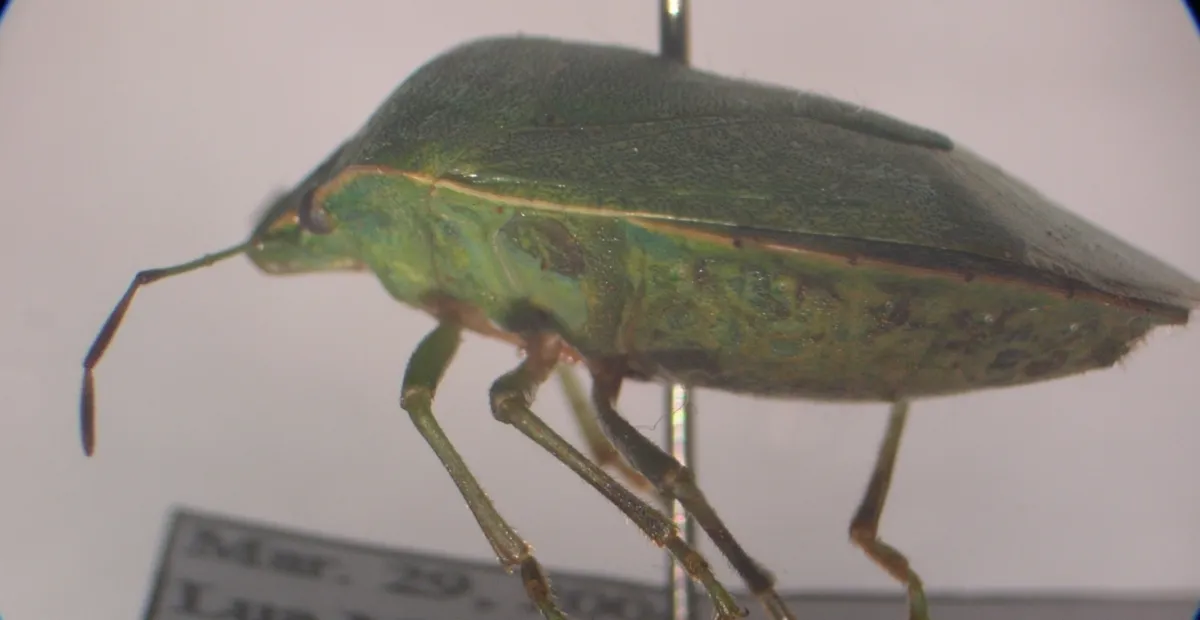
The southern green stink bug, Nezara viridula, is a shield-shaped, piercing-sucking insect pest found mainly across the southern United States and other warm regions. Adults and nymphs feed on buds, flowers, developing pods, foliage and fruit, causing blossom loss, seed injury, cloudy spots and corky blemishes. Its broad host range makes weeds, field crops and garden plants important parts of management.
Typical conditions
Overview
Nezara viridula is commonly called the southern green stink bug in the United States. Adults are shield-shaped and usually dull green, about 0.47–0.67 inch long, while nymphs are wingless and change from orange or reddish colors to green with contrasting spots. Both nymphs and adults use piercing-sucking mouthparts.
The insect often concentrates on reproductive plant tissues. On vegetables and fruit, feeding may leave pale or cloudy spots, internal corkiness, premature ripening, deformity or reduced market quality. On beans and soybean, feeding on buds, flowers and pods may cause flower loss, poor seed development and shriveled or discolored seeds. The species is sometimes confused with other green stink bugs, so confirmation should include the insect’s markings, body shape and life stage.
Symptoms and identification
- Small dark punctures surrounded by pale green, yellow, brown or cloudy discoloration on tomato and other fruit.
- White, spongy or corky tissue beneath feeding sites, especially on green tomato fruit.
- Premature ripening, fruit distortion, reduced size or poor fruit grade.
- Bud and flower loss, aborted pods and damaged or shriveled seeds in beans and soybean.
- Occasional stippling or localized injury on leaves and young stems.
- Clusters of barrel-shaped eggs on leaf undersides and brightly patterned, wingless nymphs are useful diagnostic signs.
Feeding injury can resemble damage from other stink bug species. On tomato, bacterial spotting or fruit rots should not automatically be attributed to the insect; pathogen involvement requires separate diagnosis.
Causes and spread
Adults and nymphs pierce plant tissue and inject saliva containing digestive enzymes before sucking out liquefied contents. Populations increase when suitable host plants are continuously available, particularly legumes, vegetables, weeds and late-season crops. Adults can move between field crops, gardens, field margins and unmanaged vegetation.
In the United States, risk is generally greatest in warm southern regions and during hot portions of the growing season. Weedy margins, volunteer crops, fallen fruit and overlapping plantings can maintain populations between crop cycles. The species has a broad and variable host range, but not every plant on which it is observed supports reproduction.
Life cycle and persistence
Southern green stink bugs commonly overwinter as adults in protected sites such as leaf litter, bark crevices and other sheltered vegetation. They become active in spring as temperatures rise. Females deposit clusters of barrel-shaped eggs, commonly on the underside of leaves; eggs may be pale, white or green and often darken or become pinkish as they develop.
Nymphs pass through five instars. Newly hatched first instars remain aggregated near the egg mass and generally do not feed. Feeding begins after the first molt, and later nymphs disperse, develop through additional molts and eventually become winged adults. Under warm conditions, egg-to-adult development may take roughly 35 days; cooler conditions may extend development to about 65–75 days. Several generations may occur in a favorable southern growing season.
Treatment and control
Confirm the pest before treating because several green, brown and predatory stink bugs may occur on the same crop. On a small garden scale, handpick adults and nymphs into soapy water and crush or remove visible egg masses. Inspect early morning when insects are often less active.
For commercial crops, use crop-specific scouting procedures and locally validated action thresholds rather than treating solely because one insect is present. Border-focused intervention may be appropriate when populations are concentrated along field edges. Avoid unnecessary broad-spectrum applications, which can kill egg parasitoids and predators and may lead to secondary pest outbreaks.
Insecticides may provide incomplete control because adults can reinvade from surrounding vegetation and eggs are protected within clusters. Follow the current product label, observe preharvest and reentry intervals, protect pollinators, and verify that the product is registered for southern green stink bug on the specific crop in the state where it will be used.
Low-impact and biological control
- Handpick adults, nymphs and egg masses in gardens and small plantings.
- Use insect exclusion fabric where crop pollination and airflow requirements allow.
- Conserve the egg parasitoid Trissolcus basalis, which attacks southern green stink bug eggs, and the tachinid fly Trichopoda pennipes, which parasitizes adults and nymphs.
- Avoid routine applications of broad-spectrum insecticides that destroy natural enemies.
- Use trap-crop plantings only with a well-planned removal or treatment strategy; otherwise they can increase local stink bug habitat.
- For products permitted in organic production, use only formulations currently allowed by the National Organic Program and legally labeled for the crop and pest. Test sprays on a small area first and follow all label restrictions.
Commercial biological control releases are not reliably available for home gardeners, and natural enemies alone may not prevent economic damage when stink bug pressure is high.
Prevention
- Scout plants at least weekly from flowering through fruit or pod development, checking foliage undersides, flowers, pods and fruit clusters.
- Remove or mow weeds and volunteer crops around production areas, especially known host plants that are carrying adults, nymphs or egg masses.
- Use clean cultivation, prompt harvest and removal of damaged or overripe fruit to reduce attractive feeding sites.
- Use floating row cover or insect exclusion netting on small plantings, securing edges before adults enter; remove covers when pollination is required unless hand-pollination is practical.
- Maintain crop rotation and avoid placing highly susceptible plantings immediately beside heavily infested, unmanaged vegetation or maturing legume fields when feasible.
- Monitor borders first, because infestations may build in field margins and move inward.
- Preserve flowering plants and broad-spectrum-pesticide-free habitat where practical to support parasitoids and predators.
Interesting facts
- The common name refers to the strong odor released when the insect is disturbed or crushed.
- First-instar nymphs remain grouped near the egg mass and do not normally feed; later instars disperse and begin feeding.
- Egg masses are important targets for biological control because Trissolcus basalis can parasitize southern green stink bug eggs.
- Adults and nymphs may move among weeds, vegetables, soybean, cotton and other crops as plant growth and fruiting stages change.
- Tomatoes are often injured while green, and feeding can produce pale cloud-like blemishes with corky tissue beneath the skin.
- Southern green stink bug is more damaging in warm regions, but its abundance and crop importance vary substantially by state, season and surrounding host vegetation.
Use pesticides only when monitoring shows that treatment is justified, and only products legally authorized for southern green stink bug on the specific crop in the United States and applicable state. Read and follow the current label exactly, including crop, pest, rate, protective equipment, pollinator precautions, reentry interval and preharvest interval. Do not transfer recommendations between crops or states.