
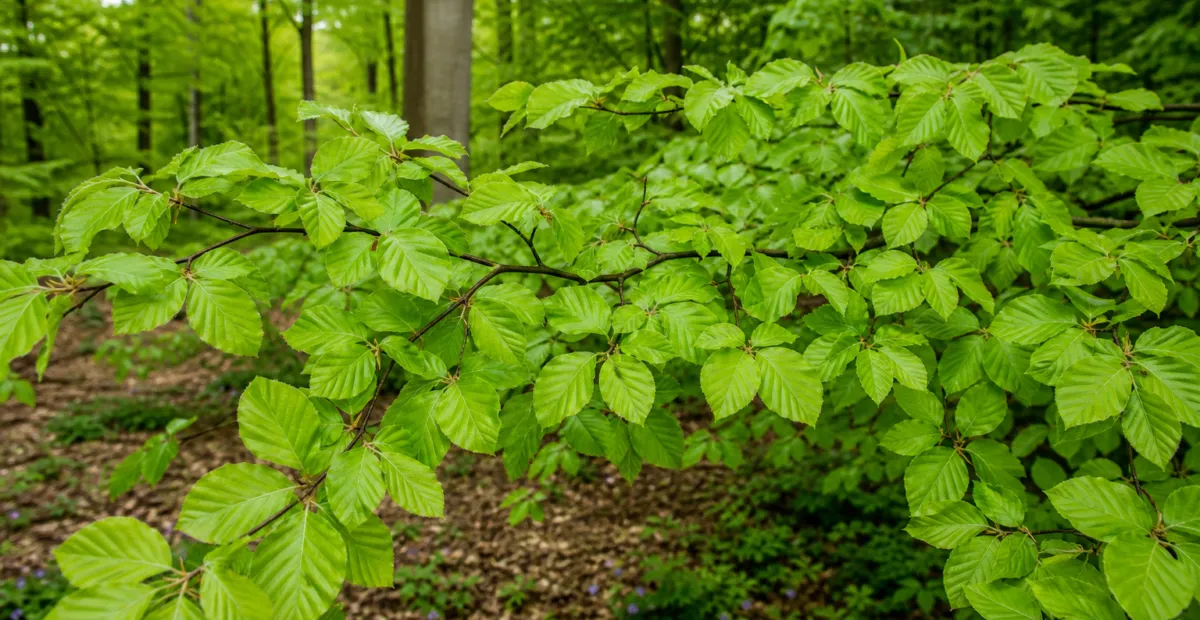
Fagus sylvatica short overview
Fagus sylvatica is a large, long-lived deciduous tree native to temperate Europe. It develops a broad, dense crown, smooth silver-gray bark and glossy green leaves that turn golden to russet in fall. Small male and female flowers appear separately on the same tree as the leaves expand, followed by spiny husks containing beechnuts. In the United States it is mainly grown as an ornamental, specimen, avenue or hedge tree where summers are not excessively hot and soils drain well.
Taxonomic classification
Fagus sylvatica care guide
Light and placement
Grow in full sun to partial shade, with morning or open overhead light preferred in hotter regions. A woodland edge or east-facing site can reduce afternoon heat stress. Pale, sparse growth may indicate inadequate light, while scorched leaf margins, premature leaf drop and drought symptoms suggest excessive heat, reflected sun or insufficient soil moisture.
Watering and humidity
Water deeply and slowly whenever the upper few inches of soil begin to dry during establishment, then extend the interval as roots spread. Keep moisture even through summer; do not alternate severe drought with saturation. Mulch the root zone to reduce evaporation, but keep mulch away from the trunk. Humid air is helpful, yet misting is unnecessary.
Soil and growing medium
Use deep, fertile, well-drained soil that retains steady moisture without staying saturated. Loam enriched with organic matter is suitable. Acidic to neutral conditions are generally tolerated; avoid compacted, chronically wet or highly alkaline ground, and protect surface roots from excavation and heavy traffic.
Feeding
Apply a thin compost mulch in spring or fall and maintain an open soil surface beneath the crown. Fertilize only after a soil test, visible nutrient deficiency or weak growth supports it; use a slow-release, balanced product at label rates. Do not feed drought-stressed, newly transplanted or declining trees until root problems are addressed.
Growth and habit
This is a strongly apical, long-lived tree that becomes increasingly broad and densely crowned with age. It establishes best when young and dislikes root disturbance, compaction and prolonged drought. Mature surface roots and dense shade can make lawn conversion, paving and underplanting difficult.
Planting and repotting
Plant in fall or early spring while the tree is dormant. Set the root flare at soil level, backfill with native soil, water deeply and mulch broadly without touching the trunk. Allow generous clearance for the eventual crown and avoid disturbing established surface roots.
Not a practical long-term container tree. Young plants can be shifted into progressively larger containers, but transplant before roots circle densely and move to the landscape while still manageable.
Propagation and pruning
Propagation
Propagate mainly from fresh seed, usually after a period of cold, moist stratification. Cultivars are commonly maintained by grafting because seed does not reliably preserve ornamental traits. Seedlings are slow to establish and should be transplanted young.
Pruning
Prune in late winter or during dormancy to remove dead, crossing or poorly attached branches and to maintain clearance. Make cuts outside the branch collar. Young hedges tolerate formative trimming, but large mature branches should be handled by a qualified arborist because wounds and decay can become significant.
Overwintering
Outdoor winter protection is normally unnecessary in the recommended hardiness range. Water before the ground freezes if autumn is dry, maintain a mulch layer over the root zone and protect young trunks from rodents and mechanical injury. Avoid late-season nitrogen that could encourage tender growth.
Uses
Used as a specimen, shade, avenue, formal hedge or woodland tree, and valued for durable timber. The nuts are eaten by wildlife and may be used as food only after appropriate preparation; raw consumption can cause digestive symptoms. Its dense canopy provides shelter and habitat structure but can suppress shade-intolerant understory plants.
Appearance
Leaves are alternate, oval to ovate and slightly wavy-edged, with silky hairs along young margins. The bark is unusually smooth and silver-gray, becoming more textured with age. Small pointed buds, dense branching and persistent coppery leaves in some winters help distinguish the tree in the landscape.
Flowering
Monoecious: separate male and female flowers occur on the same tree. Greenish-yellow male flowers hang in small rounded heads, while female flowers occur in small paired clusters. Flowering accompanies leaf emergence in spring, and mature trees produce three-sided nuts enclosed in bristly husks.
Pollination and visitors
The species relies primarily on wind rather than animal pollinators. Its small spring flowers may be visited incidentally by insects, but reliable documentation does not support listing a characteristic animal pollinator group for this taxon.
Fagus sylvatica photos
Click any photo for a larger view. Source, author and license are shown separately.
Diseases and pests
Diseases
Watch for beech bark disease, cankers, root rots and leaf disorders, especially where trees are stressed or planted in unsuitable soil. Improve drainage, avoid trunk wounds, sanitize pruning tools and remove severely affected material when appropriate; consult an arborist for major decline.
Pests
Potential problems include beech scale, woolly beech aphid, aphids, caterpillars and occasional borers. Inspect bark, shoots and new leaves, maintain vigor through correct siting and watering, and use targeted controls only when damage is substantial or pests are confirmed.
Toxicity and pollen
Raw beechnuts contain naturally occurring compounds, including tannins and fagins, that can cause gastrointestinal upset if eaten in quantity. Roasting reduces these compounds, but seeds should not be treated as a casual edible crop. Keep fallen nuts away from children and pets, and seek medical or veterinary advice after significant ingestion.
- Typical season
- Typically April–May in much of the United States, varying by region.
- Pollination / pollen
- Light, wind-dispersed tree pollen
Fagus sylvatica releases abundant, lightweight pollen from male catkins in spring. Wind dispersal means pollen can travel beyond the tree, and sensitive people may experience seasonal symptoms. Local exposure depends on flowering timing, weather and regional pollen counts.
Native habitat
Native across much of temperate Europe, especially in humid hills, mountains and well-drained forest soils. It is characteristic of cool, moisture-balanced woodland climates and is less suited to hot, drought-prone lowlands or waterlogged ground.
Interesting fact
The species is monoecious, carrying separate male and female flowers on one tree.
Its smooth gray bark remains a major identification feature even in winter.
The three-sided nuts develop inside a distinctive bristly cupule.
Older trees can form dense shade that strongly influences woodland ground flora.
Frequently asked questions (FAQ)
The most relevant questions about this plant, with short and direct answers.
🌱Quick care
What is Fagus sylvatica?⌄
Fagus sylvatica is a large, cold-hardy, deciduous tree in the beech family, Fagaceae. It is valued for smooth gray bark, dense foliage, fall color, and its mature size, which can exceed 80 feet tall and 50 feet wide.
How much sun does Fagus sylvatica need?⌄
Fagus sylvatica grows best in full sun to partial shade. Full sun usually produces the strongest growth and best leaf color, while partial shade can help reduce leaf scorch in hot or exposed locations.
How often should I water Fagus sylvatica?⌄
Water Fagus sylvatica regularly enough to keep the soil evenly moist while it establishes, usually during the first several growing seasons. Once mature, it generally needs supplemental water only during prolonged heat or drought.
Is Fagus sylvatica evergreen or deciduous?⌄
Fagus sylvatica is deciduous and normally drops its leaves in fall. Young trees and clipped hedges may retain dry brown leaves through winter, providing seasonal screening.
🌤️Environment and placement
What USDA hardiness zone is Fagus sylvatica suitable for?⌄
Fagus sylvatica is generally hardy to about USDA Zone 4, although exact performance depends on the cultivar, exposure, and local heat and moisture conditions. Protect young trees from drying winter winds and late spring freezes.
How big does Fagus sylvatica get?⌄
A mature Fagus sylvatica can grow roughly 80 feet tall and 50 feet wide, sometimes larger in favorable conditions. Give it substantial space away from buildings, pavement, overhead utilities, and small garden beds.
What soil is best for Fagus sylvatica?⌄
The best soil is fertile, moisture-retentive but well-drained loam. Fagus sylvatica tolerates a range of soil reactions and textures, but it performs poorly in persistently waterlogged, extremely dry, or heavily compacted soil.
Can Fagus sylvatica grow in clay soil?⌄
Fagus sylvatica can grow in clay soil if drainage is adequate and the soil is improved before planting. Avoid sites that stay saturated after rain, and do not amend only the planting hole in a way that creates a water-holding basin.
Can Fagus sylvatica grow in shade?⌄
Fagus sylvatica tolerates partial shade but does not develop its best density or leaf color in deep shade. A site with morning sun or filtered afternoon light is often a good compromise in hot climates.
Is Fagus sylvatica a good tree for a small yard?⌄
Fagus sylvatica is usually not a good choice for a small yard because it becomes a very large tree. A narrow or weeping cultivar may fit some restricted sites, but its ultimate height, root zone, and canopy width still require careful planning.
💧Care and problems
How do I care for a newly planted Fagus sylvatica?⌄
Keep a newly planted Fagus sylvatica evenly watered, apply a 2- to 3-inch layer of mulch over the root zone, and keep mulch away from the trunk. Avoid heavy fertilizer during establishment and protect the trunk from lawn equipment.
Why are the leaves on my Fagus sylvatica turning brown?⌄
Brown leaves on Fagus sylvatica are commonly caused by drought, heat, wind, root damage, or leaf scorch. Check soil moisture and drainage first, then reduce stress with deep watering and mulch rather than repeatedly fertilizing.
What pests affect Fagus sylvatica?⌄
Fagus sylvatica may be affected by aphids, scale insects, caterpillars, Japanese beetles, and borers, especially when stressed. Inspect the leaves, twigs, and trunk before treating, because minor infestations often need only monitoring.
What diseases affect Fagus sylvatica?⌄
Potential problems include beech bark disease, cankers, powdery mildew, and fungal decay. Good drainage, protection from trunk injury, adequate water during drought, and removal of severely damaged branches can reduce risk.
Does Fagus sylvatica need fertilizer?⌄
Established Fagus sylvatica usually does not need routine fertilizer when growing in fertile soil. Test the soil first and fertilize only when a confirmed nutrient deficiency or poor growth justifies it.
🪴Planting and repotting
When is the best time to plant Fagus sylvatica in the United States?⌄
Plant Fagus sylvatica in fall after leaf drop or in early spring before active growth begins. In colder USDA Zones, early spring may reduce winter injury to newly planted roots, while fall planting is effective where the ground remains workable.
How far apart should Fagus sylvatica trees be planted?⌄
Space standard Fagus sylvatica trees according to their mature canopy, often at least 40 to 50 feet apart for specimen planting. Hedge spacing is much closer and depends on plant size, cultivar, and the desired hedge height.
Can Fagus sylvatica be grown in a container?⌄
Fagus sylvatica is generally unsuitable for long-term container growing because it becomes a large tree and develops an extensive root system. A young tree can be temporarily container-grown, but it should be planted in the landscape before becoming root-bound.
How should I mulch Fagus sylvatica?⌄
Spread organic mulch 2 to 3 inches deep over the root zone, extending toward the drip line when practical. Leave a several-inch gap around the trunk to prevent excess moisture, decay, and pest problems.
✂️Propagation and pruning
How do I grow Fagus sylvatica from seed?⌄
Grow Fagus sylvatica from fresh beechnuts collected in late summer or fall, then sow them immediately or cold-stratify them in a refrigerator before late-winter sowing. Protect seeds and seedlings from rodents, and expect seed-grown plants to vary from named cultivars.
Can Fagus sylvatica be propagated from cuttings?⌄
Fagus sylvatica is not usually propagated easily from ordinary cuttings. Seed is practical for the species, while named cultivars are generally maintained by grafting or specialized nursery propagation.
When should Fagus sylvatica be pruned?⌄
Prune Fagus sylvatica in late winter or during the dormant season to remove dead, damaged, crossing, or poorly placed branches. Avoid severe pruning of mature trees, and use proper clearance pruning rather than indiscriminate topping.
Can Fagus sylvatica be used as a hedge?⌄
Fagus sylvatica can form an attractive clipped hedge and often retains its dry leaves through winter. It needs regular trimming from a young age and is less suitable than hornbeam for sites that are persistently wet, very dry, or prone to late frosts.
⚠️Toxicity and safety
Are Fagus sylvatica beechnuts poisonous?⌄
Raw or unripe beechnuts can cause illness if eaten in large quantities, including nausea, vomiting, diarrhea, and abdominal pain. Keep fallen nuts away from children and pets, and do not treat raw beechnuts as a routine food.
Are Fagus sylvatica leaves or bark toxic to dogs?⌄
The main documented safety concern is the nuts, especially when raw, unripe, or eaten in quantity. Prevent dogs from consuming fallen beechnuts and contact a veterinarian if a pet develops gastrointestinal symptoms after eating them.
🌸Flowering and special interest
When does Fagus sylvatica flower?⌄
Fagus sylvatica produces small, inconspicuous flowers in spring, usually after the leaves begin to emerge. Male flowers hang in rounded clusters, while female flowers develop into prickly husks containing the nuts.
Does Fagus sylvatica produce beechnuts every year?⌄
Fagus sylvatica may produce beechnuts irregularly, with heavier crops in some years than others. Mature trees are more likely to fruit well in open, sunny conditions, while regularly clipped hedges may produce few or no nuts.
What color does Fagus sylvatica turn in fall?⌄
The green-leaved form of Fagus sylvatica commonly develops golden, copper, yellow-brown, or russet fall color. Purple- and copper-leaved cultivars may show deeper bronze or reddish tones.