
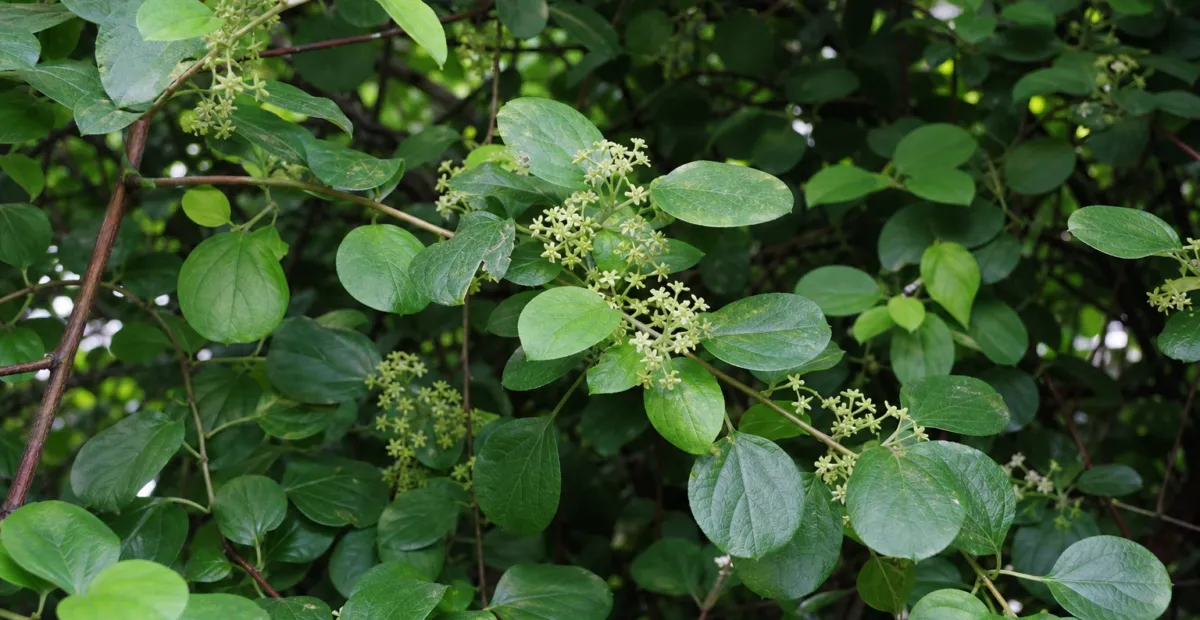
Celastrus orbiculatus short overview
Celastrus orbiculatus is a vigorous, deciduous woody vine native to East Asia and invasive across much of the eastern United States. It twines into trees and shrubs, bears small axillary flowers, and produces conspicuous yellow capsules that split to reveal red arils in fall and winter. Although attractive in dried arrangements, its rapid growth, abundant seed production, root suckering, and ability to girdle host trees make it unsuitable for most gardens.
Taxonomic classification
Celastrus orbiculatus care guide
Light and placement
Provide full sun for the heaviest flowering and fruiting, preferably with the vine trained onto a very strong trellis or other permanent support. It also tolerates partial shade and can persist beneath woodland canopies. Sparse growth and reduced fruiting may indicate inadequate light; pale, weak shoots are more likely under excessive shade than from excessive sun.
Watering and humidity
Water deeply when the upper few inches of soil begin to dry during the first growing season. Once established, it generally manages ordinary rainfall but performs best in moderately moist, well-drained soil. Increase watering during prolonged summer drought, especially for container plants, and avoid constantly saturated soil. Extra humidity is not normally required outdoors.
Soil and growing medium
Use soil that drains reliably yet holds some moisture, including loam, sandy loam, or clay amended with organic matter. It tolerates a broad pH range from acidic through alkaline and is not restricted to a specialized substrate. Avoid sites where water stands for long periods, while recognizing that excessively dry, shallow soil can limit establishment.
Feeding
Established plants rarely need fertilizer and excessive feeding can intensify unwanted vine growth. If growth is weak in poor soil, apply a thin layer of compost in spring or use a balanced slow-release fertilizer at the label rate. Do not fertilize drought-stressed, freshly transplanted, or actively declining plants until root function has recovered.
Growth and habit
This vigorous twiner rapidly extends through neighboring vegetation and can climb high into trees. Its strength, rapid regrowth after cutting, seed production, and root suckering create substantial maintenance and ecological problems. Any cultivated specimen would require permanent structural support, frequent monitoring, and strict prevention of fruit and seed dispersal.
Planting and repotting
Because this species is invasive in much of the United States, planting is generally discouraged. If retained where legal and appropriate, choose an isolated site with a robust support, keep it away from forests and naturalized edges, and check local regulations first. Water deeply after planting and monitor for root suckers and seedlings. Remove developing fruit before it can be dispersed.
Container culture is not a reliable long-term containment strategy because vigorous roots and shoots can outgrow pots and produce escapees. If a young plant must be transplanted, move it in spring or fall, use a large heavy container with drainage, and inspect for roots emerging through drainage holes. Remove unwanted fruit and dispose of all plant material securely.
Propagation and pruning
Propagation
Propagation is readily possible from fresh seed, winter root cuttings, and summer semi-ripe cuttings; layering and root suckering also contribute to spread. Seeds benefit from removal of the fleshy covering and a period of cold stratification. Propagation is not recommended because the species is invasive and seed-bearing plants can escape cultivation.
Pruning
Prune only with a clear containment or removal objective. Cut climbing stems near the root crown before fruit matures, then remove all cut material from contact with soil because stems and roots may resprout. Repeated cutting can exhaust plants only when done persistently; occasional cutting often stimulates regrowth. Wear gloves and protect yourself from falling woody material in trees.
Overwintering
The vine is hardy across much of the continental United States and generally needs no special winter protection in the ground. In colder areas, protect newly planted roots with a light mulch after the soil cools, without burying the crown. Container roots are more exposed to freezing and may need an unheated sheltered location, but winter storage does not solve the invasive-spread risk.
Uses
Historically introduced as an ornamental vine, for erosion control, and for its colorful autumn and winter fruit used in dried arrangements. Its ecological value is outweighed in much of the United States by invasive impacts on native vegetation and forest regeneration. Do not use the fruit for food or home remedies, and do not plant it as a wildlife crop because birds disperse the seeds.
Appearance
Leaves are alternate, rounded to broadly oval, and usually have shallow teeth with a pointed tip. Young stems are green to brown and become woody with age. Small greenish flowers occur in the leaf axils rather than at shoot tips. Yellow capsules split open to expose bright red arils, a key feature distinguishing this species from native American bittersweet in many identification situations.
Flowering
The species is commonly dioecious, with male and female flowers on separate plants, although reproductive variation has been reported. Flowers are small, greenish, and borne in short clusters in the axils of leaves during late spring or early summer. Female plants require compatible pollen for dependable fruit production, and a male and female plant are commonly recommended where fruiting is desired.
Pollination and visitors
Hymenopterous insects, especially bees, have been reported as important flower visitors and pollinators. Wind pollination may also contribute, so animal visitation should not be treated as the only reproductive pathway. The later red arils are eaten and dispersed by birds, which substantially increases the plant’s spread rather than serving as pollination.
Celastrus orbiculatus photos
Click any photo for a larger view. Source, author and license are shown separately.
Diseases and pests
Diseases
It is generally reported as relatively free of serious disease in cultivation, but stressed or dense growth can still develop foliar spotting or decline. Improve air movement, avoid prolonged waterlogging, sanitize tools, and remove heavily affected material. In natural areas, disease is not a dependable control because the species has few effective biological checks in North America.
Pests
Serious insect pests are not usually prominent in horticultural references. Inspect new growth for chewing damage, scale, or sap-feeding insects, especially on stressed container plants. Prefer hand removal, pruning of isolated affected shoots, and correction of watering or site problems before considering a labeled treatment. Do not transport or discard fruiting material where it can spread.
Toxicity and pollen
Horticultural safety references identify the plant as harmful if eaten, with the fruit and seeds of particular concern. The red arils are ornamental rather than edible and should not be consumed. Keep cut fruit, seeds, and plant material away from children and pets; seek medical or veterinary advice after ingestion, especially if symptoms develop. Wear gloves when handling if skin sensitivity is a concern.
- Typical season
- Typically late May through June in the United States
- Pollination / pollen
- Light pollen released by flowers; wind transport may contribute
Although bees are documented flower visitors, wind pollination has also been reported as effective, so airborne pollen exposure cannot be assumed to be negligible. Species-specific allergy data are limited; people with pollen sensitivity should avoid handling flowering branches closely and monitor symptoms during the late-spring bloom period.
Native habitat
In its native range, the vine occurs in forest margins, thickets, woodland openings, scrub, and disturbed sites across temperate East Asia. In the United States it commonly occupies forest edges, roadsides, old fields, utility corridors, and mesic woodland. It tolerates a broad range of light and soil conditions, with rapid growth favored when stems reach increased light.
Interesting fact
The flowers and fruits are borne in leaf axils, unlike the mainly terminal clusters of native American bittersweet. Yellow capsules split to reveal red arils containing pale seeds. Birds disperse the seeds over long distances. Stems and roots can regenerate after cutting or disturbance, making incomplete removal ineffective. The species can hybridize with American bittersweet.
Frequently asked questions (FAQ)
The most relevant questions about this plant, with short and direct answers.
🌱Quick care
What is Celastrus orbiculatus?⌄
Celastrus orbiculatus is a deciduous, woody, twining vine in the Celastraceae family. In the United States, it is widely recognized as an invasive plant that can climb, smother, and girdle trees.
Is Celastrus orbiculatus invasive in the United States?⌄
Yes, Celastrus orbiculatus is invasive across much of the eastern and central United States. Its rapid growth, bird-dispersed seeds, and ability to resprout make it difficult to contain.
How can I identify Celastrus orbiculatus?⌄
Look for a woody vine with rounded to broadly oval leaves, small greenish flowers in the leaf axils, and yellow fruit capsules that split open to reveal red-orange seed coverings. The vine often climbs high into trees and lacks tendrils.
Does Celastrus orbiculatus have thorns?⌄
No, Celastrus orbiculatus does not have thorns. It climbs by twining around nearby vegetation, fences, poles, and other supports.
How is Celastrus orbiculatus different from American bittersweet?⌄
Celastrus orbiculatus usually has rounded leaf tips and flowers or fruits in clusters along the stems in leaf axils. Native American bittersweet, Celastrus scandens, more often has pointed leaves and terminal flower or fruit clusters.
🌤️Environment and placement
How large does Celastrus orbiculatus get?⌄
Celastrus orbiculatus commonly grows 30–60 feet long and can develop thick, woody stems several inches in diameter. Mature vines may cover entire tree canopies or large sections of woodland.
Does Celastrus orbiculatus grow in sun or shade?⌄
Celastrus orbiculatus tolerates full sun, partial shade, and shade, but it often grows most vigorously where sunlight is available along forest edges, roadsides, fields, and disturbed sites.
What type of soil does Celastrus orbiculatus prefer?⌄
Celastrus orbiculatus can grow in well-drained loam, sand, clay, or rocky soil and is not highly particular about soil texture. It commonly colonizes disturbed ground, old homesites, forest edges, and roadsides.
Is Celastrus orbiculatus cold-hardy?⌄
Yes, Celastrus orbiculatus is cold-hardy and survives winters across much of the United States. Its exact performance depends on local climate, exposure, and the plant’s established root system.
💧Care and problems
How much water does Celastrus orbiculatus need?⌄
Celastrus orbiculatus generally grows with moderate moisture and can tolerate short periods of dryness once established. Avoid treating its drought tolerance as a reason to plant it, because the species can spread aggressively in suitable landscapes.
Why is Celastrus orbiculatus a problem for trees?⌄
Its twining stems wrap around trunks and branches while its dense foliage shades the canopy. As the stems enlarge, they can constrict trunks, break branches, and contribute to tree decline or death.
How fast does Celastrus orbiculatus spread?⌄
Celastrus orbiculatus spreads quickly through vigorous vine growth, root resprouting, and seeds carried by birds and mammals. Cutting the visible vine without addressing the roots usually leads to renewed growth.
Can Celastrus orbiculatus hybridize with American bittersweet?⌄
Yes, Celastrus orbiculatus can hybridize with the native Celastrus scandens where their ranges overlap. This can threaten the genetic identity of native bittersweet populations.
How do I remove Celastrus orbiculatus from my property?⌄
Remove vines from trees carefully, cut stems near ground level, and continue monitoring for root sprouts and seedlings. For established infestations, integrated control using repeated removal and, where legal and appropriate, targeted herbicide treatment is often necessary.
Does cutting Celastrus orbiculatus kill it?⌄
Cutting alone usually does not kill Celastrus orbiculatus because the roots can resprout vigorously. Repeated cutting may weaken the plant, but long-term control generally requires exhausting or treating the root system.
When should I remove Celastrus orbiculatus?⌄
Remove it as soon as it is identified, preferably before it produces mature fruit. Early removal reduces seed dispersal and is usually easier than controlling a large vine network.
🪴Planting and repotting
Should I plant Celastrus orbiculatus in my yard?⌄
No, planting Celastrus orbiculatus is generally not recommended in the United States. It can escape cultivation, spread into natural areas, damage trees, and be restricted or prohibited by state or local regulations.
Can Celastrus orbiculatus be grown in a container?⌄
Growing Celastrus orbiculatus in a container is not a reliable way to prevent spread. Roots can escape through drainage openings, and fruiting plants can still disperse seeds, so a noninvasive alternative is safer.
✂️Propagation and pruning
Can I pull Celastrus orbiculatus by hand?⌄
Small seedlings and young plants may be pulled when the entire root system is removed from moist soil. Hand-pulling mature vines is often incomplete and can leave roots or broken pieces capable of resprouting.
Can Celastrus orbiculatus grow from root pieces?⌄
Yes, broken or remaining root pieces can produce new shoots. Digging should therefore be thorough, and removed roots should not be left in contact with moist soil or composted where they may survive.
How does Celastrus orbiculatus reproduce?⌄
Celastrus orbiculatus reproduces by seed and vegetatively through root sprouts. Birds and mammals spread its conspicuous fruits, while disturbance and cutting can stimulate additional vegetative growth.
Can I propagate Celastrus orbiculatus from seeds?⌄
Although Celastrus orbiculatus can be propagated from seed, doing so is not recommended because the plant is invasive in the United States and may be regulated. Propagate or plant only approved noninvasive alternatives instead.
⚠️Toxicity and safety
Are Celastrus orbiculatus berries poisonous?⌄
The fruits and seed coverings of Celastrus orbiculatus may be harmful if eaten, and the available evidence does not support treating them as edible. Keep children and pets away from the berries and seek medical or veterinary advice after ingestion.
Can birds eat Celastrus orbiculatus berries?⌄
Birds and other wildlife consume and disperse the fruits, which is a major reason the plant spreads. Wildlife use does not make the berries safe for people or pets.
Is Celastrus orbiculatus safe for dogs and cats?⌄
Celastrus orbiculatus should be treated as potentially harmful to dogs and cats if eaten, especially the fruits and seeds. Prevent access and contact a veterinarian or animal poison service if ingestion occurs.
Can I use Celastrus orbiculatus in dried flower arrangements?⌄
Using fruiting stems in dried arrangements is risky because seeds may be dispersed indoors or outdoors. Do not transport or discard fruiting material where it can spread, and check local invasive-plant rules before handling it.
🌸Flowering and special interest
When does Celastrus orbiculatus flower?⌄
Celastrus orbiculatus usually flowers in late spring to early summer, often from May through June in much of the United States. The flowers are small, greenish, and generally not showy.
What do the fruits of Celastrus orbiculatus look like?⌄
The fruits begin as green, rounded capsules, turn yellow as they mature, and split open to expose bright red-orange seed coverings. They may persist into fall and winter, making the vine conspicuous after leaf drop.
Does Celastrus orbiculatus have showy flowers?⌄
No, its flowers are small, greenish, and usually inconspicuous. The ornamental feature that attracts attention is the yellow capsule opening to reveal red-orange seed coverings, although those fruits also aid its spread.