
 Source:
He cohune palm (also rain tree (Attalea cohune) short overview
Attalea cohune is a huge, slow-growing palm native to southern Mexico, Central America, and parts of Colombia. Its solitary trunk eventually supports an impressive crown of long, feather-like, blue-green fronds. In the United States it is mainly a warm-climate specimen for frost-free landscapes, large conservatories, and specialist collections. Provide full sun, steady moisture, excellent drainage, and generous space for its mature root system and canopy.
Taxonomic classification
He cohune palm (also rain tree (Attalea cohune) care guide
Light and placement
Give full sun for the strongest growth and best crown development, ideally with an unobstructed southern or southeastern exposure in the United States. Young palms can accept bright partial shade, especially in very hot climates, but deep shade produces weak, sparse growth. Bleached fronds or scorch suggest excessive reflected heat or drought; stretched leaves and slow growth indicate insufficient light.
Watering and humidity
Water deeply when the upper few inches of soil begin to dry, then allow excess water to drain completely. Keep the root zone evenly and moderately moist during hot growth, with less frequent irrigation in cool weather. Do not alternate severe drying with saturation. High humidity is beneficial, but good drainage matters more than constantly wet foliage or soil.
Soil and growing medium
Use deep, fertile soil that drains freely yet retains moderate moisture. A loam enriched with organic matter is suitable, provided the planting site does not remain waterlogged. Reported tolerance spans mildly acidic to mildly alkaline conditions, but a slightly acidic to neutral root zone is a practical target. Avoid compacted subsoil and sites where roots stay saturated.
Feeding
Feed during active warm-season growth with a complete palm fertilizer containing magnesium and micronutrients, applied at label strength. A controlled-release product is often safer than repeated heavy liquid feeding. Water before fertilizing, keep granules away from the stem base, and do not fertilize during cold weather, drought stress, or immediately after severe transplant shock.
Growth and habit
This is a solitary, slow-growing palm that may spend years developing a substantial underground stem before trunking. Once established in a warm climate, it becomes a large architectural specimen with a heavy crown. Give it stable warmth, deep soil, and room for root expansion; transplanting older specimens is likely difficult.
Planting and repotting
Plant outdoors after the soil has warmed and nighttime temperatures remain reliably mild. Set the palm at the same depth it occupied in its container; do not bury the growing point or emerging stem. Allow generous clearance from buildings, paving, and overhead utilities. Water deeply during establishment and mulch broadly without touching the trunk.
Repot only when the container is clearly root-bound, preferably during warm active growth. Use a deep, heavy container and a coarse, well-drained palm mix. Handle the root ball carefully, avoid burying the stem base, and expect recovery to be slow after major root disturbance.
Propagation and pruning
Propagation
Propagate from fresh seed. Remove adhering fruit tissue, sow promptly because viability declines with storage, and use a deep, warm, free-draining medium. Germination can be slow and irregular, and seedlings develop gradually. Transplant only after a substantial root system has formed.
Pruning
Remove only completely dead, broken, or hazardous fronds, using clean equipment. Do not cut green fronds for cosmetic shaping, strip leaf bases unnecessarily, or damage the central spear and crown. Allow yellowing leaves to finish declining naturally unless they pose a safety problem.
Overwintering
Protect from frost, especially while young. In marginal climates, use a warm microclimate, frost cloth during brief cold events, and dry protection around the crown rather than cold wet soil. Container plants should be moved before temperatures approach freezing and kept in the brightest warm space available. Ordinary household interiors are unsuitable long term.
Uses
Use as a dramatic specimen palm in frost-free parks, tropical gardens, large estates, and specialist collections. It can be grown in very large containers while young, but its eventual scale makes permanent indoor culture impractical. In its native range, fruits and seeds have food value and the seeds are an oil source; local uses should not be generalized as medical advice.
Appearance
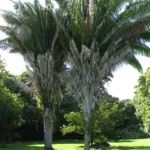
A solitary palm with a smooth gray, closely ringed trunk and a dense crown of enormous feather-like leaves. The pinnate fronds are often upright when young and may arch with age; numerous narrow leaflets create a full, textured silhouette. Leaf bases can remain attached for years, and the trunk may remain inconspicuous during the juvenile phase.
Flowering
The palm is monoecious, with separate male and female flowers borne on the same individual. Inflorescences emerge within the crown and may contain flowers of one sex or both sexes together. Flowering is associated with warm growing conditions; a dependable month-by-month schedule for the United States is not well documented.
Pollination and visitors
The flowers are likely visited by small insects, but species-specific visitor records are limited in the sources reviewed. Do not treat the palm as a strongly documented pollinator plant without local observations or site-specific evidence.
Attalea cohune photos
Click any photo for a larger view. Source, author and license are shown separately.
Diseases and pests
Diseases
Prevent problems by providing excellent drainage, avoiding chronic crown wetness, and minimizing root injury. Watch for declining spear leaves, foul crown tissue, or basal softening, which can indicate serious palm rot. Remove only clearly dead tissue with sterilized tools and improve drainage; professional diagnosis is advisable when the growing point is affected.
Pests
Inspect fronds and leaf bases for scale insects, mealybugs, mites, and borers, especially when plants are stressed. Improve light, airflow, watering consistency, and nutrition before using controls. Remove heavily infested material where practical; use horticultural oil or another labeled treatment according to the product directions and local regulations.
Toxicity and pollen
No authoritative species-specific human or companion-animal toxicity assessment was located. The fruits and seeds have documented food and oil uses in parts of its native range, but that does not establish safety for every preparation or for pets. Prevent children and animals from chewing unfamiliar plant material, and seek medical or veterinary advice after ingestion.
- Typical season
- Not documented for the United States
- Pollination / pollen
- Pollen from palm inflorescences; airborne relevance not well characterized
This is a pollen-producing flowering palm, but reliable species-specific measurements of airborne pollen, allergenicity, and United States exposure season were not located. The uncertainty should not be interpreted as proof of zero allergy risk. People with significant pollen sensitivity should avoid handling flowering material during personal symptom periods.
Native habitat
Native populations occur from southern Mexico through Central America and into Colombia, mainly in wet tropical and seasonally wet forest settings. The palm is associated with warm climates, humid conditions, and soils that can remain moist without becoming stagnant. Its natural distribution does not support reliable outdoor cultivation across most of the continental United States.
Interesting fact
The species is an accepted name in current Kew taxonomy, with several historical synonyms. Its seeds yield an edible oil, while leaves and other palm materials have traditional practical uses. Young plants may retain a largely subterranean stem before developing a conspicuous trunk. Mature leaves can become exceptionally long and heavy.
Frequently asked questions (FAQ)
The most relevant questions about this plant, with short and direct answers.
🌱Quick care
What is the he cohune palm (also rain tree?⌄
The he cohune palm (also rain tree is Attalea cohune, a large, frost-tender tropical palm in the Arecaceae family. It is native from southern Mexico through Central America and parts of Colombia.
How much light does Attalea cohune need?⌄
Attalea cohune grows best in full sun but tolerates light shade, especially while young. Provide bright, open exposure for stronger growth and a fuller crown.
How often should I water a cohune palm?⌄
Water a cohune palm regularly enough to keep the root zone moderately and evenly moist, particularly during hot or dry weather. Reduce watering only when temperatures are cool or rainfall is substantial.
Is Attalea cohune cold hardy?⌄
Attalea cohune is frost-tender and should not be treated as a reliably cold-hardy palm. Established specimens may tolerate brief temperatures near the upper 20s Fahrenheit, but freezing can damage foliage or kill young plants.
🌤️Environment and placement
Where can Attalea cohune grow outdoors in the United States?⌄
Attalea cohune is best suited to frost-free tropical and warm subtropical areas of the United States, especially southern Florida and protected coastal locations. In colder regions, grow it in a container or protected conservatory.
Can Attalea cohune grow in partial shade?⌄
Yes, Attalea cohune can tolerate light or shifting shade, particularly as a juvenile. Long-term growth and crown development are usually better with several hours of direct sun.
How large does a cohune palm get?⌄
A mature cohune palm can become a very large landscape tree, with leaves reaching roughly 25 to 30 feet long and trunks eventually reaching about 50 to 60 feet in favorable conditions. Give it substantial overhead and lateral clearance.
Is Attalea cohune suitable for a small yard?⌄
Attalea cohune is generally unsuitable for a small yard because its mature leaves and eventual height require considerable space. It is better planted as a specimen in a large landscape, estate garden, or spacious tropical property.
What climate does Attalea cohune prefer?⌄
Attalea cohune prefers warm, humid, tropical or subtropical conditions with limited temperature swings and adequate soil moisture. It performs poorly where winters bring recurring frost or prolonged cold.
💧Care and problems
What soil is best for a cohune palm?⌄
Use deep, fertile, well-drained loam enriched with organic matter. The soil should retain moisture without becoming waterlogged, because prolonged saturation can damage the roots.
Can Attalea cohune tolerate drought?⌄
Established Attalea cohune may tolerate short dry periods, but it grows best with regular moisture. Extended drought can slow growth and cause leaf stress, especially in hot, sunny sites.
Why is my Attalea cohune growing slowly?⌄
Slow growth is common when Attalea cohune is young because the trunk may remain underground for years. Cold, insufficient moisture, poor fertility, inadequate light, or root disturbance can slow it further.
Does Attalea cohune have thorns or spines?⌄
Some cultivated descriptions report sharp structures on the trunk, petioles, or leaf rachises, although the extent can vary by plant and source. Position it away from paths, play areas, and frequently used outdoor spaces until the specimen is well identified.
Should I remove damaged leaves from a cohune palm?⌄
Remove only completely dead or severely damaged leaves, using clean tools and avoiding cuts into the trunk or crown. Partly green leaves still contribute energy and should normally be left in place.
🪴Planting and repotting
How should I plant Attalea cohune in the ground?⌄
Plant Attalea cohune in a warm, frost-protected site with full sun to light shade and deep, well-drained soil. Set it at the same depth as its container soil and water thoroughly after planting.
Can Attalea cohune be grown in a container?⌄
A young Attalea cohune can be grown temporarily in a large container, but it is not a practical long-term houseplant because it eventually develops very large leaves and a substantial root system. Move it outdoors during warm weather only where temperatures remain safe.
When is the best time to plant Attalea cohune?⌄
In the United States, plant Attalea cohune in late spring or early summer after the danger of cold has passed. Warm soil and a long growing season help newly planted palms establish before winter.
✂️Propagation and pruning
How do you propagate Attalea cohune?⌄
Attalea cohune is propagated primarily from seed because it is normally a solitary palm and does not produce useful basal offsets. Use fresh, fully mature seed and provide warm, evenly moist conditions.
How long do Attalea cohune seeds take to germinate?⌄
Fresh Attalea cohune seeds may germinate in roughly one to six months under warm conditions, although timing is variable. Germination is more reliable when the seed is kept warm, clean, and consistently moist but not submerged.
Can I grow Attalea cohune from a leaf cutting?⌄
No, Attalea cohune cannot normally be propagated from leaf cuttings. Palms generally require viable seed or specialized tissue-culture methods, and a detached leaf will not produce a new plant.
⚠️Toxicity and safety
Is Attalea cohune toxic to people or pets?⌄
Species-specific toxicity information for Attalea cohune is insufficient, so its safety for people and pets should be considered unknown. Do not allow children or animals to ingest its fruits, seeds, leaves, or other parts.
Are Attalea cohune fruits edible?⌄
Attalea cohune fruits have traditional food and oil uses in parts of their native range, but household consumption should not be assumed safe without correct identification and reliable preparation guidance. Avoid eating fruit from an ornamental plant unless a qualified local source confirms its use.
Is Attalea cohune invasive in the United States?⌄
There is not enough species-specific evidence to label Attalea cohune broadly invasive throughout the United States. Its outdoor suitability and potential spread depend on local climate, seed production, and whether viable seedlings establish.
🌸Flowering and special interest
Does Attalea cohune flower?⌄
Yes, mature Attalea cohune produces cream-colored flower clusters from within the crown. The species is monoecious, so male and female flowers occur on the same plant, though flowering may be uncommon in cultivation.
What fruit does Attalea cohune produce?⌄
After flowering, Attalea cohune can produce large clusters of brownish-yellow to reddish-brown, ovoid fruits. The fruits contain seeds and have historically been used as a source of oil and other useful palm products.
How old must Attalea cohune be before it flowers?⌄
There is no dependable cultivation age for flowering because growth rate varies with climate, soil, moisture, and plant size. Juvenile palms may remain trunkless for many years, and flowering generally requires a well-established, mature specimen.
Similar plants
 Attalea butyracea care guideAttalea butyracea
 Sugar Palm (Arenga pinnata) care guideArenga pinnata
 Angalow palm (Archontophoenix cunninghamiana) care guideArchontophoenix cunninghamiana
 Northern bangalow palm (Archontophoenix alexandrae) care guideArchontophoenix alexandrae
 He (Adonidia merrillii) care guideAdonidia merrillii
 Acoelorraphe (Acoelorraphe wrightii) care guideAcoelorraphe wrightii