
 Source:
African Palmyra Palm (Borassus aethiopum) short overview
Borassus aethiopum, commonly called the African Palmyra Palm, is a towering evergreen fan palm native to tropical Africa and parts of Madagascar. Its swollen gray trunk and enormous divided leaves create a strongly architectural silhouette. In cultivation it requires intense sun, sustained warmth, deep well-drained soil, and dependable moisture, especially during establishment. It is generally a specimen for tropical landscapes, conservatories, or large specialist collections rather than ordinary gardens.
Taxonomic classification
African Palmyra Palm (Borassus aethiopum) care guide
Light and placement
Provide unobstructed full sun, ideally with a southern or western exposure and open overhead space. Young plants tolerate brief bright protection while establishing, but persistent shade causes weak, stretched growth and smaller leaves. Scorched leaf margins can indicate extreme reflected heat combined with drought; pale, elongated growth usually signals inadequate light.
Watering and humidity
Water deeply when the upper few inches of soil begin to dry, then allow excess water to drain. Keep young plants evenly moist through establishment; mature field-grown palms can tolerate seasonal dryness when roots reach groundwater. Reduce watering in cool weather, but never keep container soil cold and saturated. Humidity is secondary to warmth, drainage, and root-zone moisture.
Soil and growing medium
Use deep, fertile soil that drains freely yet holds some moisture. Sandy or alluvial loam is suitable, and a high water table is characteristic in the wild. A mildly acidic to neutral or slightly alkaline reaction is tolerated; avoid shallow, compacted, persistently stagnant soil.
Feeding
Feed only during active warm-season growth with a balanced palm fertilizer containing magnesium and micronutrients, applied at label rate. A controlled-release product is usually safer than frequent strong liquid feeding. Do not fertilize drought-stressed, recently transplanted, cold-damaged, or dormant plants; water first when the root zone is dry.
Growth and habit
This is a slow-growing, long-lived palm with a solitary trunk and a very deep early root system. The seedling first sends a strong root downward, an adaptation associated with reaching groundwater. Mature plants are imposing and difficult to move, so choose the final planting position carefully.
Planting and repotting
Plant during the warmest part of the growing season after cold weather has passed. Set the root ball at the same depth as its original position, water deeply, and mulch broadly without touching the stem. Allow generous clearance for the mature trunk and crown; establishment is slow and benefits from consistent moisture.
Container-grown plants should be moved only when necessary because the deep, vigorous root system dislikes disturbance. Use a very deep, heavy container with excellent drainage and transplant before roots become tightly circling. Large specimens are difficult to handle and are usually better planted out while young.
Propagation and pruning
Propagation
Propagate from fresh seed. Sow the large pyrene in a deep container because the emerging root descends strongly before the first leaf appears. Keep the medium warm and evenly moist, and transplant carefully once the root has established. Germination is commonly reported at about one month, but timing varies with seed freshness and conditions.
Pruning
Remove only dead, broken, or hazardous leaves with clean equipment. Do not cut the central growing point or remove green fronds unnecessarily. Thick leaf bases and spines can injure workers, so use protective clothing and professional equipment for mature specimens.
Overwintering
Keep above freezing, preferably above 50°F, and protect from cold drafts and chilled wet soil. In containers, move the palm into a bright heated conservatory before temperatures fall. Do not expose the crown to frost; severe cold injury may destroy the growing point.
Uses
Used as a dramatic tropical specimen and for ecological restoration or agroforestry in parts of Africa. Native communities use its fruits, seeds, sap, leaves, fibers, timber, and leafstalks for food, drink, fodder, construction, thatch, baskets, mats, and other materials. These traditional uses should not be treated as medical advice, and edible preparation varies by region.
Appearance
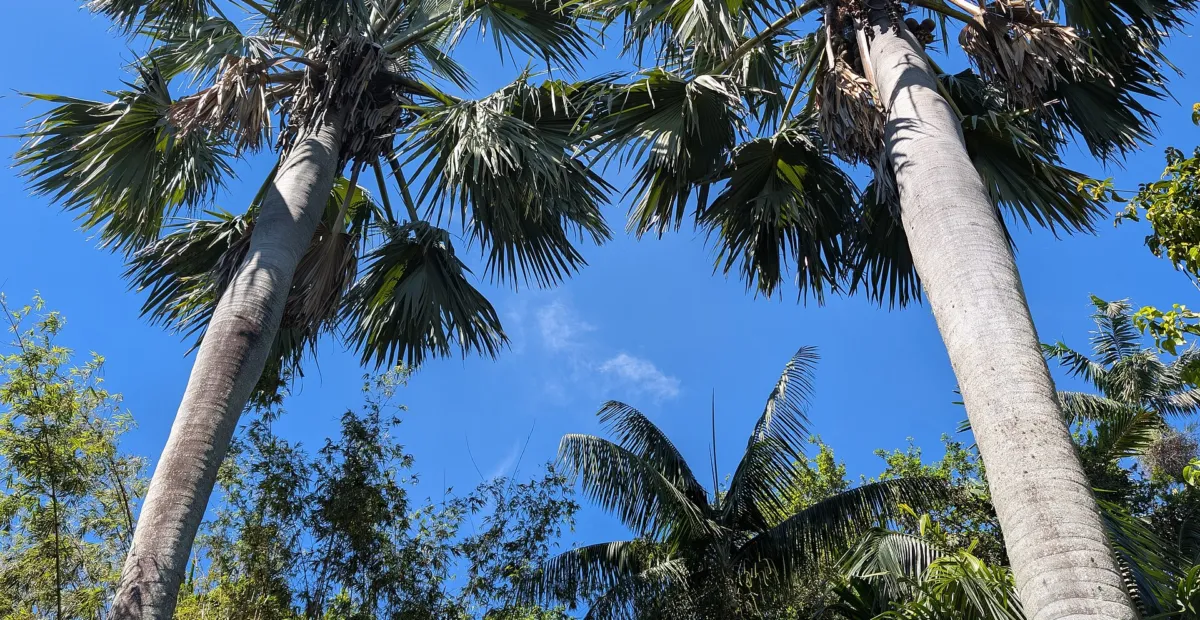
The species forms a solitary, straight, smooth gray trunk that becomes conspicuously swollen above the middle. Large fan leaves form a broad crown and are deeply divided into stiff segments; the leaf bases may be thorny. Young trunks can retain dead leaf bases, while older trunks become cleaner and more massive.
Flowering
Male and female flowers are produced on separate trees. Male inflorescences are branched and pollen-bearing, while female flowers are solitary and develop into large, fragrant, orange to brown fruits when mature. Reliable flowering dates for United States cultivation are not well established.
Pollination and visitors
A Senegalese pollination study recorded numerous insect visitors, including Apis mellifera, halictid bees, and several fly groups. The flowers are dioecious, so effective seed production requires compatible male and female plants within pollination range. Evidence for the exact visitor community varies geographically.
Borassus aethiopum photos
Click any photo for a larger view. Source, author and license are shown separately.
Diseases and pests
Diseases
Specific disease records for cultivated United States plants are limited. Prevent problems by using clean planting material, avoiding chronically waterlogged soil, improving air circulation, and removing damaged tissue with sterilized tools. Suspect rot when the growing point collapses or the trunk softens; severely affected palms may not recover.
Pests
Potential palm pests include scale insects, mealybugs, mites, and borers, although species-specific United States records are limited. Inspect leaf bases, the crown, and new growth regularly. Isolate infested container plants, wash foliage where practical, and use a labeled horticultural oil or insecticide only according to its product directions.
Related diseases and pests
Only Plant Doctor profiles whose host data indicate this plant may be affected are shown here.


Toxicity and pollen
No reliable authoritative evidence was located establishing whole-plant toxicity to people or pets. Fruits and seeds are documented as food resources in parts of Africa, but that does not establish that every plant part is safe or that raw material is appropriate for pets. Avoid consuming unidentified parts, and use gloves when handling thorny leaf bases.
- Pollination / pollen
- Pollen released from male inflorescences; local airborne behavior is insufficiently documented
Male plants release pollen from branched inflorescences. The species is not commonly represented in United States allergy calendars, and dependable clinical or aerobiological evidence for its pollen risk was not located. People with severe pollen sensitivity should avoid handling flowering male plants closely and monitor individual reactions.
Native habitat
Native populations occur across tropical Africa and parts of northwestern Madagascar, especially in seasonally dry savanna, riverine forest, floodplains, and low-lying sites with sandy or alluvial soils. The species often occupies places with a locally high water table despite living in climates with pronounced dry seasons.
Interesting fact
It is among the tallest palms native to Africa. The trunk commonly swells above the middle, creating a distinctive bottle-like profile. In its native range, the species can form dense stands along rivers and in savanna depressions where groundwater is accessible. Mature fruits may contain up to three large pyrenes.
Frequently asked questions (FAQ)
The most relevant questions about this plant, with short and direct answers.
🌱Quick care
What is Borassus aethiopum commonly called?⌄
Borassus aethiopum is commonly called the African Palmyra Palm. It is a large fan palm in the palm family, Arecaceae.
How much sunlight does an African Palmyra Palm need?⌄
An African Palmyra Palm needs full sun for strong growth. Give it the brightest outdoor location available, with unobstructed light for most of the day.
How often should you water Borassus aethiopum?⌄
Water Borassus aethiopum moderately to heavily while it is young, keeping the root zone from drying deeply. Mature plants may tolerate seasonal dryness better when established in deep soil.
Is Borassus aethiopum frost hardy?⌄
No, Borassus aethiopum is frost tender and should be protected from freezing temperatures. In most of the United States, young plants require container culture or winter protection.
How large does an African Palmyra Palm become?⌄
An African Palmyra Palm can become a very large, solitary palm, commonly reaching about 70 feet and sometimes approaching 100 feet in favorable tropical conditions. It needs substantial vertical and horizontal space.
🌤️Environment and placement
Where should I plant an African Palmyra Palm?⌄
Plant it in full sun with ample clearance from buildings, utility lines, driveways, and overhead structures. Choose a warm site with deep, fertile, well-drained sandy or alluvial loam.
Can Borassus aethiopum grow in the United States?⌄
Borassus aethiopum can grow outdoors only in warm, frost-free parts of the United States, especially suitable tropical or subtropical locations. Elsewhere, it is best treated as a large container or conservatory specimen while young.
What USDA hardiness zone is suitable for Borassus aethiopum?⌄
Borassus aethiopum is best suited to frost-free tropical and subtropical conditions rather than reliably cold USDA zones. Because dependable species-specific hardiness data are limited, gardeners should treat freezing weather as hazardous.
What soil does Borassus aethiopum need?⌄
Use deep, fertile, well-drained sandy or alluvial loam. Avoid shallow, compacted, permanently waterlogged soil, even though young palms appreciate consistent moisture.
Can an African Palmyra Palm grow in wet soil?⌄
It can tolerate sites influenced by seasonal water availability, but the soil should still drain well. Constantly stagnant or poorly aerated soil can damage the roots, particularly in containers.
How much space does Borassus aethiopum need?⌄
Give Borassus aethiopum extensive space because it develops a massive trunk, very large fan leaves, and considerable height. Do not plant it where falling leaves or mature growth could interfere with structures or people.
💧Care and problems
Why is my young Borassus aethiopum not growing?⌄
Slow growth can be normal, especially during establishment, but poor light, cold, shallow soil, drought, or root disturbance can also suppress it. Keep the plant warm, brightly lit, evenly watered, and undisturbed.
Why are the leaves of my African Palmyra Palm turning brown?⌄
Brown leaves may result from drought, cold exposure, low humidity, root stress, or natural aging. Check soil moisture and drainage first, then protect the palm from cold and avoid letting a young plant dry deeply.
Should I fertilize Borassus aethiopum?⌄
Fertilize only during active warm-season growth if the plant is growing in nutrient-poor soil or a container. Use a balanced palm fertilizer according to its label, and avoid heavy feeding when the plant is cold or stressed.
Does Borassus aethiopum need high humidity?⌄
Young Borassus aethiopum plants generally grow best with warm conditions and moderate to high moisture around the roots. Outdoor tropical humidity is helpful, but good drainage remains essential.
How do I protect an African Palmyra Palm from cold?⌄
Move container plants indoors or into a heated protected space before frost, and shelter outdoor specimens from cold wind and freezing temperatures. Keep the crown dry during cold spells and do not prune cold-damaged tissue immediately.
Can I grow Borassus aethiopum in a pot?⌄
Yes, a young Borassus aethiopum can be grown in a large, deep container temporarily. Its deep-rooting habit and eventual size make long-term container culture difficult, so repot only when necessary and avoid unnecessary root disturbance.
🪴Planting and repotting
When is the best time to plant Borassus aethiopum?⌄
Plant Borassus aethiopum during the warmest frost-free part of the growing season. Warm soil and consistent moisture help young plants establish before cooler weather returns.
How should I plant an African Palmyra Palm in the ground?⌄
Set it at the same depth at which it was growing and backfill with the native soil if it drains well. Water thoroughly after planting, mulch lightly away from the stem, and maintain steady moisture during establishment.
Does Borassus aethiopum have a deep root system?⌄
Yes, Borassus aethiopum develops a strong, deep-rooting system suited to deep soils and sites with substantial moisture below the surface. This makes deep planting sites preferable to shallow beds or cramped containers.
✂️Propagation and pruning
How do you propagate Borassus aethiopum?⌄
Propagate Borassus aethiopum from fresh seed. Sow the seed in a deep container because the emerging root grows downward early, then transplant carefully after the seedling is established.
How long does Borassus aethiopum seed take to germinate?⌄
Fresh Borassus aethiopum seed commonly germinates in about a month under warm, moist conditions. Germination can be slower or less reliable if the seed has dried excessively or been stored for too long.
Should Borassus aethiopum seed be dried before planting?⌄
Fresh seed is preferred, and drying is not necessary before sowing. If seed must be stored briefly, keep it shaded and avoid intense sun or high heat, which can reduce viability.
Can Borassus aethiopum be propagated from cuttings?⌄
No practical cutting method is established for Borassus aethiopum. Seed propagation is the appropriate method because this palm grows from a single growing point and does not normally produce suitable vegetative cuttings.
Does Borassus aethiopum need pruning?⌄
It usually needs little pruning beyond removing dead or hazardous leaves. Do not cut the central growing point, and use professional equipment for mature palms because the leaves and trunk are large and difficult to handle safely.
⚠️Toxicity and safety
Is Borassus aethiopum toxic to people or pets?⌄
There is no reliable whole-plant toxicity classification for Borassus aethiopum. Some plant parts are traditionally consumed, but species identification, preparation, and the specific tissue matter, so keep unverified material away from children and pets.
Are African Palmyra Palm leaves dangerous to handle?⌄
The leaves and leaf bases can be large, tough, and potentially abrasive or sharp to handle. Wear gloves and eye protection when pruning, and keep people away from falling fronds.
Can you eat Borassus aethiopum fruit?⌄
Some communities eat the ripe fruit pulp and immature seed tissues of Borassus aethiopum. Because preparation practices vary and reliable whole-plant safety guidance is limited, consume only material that has been correctly identified and traditionally prepared.
🌸Flowering and special interest
When does Borassus aethiopum flower?⌄
Borassus aethiopum is very slow to mature and may take several decades to flower. Reported timing varies with climate and growing conditions, so young cultivated palms should not be expected to bloom quickly.
Are African Palmyra Palms male or female?⌄
African Palmyra Palms are dioecious, meaning male and female flowers occur on separate plants. A female palm needs pollen from a male plant nearby to produce fertile seed.
Does Borassus aethiopum produce edible fruit?⌄
Borassus aethiopum produces large, fragrant fruits whose pulp and developing seed tissues are used as food in parts of Africa. Preparation and safety depend on the plant part and local tradition, so do not assume every tissue is safe to eat.
What does Borassus aethiopum fruit look like?⌄
The fruit is large, broadly ovoid, and typically yellow, orange, or brown when mature. It develops in heavy clusters and contains one to three large, hard pyrenes.
Similar plants
 He Bermuda palmetto or bibby-tree (Sabal bermudana) care guideSabal bermudana
 Ravenea glauca care guideRavenea glauca
 He royal palm (Roystonea regia) care guideRoystonea regia
 He scrub palmetto is a species of palm (Sabal etonia) care guideSabal etonia
 He Florida thatch palm (Thrinax radiata) care guideThrinax radiata
 Chaguaramo (Roystonea oleracea) care guideRoystonea oleracea