
Bull’s-eye Rot and Perennial Canker
Neofabraea perennansBull’s-eye Rot and Perennial Canker overview
Neofabraea perennans is a fungal pathogen associated with bull’s-eye rot of stored apples and pears and with perennial cankers on pome-fruit trees. Infections commonly begin through fruit lenticels or wounds during the orchard season, remain latent at harvest, and develop slowly during cold storage. In the Pacific Northwest, perennial cankers can provide an important source of spores for new infections.
Typical conditions
Overview
Neofabraea perennans causes two connected disease phases. On harvested fruit, it is associated with bull’s-eye rot, a storage decay that usually begins as a latent orchard infection. On trees, especially apples in the inland Pacific Northwest, it can cause perennial canker that expands in successive seasonal bands.
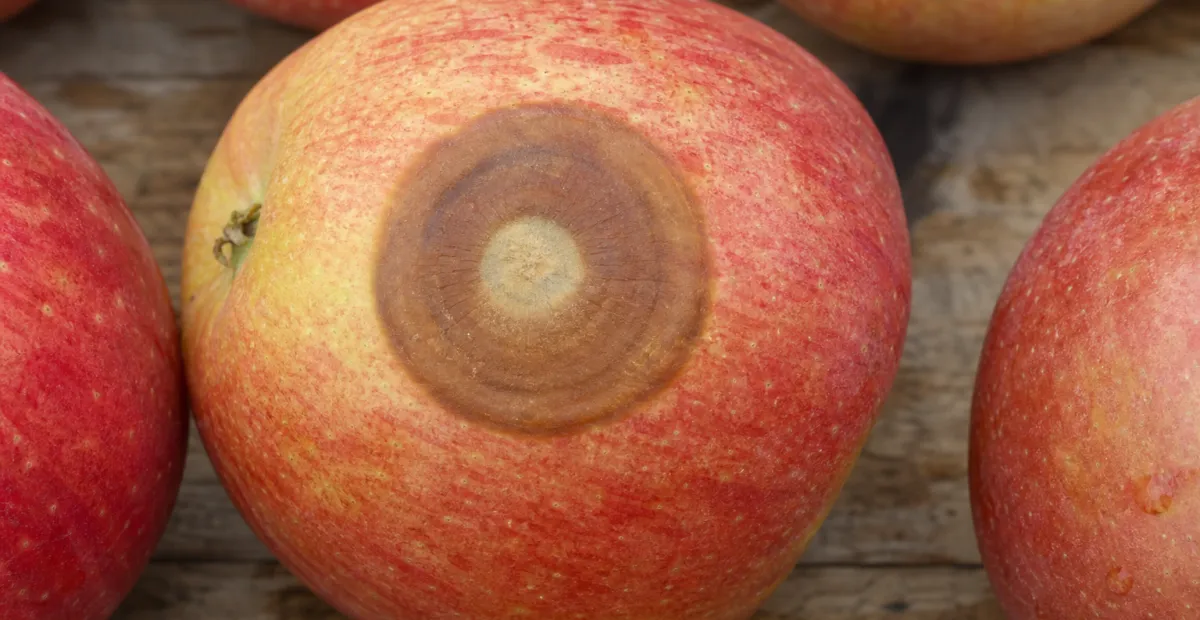
Fruit symptoms are most important in long-term storage. Lesions are typically circular, sunken, brown to dark brown, and firm, with a noticeably paler center than lesions commonly associated with some other Neofabraea species. Small cream-colored spore-producing structures may sometimes emerge from the decayed tissue, but they are not always visible.
Because several Neofabraea and related fungi produce similar fruit rots and cankers, visual diagnosis is provisional. Confirmation may require isolation, microscopy, or species-specific molecular testing.
Symptoms and identification
- Fruit: circular, slightly sunken brown lesions, often beginning at lenticels or minor injuries; the lesion may develop a bull’s-eye appearance as it enlarges.
- Storage development: infections are often invisible at harvest and become evident only after prolonged cold storage, commonly after several months.
- Rot tissue: the affected flesh is generally firm and somewhat mealy rather than rapidly watery, and the boundary with healthy tissue can remain distinct.
- Fruiting structures: short, wet-looking cream-colored spore masses may protrude through the skin in the decayed area, although their absence does not rule out the disease.
- Bark and limbs: perennial cankers may show reddish-brown to brown, sunken or dead areas with concentric annual margins; expanding cankers can weaken or kill scaffold limbs.
Causes and spread
The fungus survives on infected or dead bark, perennial cankers, pruning stubs, and other woody pome-fruit tissues. Spores produced in these sites are dispersed primarily by rain splash and wet-weather runoff. Fruit infection commonly occurs through lenticels, wounds, stem or calyx areas, and other openings in the fruit surface.
Infections may occur throughout the growing season, but research in the Pacific Northwest found that infections during approximately the final eight weeks before harvest are especially important for disease appearing in storage. Rough harvest, hail, insect injury, limb rubbing, and other skin damage increase opportunities for infection.
The pathogen is not usually spread by healthy fruit simply touching one another before infection, but decayed fruit and contaminated bins can contribute to postharvest contamination and should be removed from handling and storage systems.
Life cycle and persistence
Neofabraea perennans survives year-round in cankers and colonized woody tissue. During cool, wet periods, it produces asexual spores in fruiting structures on infected bark. These spores are released during rain or extended surface wetness and are carried to susceptible fruit or fresh wounds.
After entering fruit, the infection can remain quiescent while the fruit is on the tree and immediately after harvest. During extended storage, the fungus resumes growth and produces slowly enlarging brown lesions. Cankers on trees may renew their growth annually, producing successive concentric margins and maintaining an orchard inoculum source.
The exact contribution of each Neofabraea species varies by orchard, region, host, and season. Laboratory identification is needed when species-level attribution matters.
Treatment and control
Management is most effective when directed at both orchard inoculum and postharvest handling. Remove and destroy or properly dispose of cankered wood, dead branches, mummified fruit, and severely decayed stored fruit. Disinfect pruning tools between cuts when working through diseased wood, and avoid pruning during wet conditions.
For commercial orchards, integrate preharvest disease protection with careful harvest, rapid cooling, sanitation, and storage monitoring. Research indicates that infection risk and the benefit of protection can be greatest late in the season, but the correct timing depends on local weather, crop stage, disease history, and the product label. Home gardeners should prioritize sanitation, wound reduction, and removal of affected fruit rather than attempting to treat stored fruit after rot is established.
Do not rely on the appearance of a single lesion to distinguish N. perennans from other bull’s-eye rot fungi. Submit representative fruit or canker tissue to a qualified plant diagnostic laboratory when confirmation is important.
Low-impact and biological control
- Use rigorous orchard sanitation: remove cankered wood, dead bark, fallen or mummified fruit, and diseased fruit from storage.
- Prune during dry weather and make clean cuts below visible canker margins; dispose of infected material away from the orchard.
- Minimize fruit injury through careful thinning, pest management, hail protection where feasible, and gentle harvest handling.
- Clean and sanitize bins, tools, packing surfaces, and storage areas before use.
- Maintain good canopy structure and irrigation practices to reduce extended wetness, while recognizing that cultural controls may not fully prevent disease under high inoculum pressure.
- Biological or reduced-risk products should be considered only when they are specifically registered or permitted for the crop and disease in the United States and supported by local extension recommendations.
Prevention
- Prune out perennial cankers and dead or visibly infected limbs during dry weather; cut well below diseased tissue and remove prunings from the orchard.
- Reduce wounds from hail, pruning, limb rubbing, insects, and rough picking or bin handling.
- Maintain clean harvest bins, packing equipment, and storage rooms; remove decayed fruit promptly.
- Harvest carefully and cool fruit promptly, avoiding bruising and unnecessary delays before storage.
- Monitor orchards for cankers and storage losses, particularly in Pacific Northwest production areas with a history of bull’s-eye rot.
- Use cultivar, orchard-site, irrigation, and canopy-management decisions that reduce prolonged wetness where practical.
Interesting facts
- The name bull’s-eye rot describes the circular, target-like appearance that can develop as fruit lesions enlarge.
- Fruit infection may occur in the orchard but remain invisible until months into cold storage.
- In the inland Pacific Northwest, N. perennans is particularly associated with perennial cankers of apple, whereas the dominant Neofabraea species can differ in other regions.
- Neofabraea disease complexes include several closely related fungi with overlapping symptoms, making species-level diagnosis difficult from photographs alone.
- Studies have documented bull’s-eye rot pathogens from European pear cultivars, Asian pear, and quince as well as apple, but regional prevalence differs.
Use only fungicides and postharvest treatments legally authorized in the United States for the specific crop, use site, and disease. Product registrations, crop tolerances, resistance restrictions, and postharvest permissions can change; follow the current EPA-approved label and applicable state requirements exactly. Do not infer a legal recommendation from research trials or from a product registered for another crop or disease.