Some houseplants are measured in inches. Others are measured in generations. A jade plant passed from grandmother to grandchild, a century-old fern in a conservatory, or a cycad that has spent more than 250 years in a container can make an ordinary living room feel connected to a much longer story.
But “the oldest houseplant” can mean two different things. It may refer to the oldest individual plant still growing in a pot, or to ancient plant groups whose ancestors were on Earth long before homes, greenhouses and gardening catalogs existed. The most famous record-holder belongs to the first category: an Eastern Cape giant cycad that arrived at a London botanical garden in 1775 and is still alive today.
Its survival is not magic. These plants succeeded because their natural biology matched the conditions people could provide indoors: steady temperatures, protection from freezing weather, restrained watering and, in many cases, very slow growth.
The 1775 cycad that became a living time capsule
Encephalartos altensteinii, commonly called the Eastern Cape giant cycad, is widely regarded as the oldest known potted plant still living. It was collected in South Africa and transported by ship to England in the 18th century. Today, the plant grows in a conservatory, where its armored trunk and stiff, featherlike leaves make it look more like a prehistoric survivor than a typical houseplant.
Cycads are not palms, even though they are often mistaken for them. They belong to an ancient group of seed plants with a fossil record stretching back hundreds of millions of years. Their reputation as “living fossils” does not mean that modern cycads have remained unchanged, but it does reflect how long this general plant lineage has persisted.
The individual cycad’s age is especially impressive because it has survived repeated changes in containers, buildings, caretakers and horticultural fashions. Its secret is partly its pace. Cycads usually grow slowly, tolerate being somewhat root-bound and store resources in a thick trunk. A plant that does not rush into rapid growth also tends to demand less frequent repotting and less frequent watering.
Why a cycad can outlast a busy gardener
- Slow growth: It does not quickly outgrow its container or exhaust its growing medium.
- Water storage: Its stout trunk helps it endure short periods of dryness.
- Firm foliage: Tough, leathery leaves lose water more slowly than soft, thin leaves.
- Adaptation to seasonal dryness: Many cycads come from climates where rain is not constant throughout the year.
- Protected culture: A conservatory shields the plant from hard freezes, extreme wind and sudden weather swings.
Ancient plant families that became modern houseplants
The oldest houseplants are not necessarily the oldest plant species on Earth. Ferns, cycads, ginkgo relatives and many succulents belong to lineages with deep evolutionary histories, but the plants sold today are often cultivated varieties, propagated cuttings or descendants of wild plants collected much more recently.
Ferns are a good example. Their ancestors appeared hundreds of millions of years ago, long before flowering plants became dominant. Yet the familiar Boston fern, bird’s-nest fern and maidenhair fern entered homes through more recent horticultural traditions, especially during the 19th-century fascination with ferns.
Succulents also have ancient survival strategies, although the plants in your windowsill may be relatively young individuals. Jade plants, aloes, haworthias and many cacti survive difficult conditions by storing water, reducing water loss or pausing growth when conditions are unfavorable.
Before the houseplant boom: containers, courtyards and orangeries
People have grown plants in containers for thousands of years, but the modern houseplant developed gradually. Ancient gardeners used pots and planters for ornament, food, fragrance and religious displays. In warm regions, plants could live outdoors for much of the year and move into sheltered spaces when necessary.
In cooler parts of Europe and North America, growing tender plants indoors required more infrastructure. Orangeries, conservatories and heated glasshouses allowed wealthy gardeners to protect citrus, palms, camellias and other plants from winter cold. These spaces were not ordinary living rooms, but they created the model for indoor gardening: select a plant, recreate its climate as closely as possible and protect it from the season it cannot tolerate.
That principle still works in a modern American home. A sunny south-facing room in Arizona is very different from a north-facing apartment in Minnesota, but both can support plants when you match the plant to the available light and adjust watering to the room rather than following a rigid calendar.
The Wardian case changed indoor gardening
One of the most important developments in houseplant history was the Wardian case, a glazed wooden container developed in the 19th century. It was designed to keep plants alive during long journeys by ship, but it also became a miniature growing environment for homes and conservatories.
The case reduced exposure to salty air, drying winds and pollution while helping maintain humidity around the leaves. Ferns, mosses and other small plants could travel farther and survive in urban interiors. The same basic idea lives on in today’s terrariums.
A sealed terrarium is not suitable for every houseplant. Small ferns, mosses and humidity-loving foliage plants may appreciate it, while cacti and succulents usually need more airflow and a drier setup. The lesson is broader than the container itself: plants last longer when their surroundings protect them from extremes.
Why Victorian ferns became indoor classics
During the Victorian era, ferns became wildly fashionable. Collectors displayed them in conservatories, parlors and special glass cases. Their popularity came from several useful qualities: many tolerate filtered light, they look attractive without flowers and they can thrive in humid, sheltered spaces.
Not every fern is easy indoors. Maidenhair fern, for example, can collapse quickly when its root ball dries out, while a bird’s-nest fern is often more forgiving when light and humidity are moderate. A Boston fern may grow vigorously in a bright bathroom but struggle beside a dry heating vent.
Compare varieties instead of treating all ferns alike
- Boston fern: Choose it for bright, indirect light and higher humidity. It may need more frequent watering than tougher foliage plants.
- Bird’s-nest fern: Its upright, leathery fronds often handle ordinary indoor conditions better than delicate fern types.
- Maidenhair fern: Best for a gardener who can check moisture regularly and provide consistent humidity.
- Button fern: Its smaller leaves and compact form can work well in a protected spot away from hot, dry air.
These comparisons are not rules carved in stone. A plant’s response depends on pot size, soil texture, temperature, light and the humidity in your home.
The survival formula: slow growth, storage and restraint
Many long-lived houseplants share a surprisingly simple formula. They grow slowly, store water or energy, and do not need constant disturbance. That makes them better candidates for surviving occasional mistakes than fast-growing tropical plants with thin leaves and delicate roots.
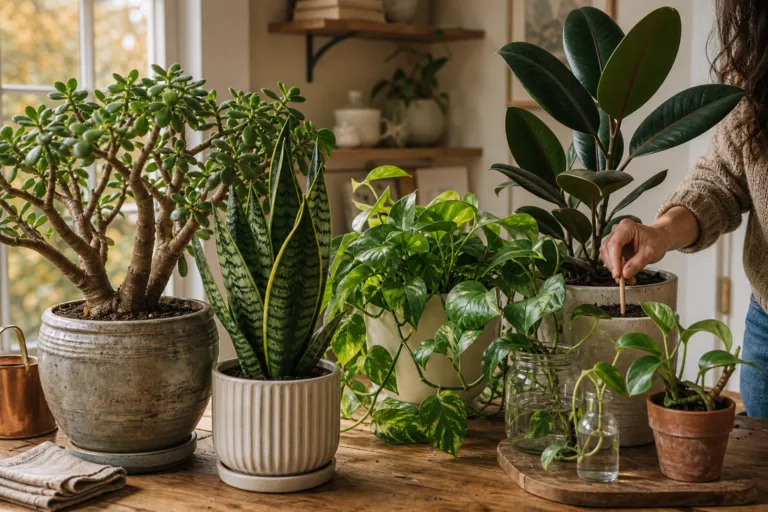
Snake plants, ZZ plants, cast-iron plants, ponytail palms, jade plants and many cycads fit this pattern. They still need light and appropriate care, but they generally recover better from a missed watering than from a constantly wet pot.
Protection matters just as much as toughness. A plant may tolerate dry soil for a while but fail after repeated exposure to cold drafts, dark corners, waterlogged roots or sudden temperature changes. Longevity often comes from avoiding repeated stress rather than from receiving intensive care.
Try a simple watering experiment at home
One reason old plants survive is that their caretakers learn to observe rather than guess. You can practice the same skill with a small watering log. Choose one plant and record the pot’s weight, the moisture depth and the date each time you water.
A practical two-week measurement plan
- Water the plant thoroughly until a small amount drains from the bottom. Empty the saucer after about 10 minutes.
- Weigh the entire pot with a bathroom scale, or lift it and describe how heavy it feels. Record the number if your scale is sensitive enough.
- Check the top 2 inches of potting mix with your finger or a wooden chopstick. Note whether it feels wet, slightly damp or dry.
- Repeat the check every two days without automatically adding water.
- Water again only when the plant’s needs and the potting mix indicate that it is ready.
For a typical 6-inch foliage plant in an indoor room around 68–72°F, you may find that the pot loses noticeable weight over 7 to 14 days. Treat that range as an observation, not a universal schedule. A sunny room, a small pot or a forced-air vent can shorten the interval, while winter low light can lengthen it.
The useful measurement is not a perfect number. It is the pattern you discover for your own plant. If the soil remains wet for two weeks, improve drainage and reconsider the pot size before watering again.
How to care for a long-lived houseplant today
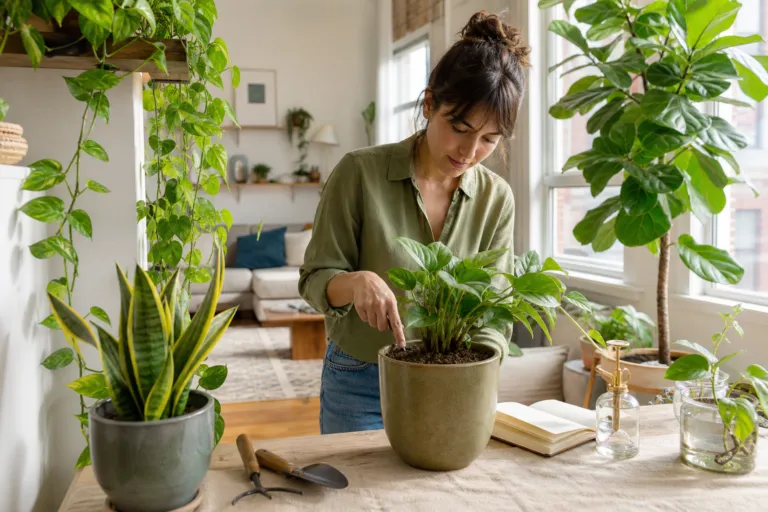
You do not need a Victorian conservatory to give an old-fashioned plant a long life. Start by choosing a plant whose natural preferences fit your home.
- Match light first: Low-light tolerance does not mean no light. Place the plant where it receives the brightest suitable light without scorching.
- Use a drainage hole: A decorative cachepot can hide a nursery pot, but excess water should have a way out.
- Water the root ball, not the calendar: Check moisture before watering and adjust through the seasons.
- Keep roots comfortable: Repot when roots circle densely, water runs straight through, or growth has clearly stalled – not simply because spring has arrived.
- Protect from extremes: Keep tropical foliage away from cold windows, heating vents and sharp drafts.
- Rotate gradually: Turn the pot occasionally for even growth, but avoid moving a stressed plant from dim light directly into hot sun.
- Inspect regularly: Look beneath leaves and along stems for pests, yellowing or soft spots before problems spread.
Old plants teach a patient style of gardening
The world’s oldest potted plants are impressive because they are ancient, but their real lesson is practical. They did not survive through constant intervention. They survived because their biology, container, climate and care routine worked together over time.
Choose a plant that suits your light. Water when the root zone needs it. Make changes gradually and record what happens. Whether you grow a cycad, a fern, a jade plant or a cutting inherited from family, you are participating in the same quiet tradition that has kept indoor greenery alive for centuries.
With the right match and a little patience, your houseplant may become more than decoration. It may become a living heirloom – one that grows slowly enough for you to watch, learn from and eventually pass along.