
 Source:
Arenga palm (Arenga australasica) short overview
Arenga australasica is a rare, clumping palm native to wet coastal forests of northern Australia and nearby islands. It forms several suckering trunks and carries very large, pinnate leaves with glossy dark-green upper surfaces and paler undersides. Pendant inflorescences bear small yellow flowers, followed by red, purple, or brown fruit. The fruit flesh contains irritating calcium oxalate crystals, so this palm needs careful handling and a warm, humid growing environment.
Taxonomic classification
Arenga palm (Arenga australasica) care guide
Light and placement
Provide bright filtered light or partial shade, ideally with protection from intense afternoon sun and cold or drying winds. A sheltered east-facing or lightly shaded south-facing position can work in warm climates. Too much harsh sun may scorch leaflets; too little light produces weak, stretched growth and reduced vigor.
Watering and humidity
Keep the root zone evenly moist but never persistently waterlogged. Water deeply when the surface begins to dry, then allow excess water to drain completely. Increase irrigation during hot weather and active growth; reduce frequency in cool or dim conditions. High humidity helps prevent foliage stress, especially indoors.
Soil and growing medium
Use a rich but sharply draining medium based on sandy loam, with added organic matter for moisture retention. The species is associated with sandy, rocky, or red-basalt soils in wet coastal forests. Slightly acidic to neutral conditions are suitable; avoid compacted, stagnant substrates.
Feeding
Feed during active warm-season growth with a complete palm fertilizer containing magnesium and micronutrients, following the product label. Apply to moist soil and water afterward. Reduce or stop feeding during cool, low-light periods and after transplanting until new growth resumes; avoid heavy fertilizer in dry soil.
Growth and habit
This is a large, evergreen, clump-forming feather palm with one to three dominant trunks and numerous basal suckers. Individual stems are monocarpic, so the flowering trunk eventually dies and is replaced visually by younger stems. Give the clump stable support, warmth, moisture, and enough space for ongoing sucker production.
Planting and repotting
Plant during the warmest part of the growing season after nights remain consistently warm. Set the root ball level with the surrounding soil and do not bury the stem base. Allow generous room for suckering stems and establish with regular irrigation while preserving excellent drainage.
Repot only when roots substantially fill the container, preferably during warm active growth. Use a heavy, stable container and a free-draining palm mix. Minimize root disturbance because large palms establish slowly after transplanting.
Propagation and pruning
Propagation
Propagate from fresh seed after removing fruit pulp, using warm temperatures and a consistently moist, well-drained medium. Basal suckers may be separated only when well rooted, but division is difficult and can damage both the parent clump and offsets.
Pruning
Remove only dead, damaged, or diseased leaves with clean tools. Do not cut healthy green fronds for appearance. After a trunk has completed flowering and fruiting and clearly declines, remove it at the base if safe, while protecting emerging suckers.
Overwintering
Move container plants into a bright, warm greenhouse or conservatory before temperatures fall below about 40°F. Protect from drafts, cold glass, and overwatering during low light. In marginal outdoor climates, use frost cloth and root insulation, but sustained freezes are likely to damage the palm severely.
Uses
Primarily an ornamental specimen and conservatory palm for tropical or frost-free landscapes. Its clumping habit, large feather leaves, and colorful fruit provide strong architectural interest. It is not recommended for food use because the fruit flesh is strongly irritating, and no unsupported medicinal use should be inferred.
Appearance
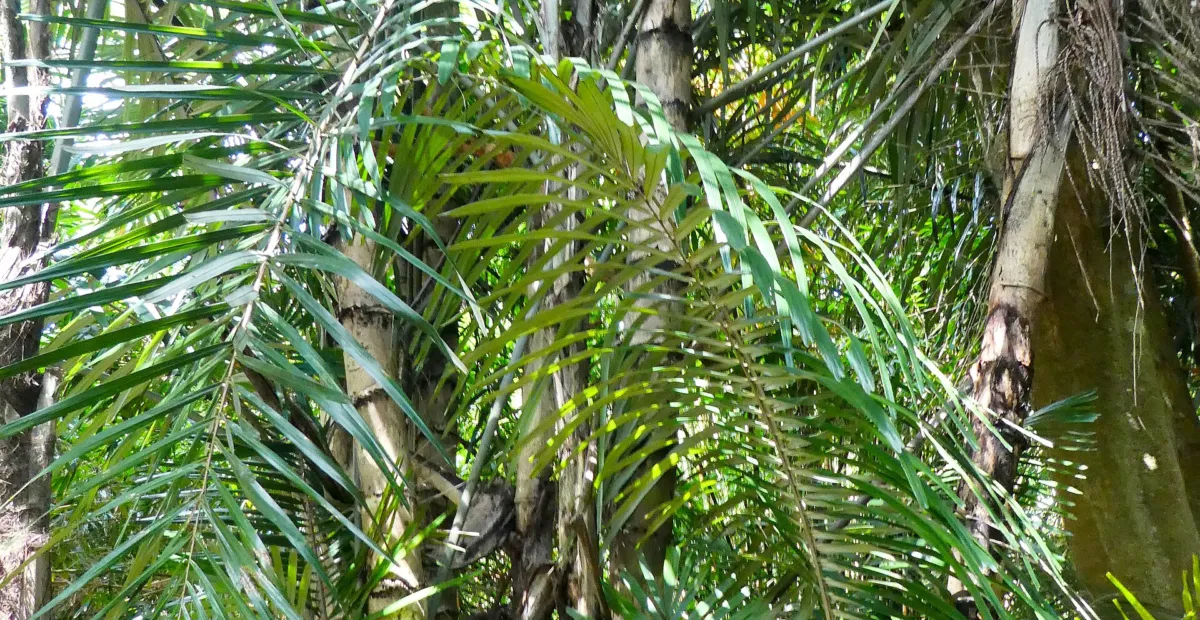
The palm forms several ring-scarred, grayish trunks with dark fibrous leaf bases and many basal suckers. Its large pinnate leaves carry numerous narrow, stiff leaflets arranged in a distinctive V-shaped profile; leaflet tips are irregularly notched and undersides may appear silvery or gray. Long pendant inflorescences and red-to-purple fruit aid identification.
Flowering
Small yellow bisexual flowers are produced on long, pendant, branching inflorescences emerging from the leaf bases. Inflorescences appear progressively down the stem, and available references indicate that the lowermost inflorescence is the one that develops fruit. Individual stems are monocarpic and die after flowering and fruiting, while basal suckers continue the clump.
Pollination and visitors
The species has bisexual yellow flowers, but reliable sources reviewed here do not identify a specific pollinator species or a sufficiently documented visitor community. Do not assume bee or butterfly attraction without local observation.
Arenga australasica photos
Click any photo for a larger view. Source, author and license are shown separately.
Diseases and pests
Diseases
Prevent disease by providing airflow, avoiding chronically waterlogged soil, and disinfecting pruning tools. Watch for leaf-spot symptoms, stem or root decline, and rot under cool, wet conditions. Remove badly affected tissue and correct drainage or irrigation problems before considering a labeled palm fungicide.
Pests
Inspect for scale insects, mealybugs, spider mites, and mites stressed by dry indoor air. Remove small infestations manually or with insecticidal soap according to its label. Improve humidity and airflow, quarantine affected containers, and avoid repeated broad-spectrum insecticide use that can disrupt beneficial predators.
Related diseases and pests
Only Plant Doctor profiles whose host data indicate this plant may be affected are shown here.
 PestRed Palm WeevilRhynchophorus ferrugineus
 PestBroad mitePolyphagotarsonemus latus (Banks)
 DiseaseAlternaria leaf spot and fruit rotAlternaria alternata
 Environmental stressWaterlogging
 Environmental stressUnderwatering
 PestObscure mealybugPseudococcus viburni
 PestCitrus mealybugPlanococcus citri
 DiseasePear Decline‘Candidatus Phytoplasma pyri’
Toxicity and pollen
The fleshy fruit covering contains irritating calcium oxalate crystals that can cause intense itching and skin irritation on contact. Do not handle or process ripe fruit without gloves, keep fallen fruit away from children and pets, and wash exposed skin promptly. Evidence for toxicity from other plant parts is limited.
- Typical season
- Not reliably documented for United States exposure conditions
- Pollination / pollen
- Pollen from small palm flowers; airborne-allergy significance not established
As a flowering palm, it produces pollen, but reliable sources reviewed here do not establish its airborne pollen burden or importance as a US allergen. Avoid presenting the plant as allergy-free; sensitive growers should limit exposure to flowering material and use ordinary garden hygiene.
Native habitat
Native populations occur in wet lowland and near-coastal forests of northern Australia, with records extending to New Guinea and nearby islands. It grows in rainforest, vine forest, monsoon forest, creek beds, and shoreline-influenced habitats, often on sandy, rocky, or red-basalt soils from near sea level to several hundred feet.
Interesting fact
The species is monocarpic at the individual-trunk level: a flowering and fruiting stem eventually dies while basal suckers continue the clump. Its leaves can reach about 11.5 feet long. The fruit colors range from red to purple or brown as they mature. Some taxonomic treatments associate it closely with Arenga microcarpa.
Frequently asked questions (FAQ)
The most relevant questions about this plant, with short and direct answers.
🌱Quick care
What is Arenga australasica commonly called?⌄
Arenga australasica is commonly called arenga palm. It is a clump-forming Australian palm in the Arecaceae family.
How much light does an arenga palm need?⌄
An arenga palm grows best in bright filtered light to partial shade. Protect it from intense afternoon sun, especially when grown in a container or in a hot, dry climate.
How often should I water Arenga australasica?⌄
Water Arenga australasica regularly and keep the root zone consistently moist but not waterlogged. Increase watering during hot, dry weather and reduce it slightly during cool periods.
Is Arenga australasica frost hardy?⌄
Arenga australasica is frost tender and should be protected below about 35°F. In colder parts of the United States, grow it in a container that can be moved indoors or under shelter.
Is arenga palm easy to grow indoors?⌄
An arenga palm can be grown indoors when given bright filtered light, high humidity, warmth, and consistently moist but well-drained soil. Its eventual size can make long-term indoor cultivation difficult.
🌤️Environment and placement
Where should I plant an arenga palm outdoors?⌄
Plant Arenga australasica in a warm, sheltered location with bright filtered light or partial shade. A protected coastal or subtropical site with moist, well-drained soil is especially suitable.
What USDA hardiness zone is suitable for Arenga australasica?⌄
Arenga australasica is best suited to frost-free or nearly frost-free areas, broadly comparable to warm USDA Zones 10–11. Local protection may still be needed during unusual cold snaps.
Can Arenga australasica tolerate salt spray?⌄
Arenga australasica can tolerate some coastal exposure and salt spray when established. Even so, shelter from persistent drying winds and severe salt exposure will improve its appearance.
How large does Arenga australasica get?⌄
Arenga australasica is a medium to large clumping palm with long, pinnate leaves and several dominant stems. Its mature size varies with climate and cultivation, so allow substantial horizontal and vertical space.
Does Arenga australasica grow in full sun?⌄
Arenga australasica generally prefers bright filtered light to partial shade rather than harsh full sun. Gradual acclimation may allow more sun in humid climates, but intense exposure can scorch foliage.
💧Care and problems
What soil is best for an arenga palm?⌄
Use sandy, loamy, or rocky soil that drains freely while retaining some moisture and organic matter. Avoid dense, poorly drained soil because constantly saturated roots can decline.
Why are the leaves of my arenga palm turning brown?⌄
Brown leaves commonly result from dry soil, low humidity, salt buildup, cold exposure, or excessive direct sun. Check moisture and drainage first, then protect the plant from cold and harsh afternoon light.
Why is my Arenga australasica not growing?⌄
Slow growth can result from cool temperatures, inadequate moisture, low light, root restriction, or transplant stress. Keep the palm warm and evenly moist in well-drained soil, and avoid disturbing the roots unnecessarily.
How should I fertilize Arenga australasica?⌄
Feed Arenga australasica during active growth with a palm fertilizer that supplies nitrogen, potassium, magnesium, and micronutrients. Follow the product label and avoid heavy applications to dry soil.
🪴Planting and repotting
Can I grow Arenga australasica in a container?⌄
Yes, Arenga australasica can be grown in a large container with drainage holes and a coarse, organic-rich potting mix. Container plants need more frequent watering and protection from cold than plants in the ground.
When is the best time to plant an arenga palm?⌄
Plant an arenga palm during the warm growing season after the danger of frost has passed. Warm soil helps root establishment, while planting before cold weather can cause transplant stress.
How do I repot Arenga australasica?⌄
Repot Arenga australasica only when the container is crowded or the root system has filled the pot. Move it into a slightly larger container with fresh, sharply draining mix and disturb the root ball as little as possible.
✂️Propagation and pruning
How is Arenga australasica propagated?⌄
Arenga australasica is primarily propagated from seed, and established clumps may also produce basal suckers. Seed should be fresh and kept warm and evenly moist, while sucker division can be stressful and is less reliably documented.
Can I divide arenga palm suckers?⌄
You may be able to separate well-rooted basal suckers from an established clump, but division can damage the parent or sucker. Attempt it during warm weather and retain as many roots as possible.
How do I prune an arenga palm?⌄
Remove only dead, damaged, or hazardous leaves and spent flower or fruit structures when practical. Do not cut healthy green fronds or remove the growing point, because palms cannot regenerate from a destroyed crown.
⚠️Toxicity and safety
Is Arenga australasica poisonous?⌄
The fruit flesh of Arenga australasica presents a moderate contact hazard because it contains irritating calcium oxalate crystals. It can cause intense itching, so handle fruit with gloves and keep children and pets away.
How should I handle arenga palm fruit?⌄
Wear waterproof gloves when handling Arenga australasica fruit, and avoid touching your eyes or face afterward. Wash exposed skin promptly with soap and water if irritation occurs.
Can pets touch or eat arenga palm fruit?⌄
Pets should be prevented from chewing or handling Arenga australasica fruit. The irritating fruit flesh can cause significant discomfort on contact, and ingestion should be discussed with a veterinarian.
🌸Flowering and special interest
What do Arenga australasica flowers look like?⌄
Arenga australasica produces small yellow flowers in inflorescences among the leaves. Only the lowermost inflorescence is reported to produce fruit.
What color are arenga palm fruits?⌄
Arenga australasica fruits may mature red, purple, or brown. Each fruit generally contains a small number of smooth, hard-coated seeds surrounded by irritating fleshy tissue.
Does Arenga australasica produce fruit indoors?⌄
Indoor fruiting is unlikely unless the palm is mature, very large, and grown under highly suitable warm and bright conditions. Outdoor plants in an appropriate subtropical climate have a better chance of flowering and fruiting.
Similar plants
 Arikury Palm (Syagrus schizophylla) care guideSyagrus schizophylla
 Nikau (Rhopalostylis sapida) care guideRhopalostylis sapida
 He royal palm (Roystonea regia) care guideRoystonea regia
 Saw palmetto (Serenoa repens) care guideSerenoa repens
 He Chusan palm (Trachycarpus fortunei) care guideTrachycarpus fortunei
 Rio Grande palmetto (Sabal mexicana) care guideSabal mexicana